Terzan 5 - An Unusual Globular Cluster
Researchers have confirmed a new class of objects within our Milky Way: remnants referred to as "fossil fragments of the galaxy core". Terzan 5 is the prototype of these remnants from the early formation phase of our galaxy.
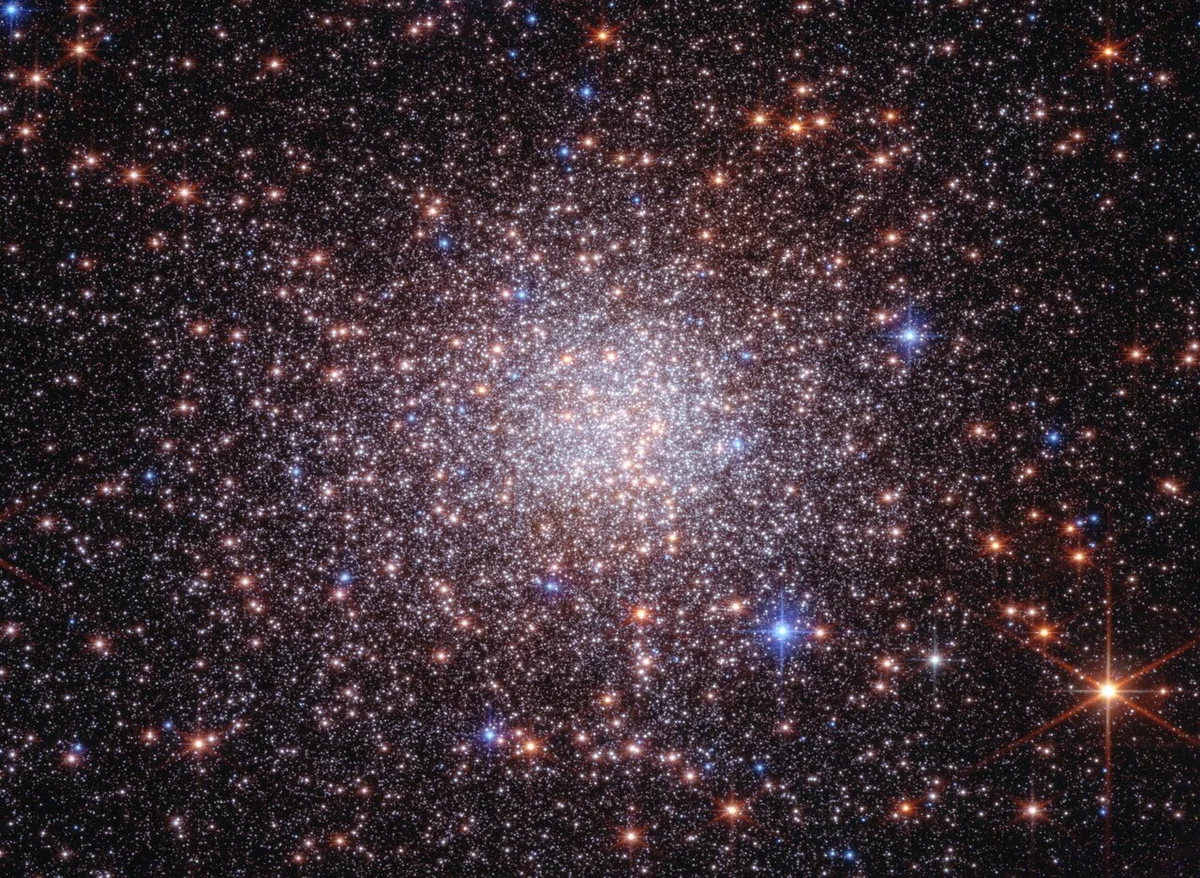
Researchers have confirmed a new class of objects within our Milky Way: remnants referred to as "fossil fragments of the galaxy core" (bulge fossil fragment). Terzan 5 is the prototype of these remnants from the early formation phase of our galaxy. Billions of years ago, similar primordial clumps spread out and merged to form the core of the Milky Way, yet Terzan 5 has remained intact to this day. A new study, which combined recent observations from NASA/ESA/CSA's James Webb Space Telescope with data collected over a 12-year period from NASA/ESA's Hubble Space Telescope, has clearly shown that Terzan 5 has undergone up to four different phases of star formation, confirming that it is not a true globular cluster but something much more unusual and rarer.
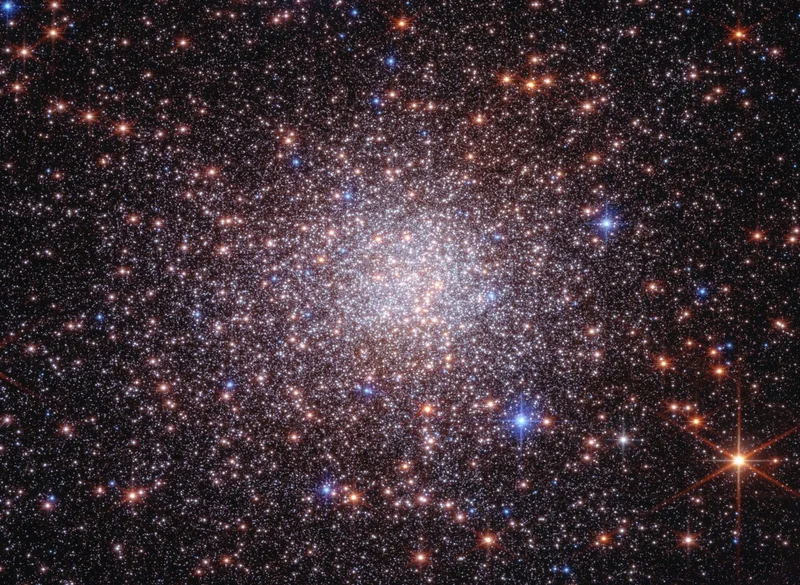
Researchers utilizing two of humanity's most powerful observatories – the James Webb and Hubble Space Telescopes – have definitively demonstrated that Terzan 5 is not a globular cluster as it was once classified. This opens new insights into the formation and development of galaxies like our own. A globular cluster typically consists solely of a single population of old stars. The new data not only confirm the existence of two distinct stellar populations in Terzan 5 but also provide clues to two additional, younger phases of star formation. Although Terzan 5 lies in the dense bulge of the Milky Way, the central, spherical region of our galaxy with older stars, it was massive enough to retain its individuality while lighter systems spread out and mixed billions of years ago to form the bulge. It is like a clump in an otherwise well-mixed cake batter.
"The new near-infrared observations from the Webb telescope, matched with the archival observations from the Hubble telescope, have given us a much clearer picture of the history of Terzan 5," said Giorgia Zullo, who led the research and is a PhD student at the University of Bologna in Italy.
These findings were presented on Tuesday at a press conference during the 248th meeting of the American Astronomical Society and published in the journal Astronomy & Astrophysics.
Four Generations of Stars
The star cluster Terzan 5, discovered in 1968 by astronomer Azop Terzan, resembles a globular cluster in many respects. However, in 2009 it was determined that it hosts two distinct stellar populations. In 2016, the Hubble Space Telescope provided the first estimate of their ages: one population formed about 12 billion years ago (around the time of the Milky Way's formation), while the other formed about 5 billion years ago, shortly before the Earth began to form. This indicates a more complex formation history than that of a typical globular cluster.
The exploration of Terzan 5 is complicated by its location in a star-rich and heavily dust-obscured region of our galaxy. This is where the Webb telescope came into play. Its infrared images allowed the research team to see through the dust and catalog significantly more and fainter stars than previous studies. By measuring the colors and brightness of the stars, astronomers can categorize them into groups of different ages and chemical compositions.
Webb was able to measure these key properties for every star in its field of view – both for stars within Terzan 5 and for foreground stars that do not belong to it. To isolate the stars of Terzan 5, the team utilized the capabilities and long operational duration of the Hubble telescope. The twelve-year gap between Hubble's images enabled the team to measure very small movements of individual stars, known as proper motions, thus determining which stars belong to Terzan 5 and which are part of the bulge of the Milky Way.
By combining data from the Webb and Hubble telescopes, the researchers found clear evidence of two additional stellar populations: one that formed 3.8 billion years ago and another that emerged only 2.5 billion years ago. Furthermore, they were able to determine the ages of the already known stellar populations with unprecedented accuracy, finding that they formed 12.5 billion and 4.7 billion years ago, respectively.
For the previously known two stellar generations, astronomers could not rule out the possibility that Terzan 5 interacted with another object, such as a globular cluster or a giant molecular cloud, thus enriching itself with new gas and dust, triggering a second star formation phase. With four stellar generations, these explanations are now ruled out.
Measurements of the stellar composition of Terzan 5, conducted at the W.M. Keck Observatory and the Very Large Telescope of the European Southern Observatory, also indicate very different populations. "Besides the age of these populations, the star cluster preserves a kind of fossil record of the progressive enrichment with heavy elements through supernovae," said co-author R. Michael Rich, research astronomer at the University of California, Los Angeles.
Terzan 5 formed multiple stellar generations because it was able to retain the necessary raw materials. There are indications of massive supernova explosions in Terzan 5, where heavier elements were produced that were incorporated by subsequent stellar generations. In systems with lower mass, the force of the explosions would have expelled the formed elements and simultaneously swept away any remaining gas and dust. The progenitor of Terzan 5 had enough mass to retain the ejecta of these stars, allowing new stellar generations to form over billions of years.
"Fossil Fragment of the Galaxy Core"
The results indicate that Terzan 5 is most likely the remnant of a far more massive stellar system that originally formed 12.5 billion years ago. Terzan 5 is extraordinary because it has survived and never merged with the bulge of the Milky Way or fully "mixed" into it. "For some reason, this peculiar star cluster formed separately from the bulge and was not destroyed during the formation of the bulge itself," said Francesco R. Ferraro, professor at the University of Bologna and leader of the Webb observations. "Terzan 5 is what we now refer to as a 'bulge fossil fragment' as it resembles the original star clusters that contributed to the formation of the bulge."
So far, only one other cosmic object is known to resemble Terzan 5: Liller 1. This second globular cluster was reclassified from a globular cluster to a fossil fragment of the bulge. It too contains multiple stellar generations. There may be other objects of this kind. Ferraro's team will investigate another 40 to 50 globular clusters orbiting within the galaxy core to determine whether their stellar populations are all the same, as in globular clusters, or whether they encompass multiple generations, as in fossil fragments of the galaxy core.
Possible Parallels for Galaxy Formation Near and Far
Ultimately, this research could expand our understanding of how the central bulges of galaxies form over hundreds of millions of years. "Based on observations and detailed simulations, we believe that galaxies in the early universe had massive gas disks that fragmented into clumps and formed stars. These clumps migrated to the centers of galaxies, and many merged to form their bulges," said Barbara Lanzoni, co-author and associate professor at the University of Bologna. For example, Webb has discovered several examples of "clumpy" galaxies that were actively forming when the universe was only a few hundred million years old, like the clumps in the Firefly-Sparkle galaxy. "Terzan 5 could provide direct evidence that may help explain how galaxy cores have formed throughout the universe," said Lanzoni.