The Galaxy Pair NGC 5005 and NGC 5033
The two galaxies NGC 5005 and NGC 5033, located in the northern constellation Canes Venatici, were discovered on May 1, 1785, by the German-British astronomer Friedrich Wilhelm Herschel.
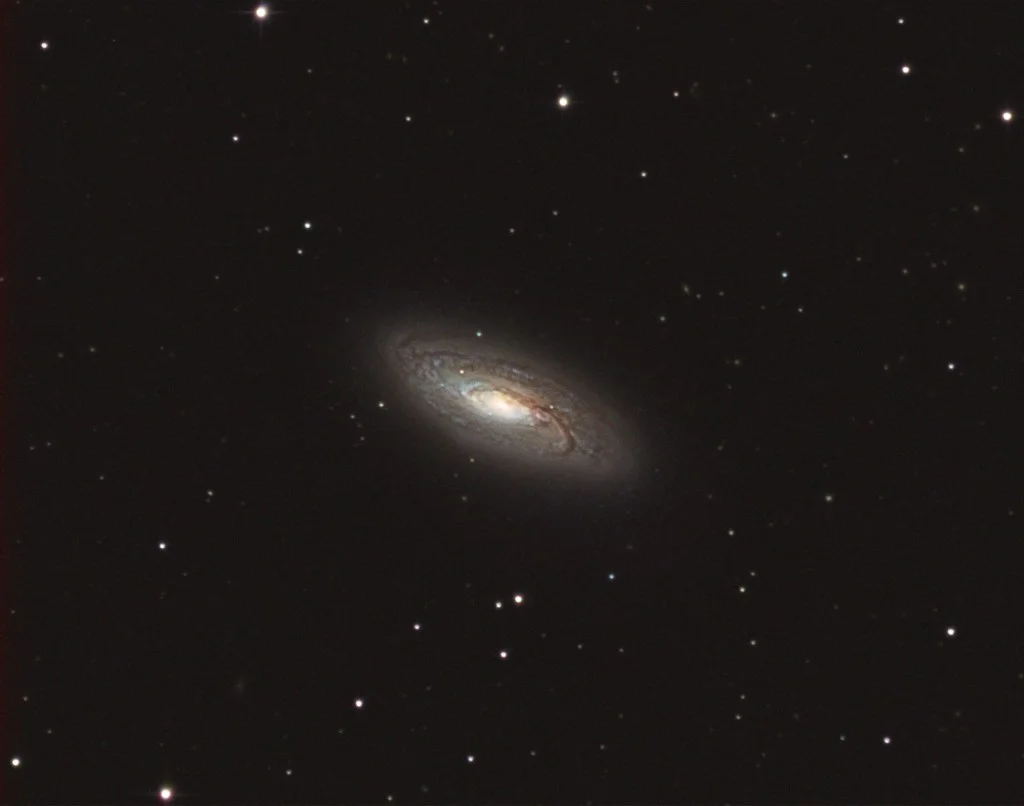
The two galaxies NGC 5005 and NGC 5033, located in the northern constellation Canes Venatici, were discovered on May 1, 1785, by the German-British astronomer Friedrich Wilhelm Herschel using his 18.7-inch reflector telescope. NGC 5005 is also listed as Caldwell 29 in Sir Patrick Moore's "Caldwell Catalog." The common name for the galaxy NGC 5033 is less well-known; it is also referred to as the "Water Beetle Galaxy."
The Barred Spiral NGC 5005
NGC 5005 is a bright barred spiral galaxy of Hubble type SBbc, inclined at about 36° to the edge. It is located at a distance of 44 to 66 million light-years from Earth at the edge of the Virgo galaxy cluster. The galaxy is already easily observable in small to medium telescopes. It has a brightness of 9.8 mag, an apparent diameter of 5.8 x 2.9 arcminutes, and a high surface brightness. Its diameter is estimated to be 75,000 light-years, and its mass is about 50 billion solar masses. Furthermore, it possesses a bright disk interrupted by dense dust lanes and knots. The galactic disk is significantly tilted against our line of sight. Its relatively bright active galactic nucleus (AGN) is of the LINER type (Low-Ionization Nuclear Emission-Line Regions) and contains weakly ionized gas. The energy source for the LINER emission is debated. Some researchers suspect that LINERs are powered by active galactic nuclei containing supermassive black holes. Others propose that LINERs are driven by star formation activities.
However, X-ray studies suggest that there is a variable, point-like source of hard X-ray radiation in the core of the galaxy. This could indicate that NGC 5005 contains a supermassive black hole. The strong, variable X-ray emission is characteristic of radiation expected from hot, compressed gas in the vicinity of a black hole in an active galactic nucleus. According to a study published in 2009, the mass of the central black hole in NGC 5005 is estimated to be between 120 and 340 million solar masses. The central regions of the galaxy also contain a significant amount of molecular hydrogen. This is distributed in a ring with a radius of three kiloparsecs and in a massive central disk with two billion solar masses. A gas stream is moving within this ring towards the northwest. This suggests that NGC 5005 transports gas equivalent to 50 solar masses into its center annually, potentially promoting a phase of enhanced star formation, known as a starburst. Some researchers even believe that this star formation outburst is already occurring at a rate of 0.63 solar masses per year. Currently, the star formation rate in the rest of the galaxy is relatively low. The spiral arms in NGC 5005 are primarily limited by interstellar dust lanes, and there are only a few small HII regions.
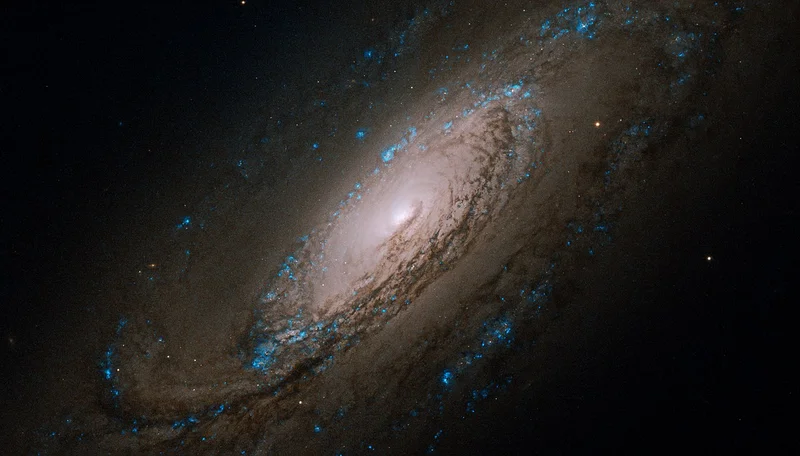
In this celestial area of the constellation Canes Venatici, there are other galaxies such as NGC 5002, NGC 5014, and IC 4207, with NGC 5005 being the main galaxy of the NGC 5005 galaxy group (LGG 334), which comprises a total of 16 members. Along with 13 other galaxies, this collection is also referred to as the Canes Venatici chain. The supernova SN1996ai was detected on June 16, 1996, by the Italian amateur astronomer Claudio Bottari in NGC 5005. The Type Ia supernova reached an apparent brightness of 14.5 mag and was located 24 arcseconds northeast of the galaxy center. A few days later, it reached magnitude 13.
The Spiral Galaxy NGC 5033
In close proximity to NGC 5005 is the visually appealing spiral galaxy NGC 5033 of Hubble type Sc. Due to its interesting appearance, it is frequently photographed by amateur astronomers. The two galaxies weakly influence each other as a true galaxy pair. They are still spatially far apart. The gravitational forces between the two objects are not yet strong enough to distort their disks through tidal forces. Only in very long-exposed photographs are weak tidal arms visible between NGC 5005 and NGC 5033. The galaxy has a relatively weak disk. Its spiral arms contain extensive star formation regions where star formation is continuously occurring. In the southern half of the disk, a noticeable curvature is evident in photographs. This marks the beginning of a tidal tail, which continues as a faint streak further to the left. The compact core is surrounded by dense dust lanes.
NGC 5033 has an active galactic nucleus (AGN) of the Seyfert-1 type. A supermassive black hole with a mass of 44 million solar masses is suspected to be present there. The bright emission visible in visible light (as well as in other wavelength ranges) is partially generated by the hot gas surrounding this black hole. The energy released indicates that the central black hole is currently devouring stars, dust, and gas that come too close. Integral field spectroscopic observations of the center of NGC 5033 suggest that the Seyfert core is not located at the kinematic center of the galaxy. This is interpreted as evidence of a possible early galaxy merger with a compact low-mass satellite in the past. This could also explain the distorted disk of NGC 5033. The displacement of the core could destabilize the gas rotation, causing gas to fall into the Seyfert core, where it is compressed and heated, making the core appear active. Unlike other Seyfert galaxies, such as Messier 77 in Cetus, there seems to be no associated starburst with this active core.
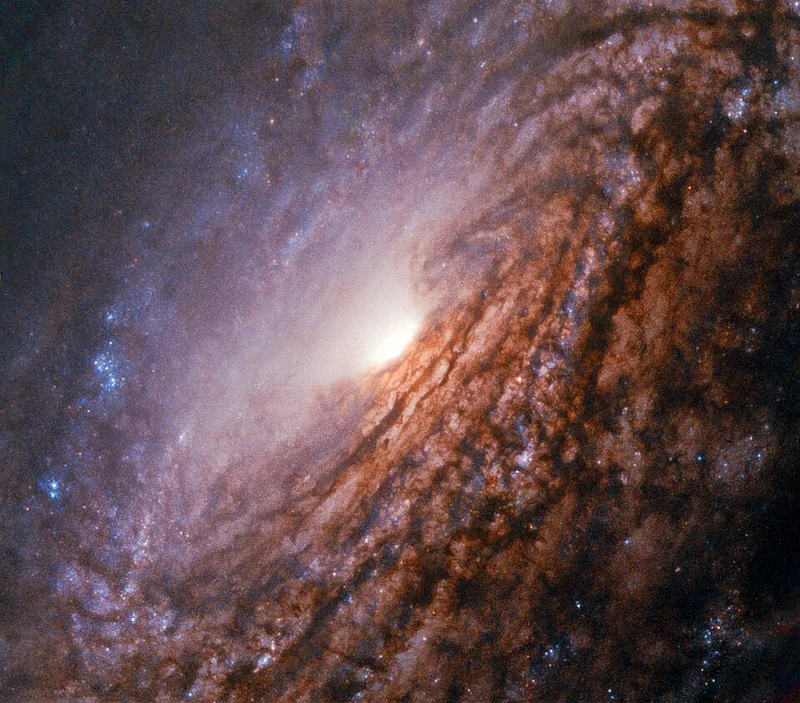
With an apparent brightness of 10.8 mag and an apparent diameter of 10.7 x 5.0 arcminutes, NGC 5033 appears significantly fainter to the observer than NGC 5005 due to its lower surface brightness. Its relative proximity to Earth – depending on the source, it ranges from 38 to 60 million light-years – and its active galactic nucleus make it a frequently studied object for professional astronomers. Current studies estimate a distance of 41 million light-years and a true diameter of the galaxy of 125,000 light-years. Thus, this island of worlds is approximately as large as our own galaxy. Unlike the Milky Way, NGC 5033 lacks a central bar. In its immediate vicinity are the irregular dwarf galaxies Holmberg VIII (UGC 8303) and UGC 8314. These two objects are considered satellite galaxies, similar to the two Magellanic Clouds of our Milky Way.
Over the decades, four supernovae have been observed in NGC 5033. On May 14, 1950, the American-Swiss astrophysicist Fritz Zwicky discovered the supernova SN 1950C. It reached an apparent brightness of 18.2 mag. The type of this supernova was not determined. On June 13, 1985, the Russian astronomer Natalya Metlova discovered the Type II supernova SN 1985L. It reached a maximum brightness of 12.5 magnitudes. The Type IIb supernova, SN 2001gd, was discovered on November 24, 2001, by the Japanese amateur astronomers Kōichi Itagaki and the Italian Alessandro Dimai. It reached a brightness of 16.5 mag. The asteroid search program ATLAS discovered the Type II supernova SN 2025mvn on June 3, 2025, with a magnitude of 17.9.
Observation
Under a very dark land sky, NGC 5005, along with the main star of Canes Venatici, Cor Caroli, is already indirectly observable in a 7x50 binocular. In a 3 to 4-inch refractor with low magnification, it appears only as a diffuse, oval light spot, with a slightly brighter center. NGC 5033 is a greater challenge for amateur astronomers, as it appears significantly fainter and is only indirectly visible. With an aperture of 6 to 8 inches and medium magnifications of 70x, the disk of NGC 5005 already appears slightly mottled when viewed indirectly. It brightens towards the center, revealing an oval core region. The galaxy shows a very diffuse, somewhat elongated disk. Its center appears brighter, with no further details discernible. At the northern end of the disk, there is a faint star. Both galaxies are embedded in a rich field of stars.
The 3:1 elongated disk of NGC 5005 is relatively bright in a 10 to 12-inch telescope. It shows a pronounced core area, whose central region appears lens-shaped. The core itself is sharp and star-like. When viewed indirectly, the galaxy disk appears significantly asymmetrically distorted. At the southern end of the galaxy, there is a small sharp boundary, which may be part of one of its spiral arms. Additionally, indistinct light arcs can be detected that trace the spiral structure. NGC 5033 also appears brighter, with a brighter central region characterized by a star-like core. It appears elongated in the north-south direction. With telescopes of 16 inches or more, brighter and darker areas can be recognized in the bright disk of NGC 5005, especially at the southern periphery of the central region. Its large, bright core and the two inner arms, one bent to the west and one to the east, are particularly noticeable. NGC 5033 also benefits significantly from a larger telescope aperture. In this galaxy, the spiral arms also slowly become apparent at a magnification of 120x. They manifest as bright and dark spots in the disk, best seen east and west of the center. Its bright, elongated core with a star-like center now stands out prominently.
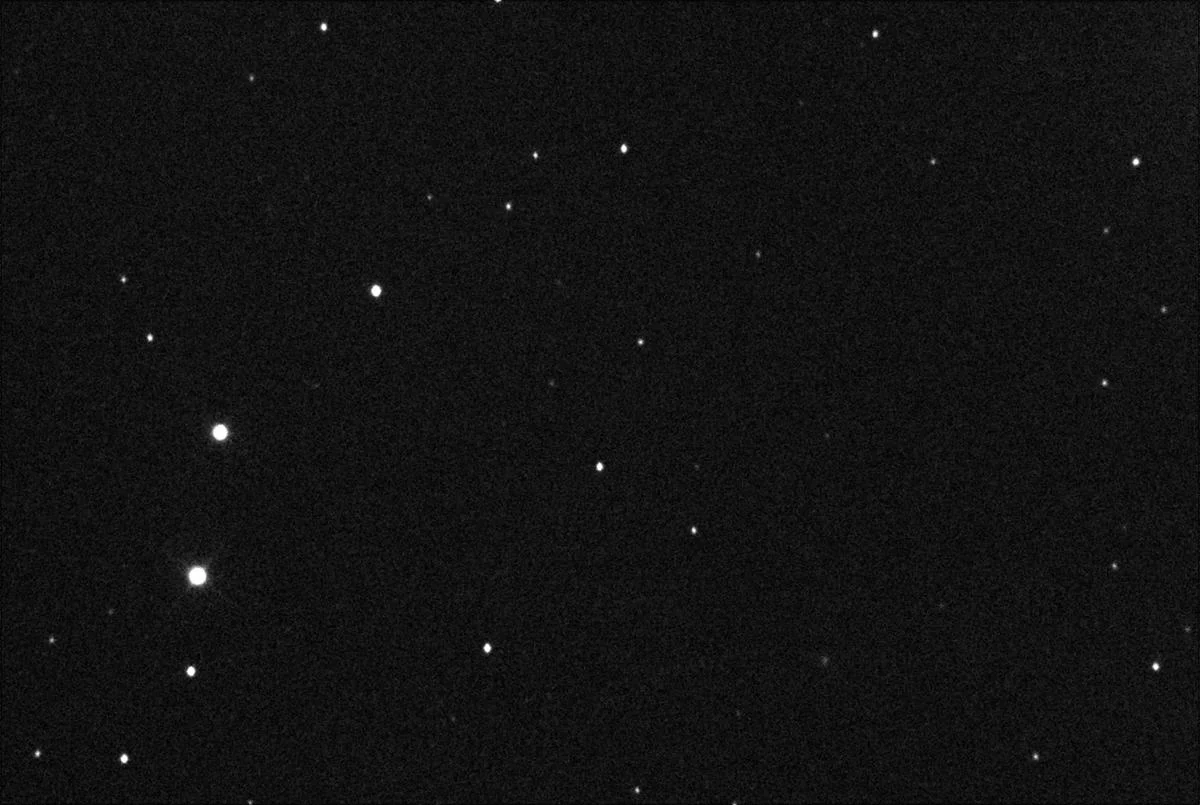
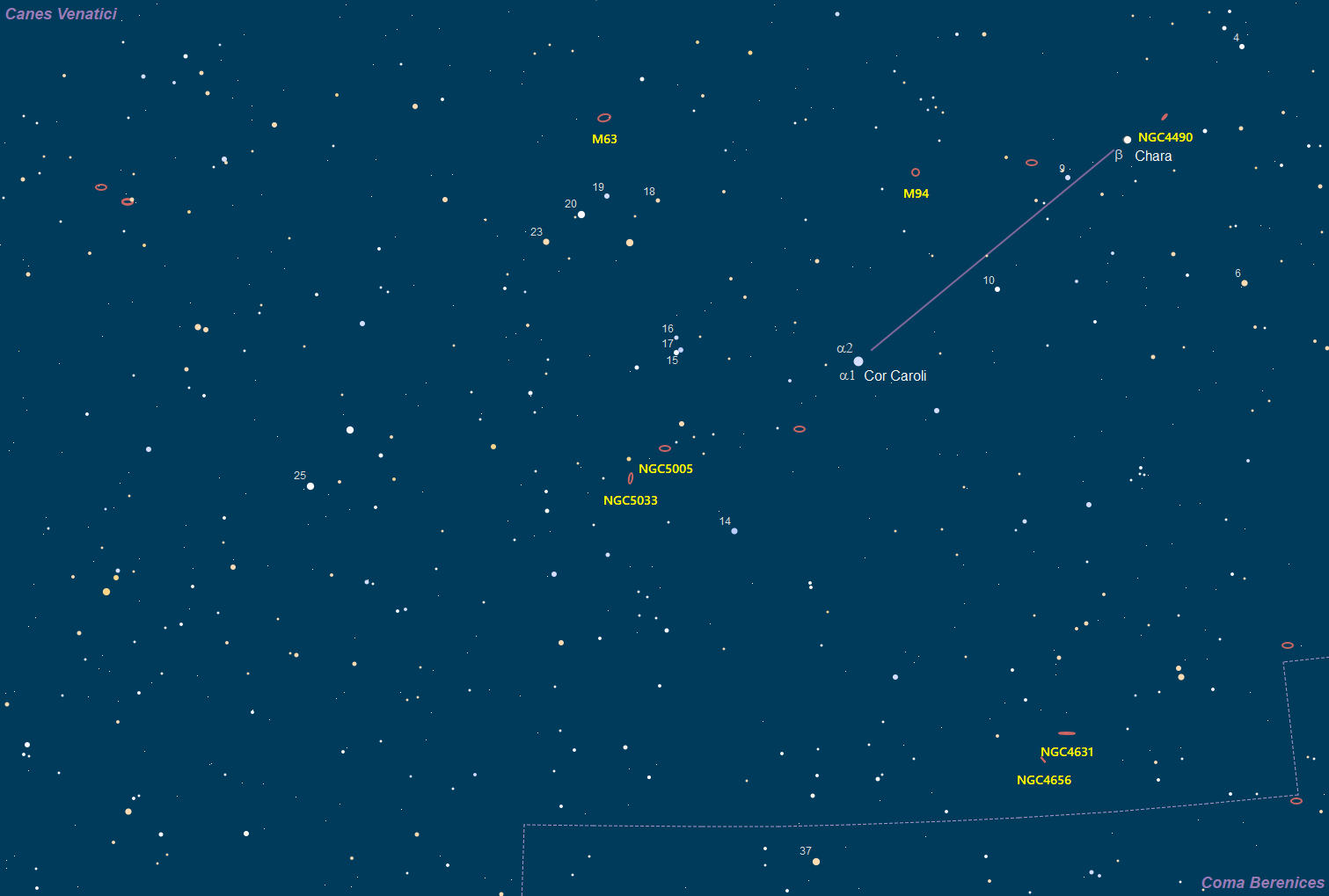
The two galaxies are best seen in the spring months when the constellation Canes Venatici is high in the sky. NGC 5005 is relatively easy to locate. It is located just three degrees southeast of the beautiful double star Cor Caroli (Alpha CVn), which has a brightness of 2.9 mag. About two degrees east of Alpha Canum Venaticorum is a triangle of stars of the 6th and 7th magnitude. The galaxy is situated about one and a half degrees south of this trio. Just 40 arcminutes southeast of NGC 5005 is NGC 5033. It appears in an 8-inch telescope at low magnification in the same field of view.
 Finder Chart NGC 5005 & NGC 5033 (72.8 KiB, 47 hits)
Summary for NGC 5005 & NGC 5033
Data and facts for the galaxies NGC 5005 and NGC 5033...