The Galaxies Messier 60 and NGC 4647
Messier 60 (NGC 4649) is an elliptical galaxy in the constellation Virgo. It was discovered on April 11, 1779, by the German astronomer Johann Gottfried Köhler...
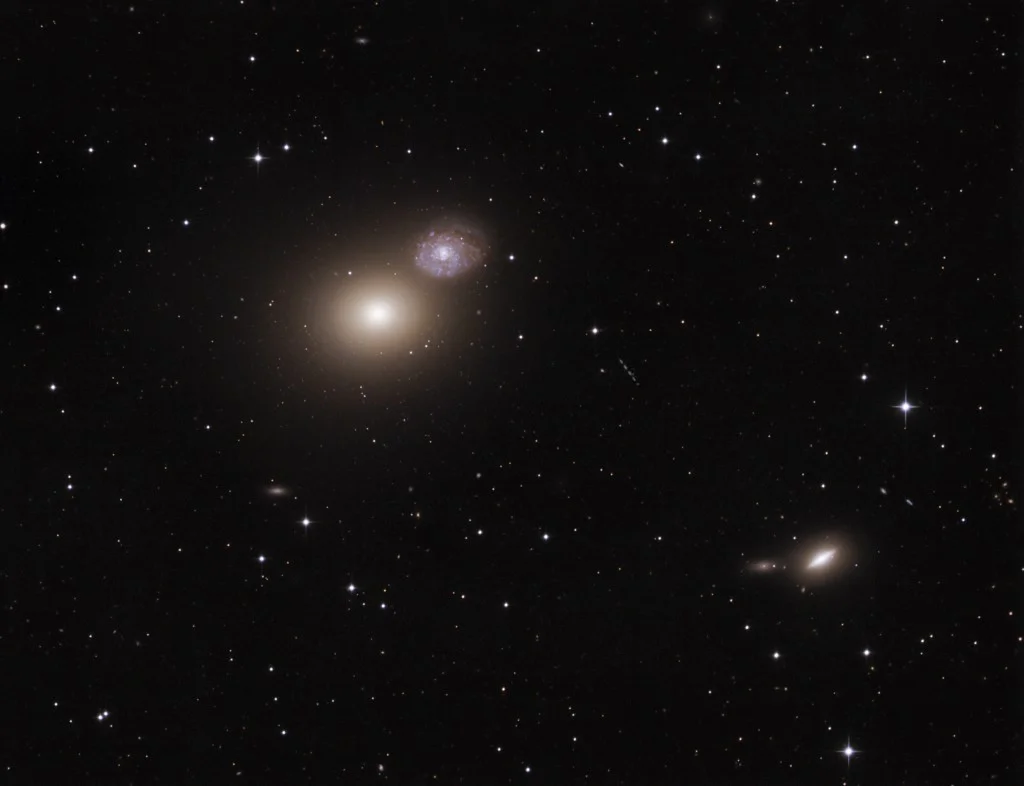
Messier 60 (NGC 4649) is an elliptical galaxy in the constellation Virgo. It was discovered on April 11, 1779, by the German astronomer Johann Gottfried Köhler at his private observatory in Dresden, along with M 59, while he was observing a comet (C/1779 A1 Bode) in the same section of the sky. He noted: "Two very small nebulae, hardly visible in a 3-foot telescope: one above the other." The Italian astronomer Barnaba Oriani discovered the galaxy a day later, and Charles Messier independently discovered it just four days after Köhler. During his search, Messier also discovered another galaxy in the Virgo galaxy cluster (M 58), which Köhler had apparently overlooked. He eventually added the object to his famous nebula catalog. Messier describes M 60 as "somewhat clearer" than M 58 and M 59, as well as a nebula without stars.
In his records, he also noted the comet that passed by M 60 between April 13 and 14, 1779. This comet passed so close to the galaxies that it appeared in Messier's telescope in the same field of view and completely outshone the two other galaxies. For this reason, Charles Messier only discovered the galaxies the following night. Messier 60 forms an attractive pair with the nearby spiral galaxy NGC 4647. It was discovered on March 15, 1784, by the German-British astronomer Friedrich Wilhelm Herschel. Herschel recognized both objects as double nebulae, as did his son John, who described it as "a very beautiful and remarkable object." Both galaxies are also listed as Arp 116 in Halton Arp's catalog of unusual and interacting galaxies.
An Elliptical Giant Galaxy
Messier 60 is bright enough to be observed with any telescope. It is one of the three large elliptical giant galaxies in the Virgo cluster, which contains more than 1,300, possibly even more than 2,000 galaxies. This cluster is located at the center of the Virgo supercluster, which also includes the Local Group. M 60 is the easternmost Messier object in this cluster and the third brightest galaxy. Only Messier 49 (8.4 mag) and Messier 87 (8.7 mag) appear more luminous. As the easternmost Messier galaxy of the Virgo cluster, M 60 is also the last in a series of three galaxies (M 58, M 59, and M 60) that fall into the field of view of a telescope aimed at this area of the sky. Messier 60 is located 56.7 million light-years from Earth. The galaxy is the dominant member of a subcluster of four fairly isolated galaxies, referred to as the M60 group (Virgo Cluster C). At the same time, it is considered the nearest known isolated compact galaxy group.
The galaxy is of Hubble type E2. However, some sources classify it as a lenticular galaxy of Hubble type S0. The value E2 indicates a flattening of 20%, making the galaxy appear nearly round. It has an apparent magnitude of 8.8 and an apparent diameter of 7.4 x 6.0 arcminutes. Unlike spiral galaxies, elliptical galaxies do not exhibit organized structures and appear rather dull to the observer. The galaxy, which appears slightly flattened in telescopes, has a true diameter of 118,000 light-years. Its outer halo could be even larger. It has a mass of over one trillion solar masses. Its absolute magnitude is -22.3, corresponding to an intrinsic luminosity of 71 billion suns. The halo of the galaxy is thought to contain up to 5,100 globular star clusters, which is 20 times the number of globular star clusters that our own galaxy hosts (approximately 150 to 200).
The Companions of Messier 60
In close proximity to Messier 60, about 2.5 arcminutes away, is the small barred spiral galaxy NGC 4647. It is likely interacting with M 60 and has a diameter of 55,000 light-years. It is located 61 million light-years from Earth, contains 10 billion stars, and extensive star formation regions. The two optical disks of the galaxies appear to overlap. Although the overlap of their halos suggests such a gravitational interaction, photographic images show no signs of distortions, as would be expected with galaxies so close together. This suggests that the two galaxies are actually only superimposed due to a perspective effect and may be somewhat farther apart. However, Hubble observations indicate that a tidal interaction between M 60 and NGC 4647 may have already begun. However, recent studies do not confirm this suspicion.
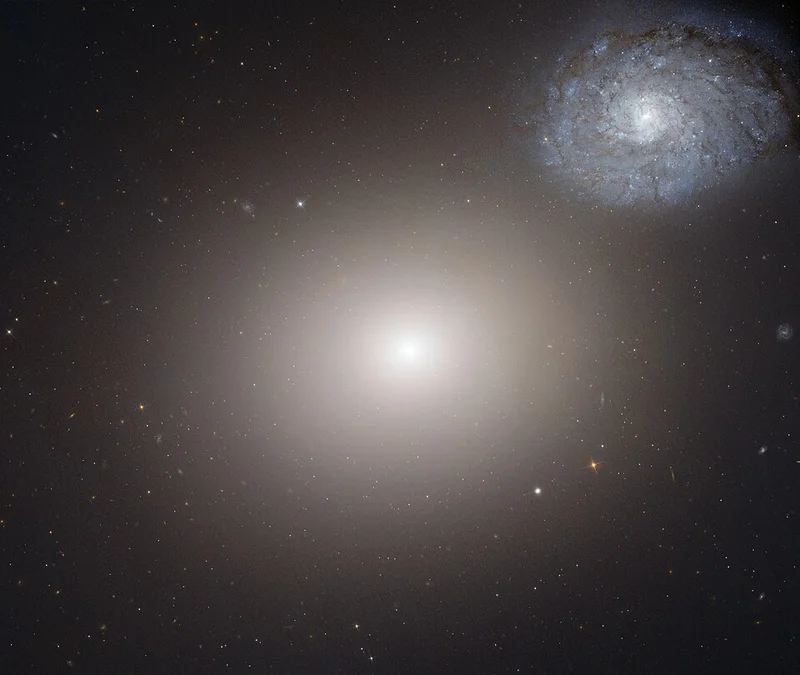
The two galaxies therefore form a purely optically bound galaxy pair, referred to as Arp 116 (Holm 448). Halton Arp classified his catalog of unusual galaxies into groups based purely on morphological criteria. According to Arp, this galaxy belongs to the class of "Elliptical galaxies near spiral galaxies that disturb them." A Type I supernova designated SN 1979A was observed in NGC 4647 in 1979. On April 16, 2022, Japanese amateur astronomer Koichi Itagaki discovered another bright point in the disk of NGC 4647. This also turned out to be a Type Ia supernova. The supernova SN 2022hrs reached a maximum brightness of 12.6 magnitudes just a week later. This allowed the distance to NGC 4647 to be recalculated. It is now located 91 million light-years away and thus significantly in the background of Messier 60.
In the immediate vicinity of M 60, the ultra-compact dwarf galaxy M60-UCD1 was discovered in 2013. It is located 22,000 light-years from the main galaxy and contains a supermassive black hole weighing 21 million solar masses. The dwarf galaxy likely formed about 10 billion years ago during a collision with another galaxy. It represents the remaining core of that galaxy. The dwarf galaxy has a diameter of only 300 light-years and contains about 140 million suns. Notably, about half of its mass is within a radius of only about 80 light-years. M60-UCD1 is therefore considered the smallest and least massive galaxy with a confirmed central black hole. It may be the densest known galaxy with an extraordinarily high stellar density of more than one hundred stars per cubic light-year in the local universe. The stellar density is thus about 15,000 times higher than in the vicinity of the Sun. This means that the stars are about 25 times closer together. During the collision with M 60, many stars and dark matter were ripped from the main galaxy due to gravitational forces. It is likely that the dwarf galaxy will completely merge with M 60 in the distant future.
Also at the center of Messier 60, a supermassive black hole with a mass of about 3.4 to 4.5 billion solar masses is suspected. It is currently inactive and ranks among the largest known black holes in the local universe. Its mass is about 1,000 times that of the black hole at the center of our Milky Way. The X-ray radiation of the galaxy shows a cavity created by jets that the black hole expelled during earlier active phases. The motion of M 60 through the intercluster medium of the Virgo cluster leads to ram-pressure stripping of gas from the outer halo of the galaxy. On January 28, 2004, a Type Ia supernova was discovered in M 60. At its discovery, it had a brightness of only 18.8 magnitudes and was already fading. It likely brightened about half a year earlier. However, it went unnoticed because M 60 was near its conjunction with the Sun at that time.
Observation
Messier 60 is already relatively clearly recognizable as a small, blurred light spot under a dark land sky with a 10×50 binocular. With a 3 to 4-inch refractor and medium magnifications of 60 times, the galaxy appears as an indistinct, oval light spot with a slightly brighter center. Under good viewing conditions, with an aperture of 5 inches and higher magnification, its companion NGC 4647 can also be detected with indirect vision. It appears as a northwestern bulge of the halo. With 6 to 8-inch apertures and 70 to 100 times magnification, M 60 appears somewhat brighter and more extended. The core appears star-like and very bright, while the core region is rather diffuse. The brightness of the coma only moderately increases towards the center. It forms a flat, isosceles triangle with two fainter stars. NGC 4647 appears only as a structureless, 12 mag bright and only one arcminute large light spot. This is slightly overlapped by the outer halo of M 60 from an aperture of 8 inches.

With telescopes of 10-inch aperture and larger, the companion galaxy has a somewhat brighter, diffuse center and seems to be separated from M 60 by a dark strip. With even larger telescopes, both galaxies appear quite bright. The brightness of M 60 only moderately increases towards the center. Notably, the weak core appears star-shaped. The core region of NGC 4647 is nearly uniformly bright and is surrounded by an equally uniform, slightly mottled halo. Only 25 arcminutes northwest of M 60 is the elliptical galaxy M 59 with a brightness of 9.7 magnitudes. With medium magnifications, both Messier objects are in the same field of view of a telescope.
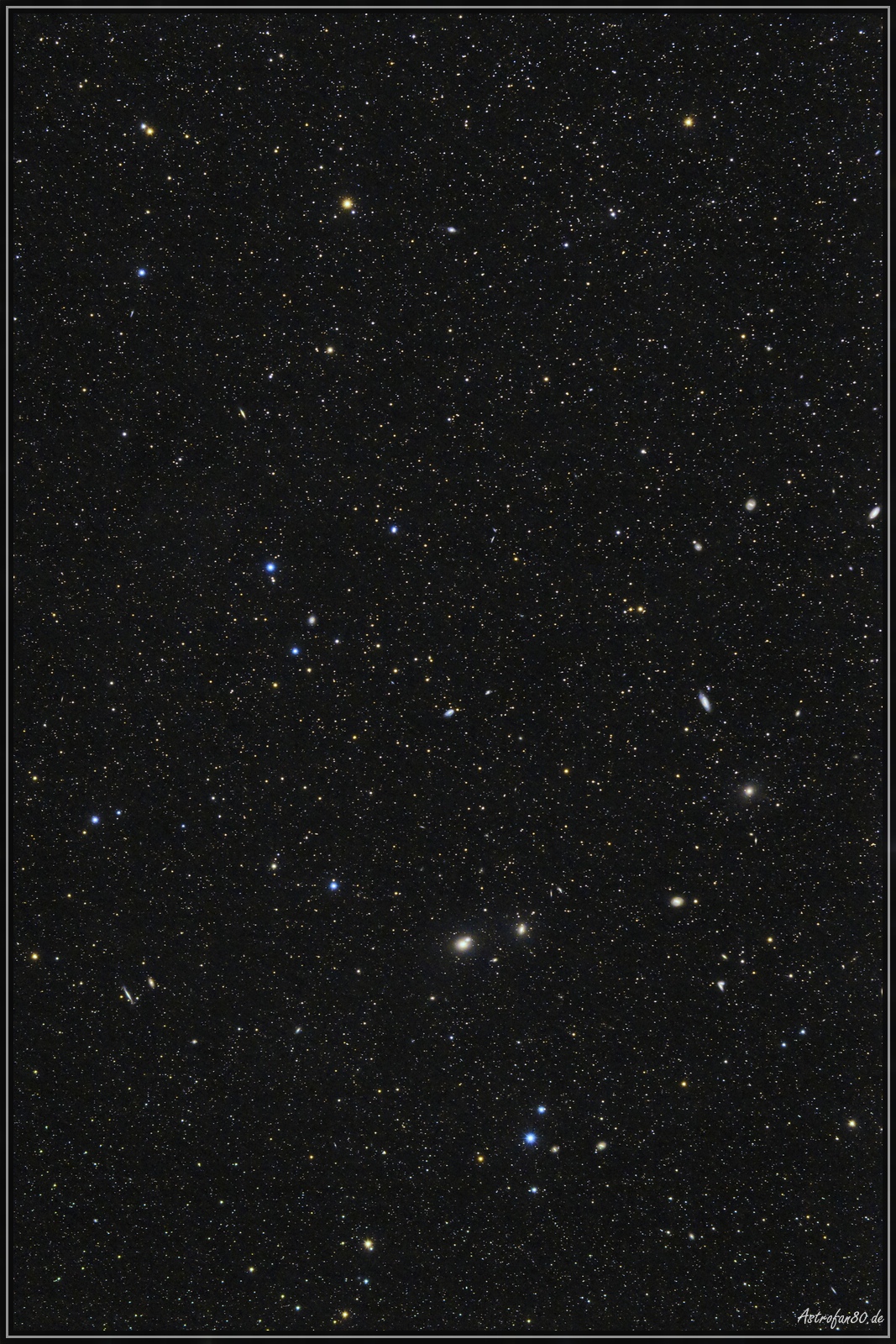
Messier 60 is a typical object of the spring sky and early summer and is located near the border of the constellation Coma Berenices. The galaxy is relatively easy to find, as it is about 7° west of Rho Virginis and 4.5 degrees west and slightly north of Epsilon. Starting from the star Vindemiatrix (Epsilon Vir, 2.8 mag), we draw a line towards Denebola (Beta Leo, 2.1 mag). About 5° west of Epsilon Vir is a triangle of stars of the 6th and 7th magnitude, grouped around Rho Vir (4.9 mag). The galaxy is located about 1.5 degrees north of this group.
 Finder Chart Messier 60 & NGC 4647 (57.5 KiB, 24 hits)
Summary for Messier 60 & NGC 4647
Data and facts for the galaxies Messier 60 and NGC 4647 in Virgo
Object Name
Messier 60
NGC 4647
Catalog Designation
NGC 4649, UGC 7898, PGC 42831, MCG 2−33−2, KCPG 353B, ARP ...