The Galaxy Messier 59 - Spreewald-Spechtler
Messier 59 (NGC 4621) is an elliptical galaxy in the constellation Virgo. The object was discovered on April 11, 1779, by the German astronomer Johann Gottfried Köhler in Dresden along with Messier 60 and NGC 4638 while observing the comet Bode.
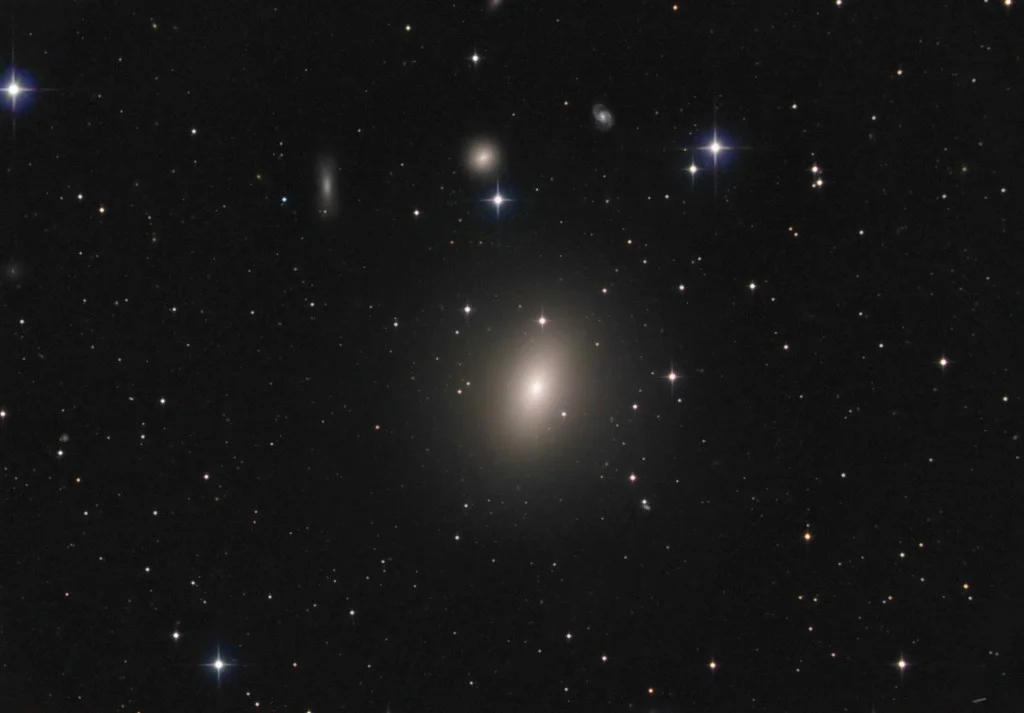
Messier 59 (NGC 4621) is an elliptical galaxy in the constellation Virgo. The object was discovered on April 11, 1779, by the German astronomer Johann Gottfried Köhler in Dresden, along with Messier 60 and NGC 4638, while he was observing the comet Bode. That night, the Saxon astronomer observed the comet in the same section of the sky. Köhler described the two galaxies as "two very small nebulae that are hardly visible in a 3-foot telescope: one above the other".... Read more
An elliptical galaxy with an unusual center
The galaxy has an apparent magnitude of 9.7 and a size of 5.4 x 3.7 arcminutes, making it observable even with small telescopes and powerful binoculars. It is located 52.2 million light-years away from Earth, in the eastern part of the Virgo galaxy cluster. This region is densely populated with galaxies. It is considered one of the largest elliptical galaxies (Hubble type E5) in this cluster. However, it is significantly less massive and less luminous than the elliptical cluster members Messier 49, Messier 60, and Messier 87. Approximately 1,500 to 2,000 galaxies form the core of the Virgo supercluster. This also includes our Local Group with the Milky Way. The true diameter of M 59 is estimated to be 75,300 light-years, and its mass is 270 billion solar masses. Messier 59 is tilted at about 163° relative to our line of sight. Its halo is not perfectly elliptical but has pointed edges. These arise from the superposition of three differently elliptical structures. The overall shape of M 59 also exhibits a flattening of about 50%. Its core likely contains a supermassive black hole with a mass of 270 million solar masses. This is nearly 100 times more massive than the black hole at the center of the Milky Way.
The black hole at the center of the galaxy is currently quite calm but also emits radiation in the radio and X-ray spectrum. This indicates an outflow in the accretion disk of the black hole. Although elliptical galaxies are considered the most evolved form, M 59 shows signs of star formation in a significantly younger stellar disk near the center. It is suspected that this disk material may originate from an early merger with another galaxy. The core of Messier 59 appears significantly bluer and rotates in the opposite direction up to a distance of 200 light-years from the center. This is the smallest region in a galaxy where such rotation is known. The galaxy merger triggered star formation in the central region of M 59 in the past. Thus, this galaxy is somewhat atypical. Elliptical galaxies typically contain many red and old stars and show few or no signs of star formation processes.
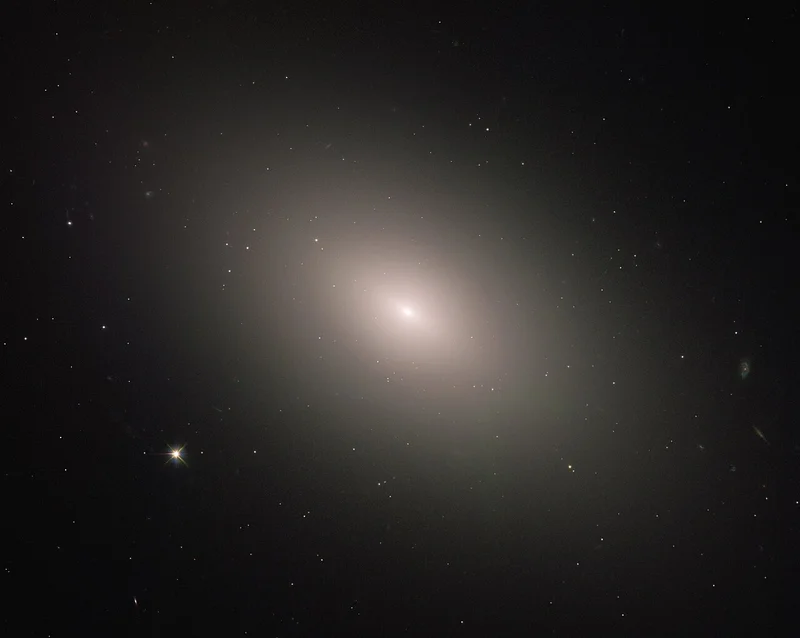
Like all large elliptical galaxies, Messier 59 is rich in globular clusters. It is estimated that there are 2,200 globular clusters in the galaxy. This is ten times more than in our galaxy but only one-tenth of the globular clusters in M 87. The high number of these star clusters allows researchers to study the formation and evolution of these systems. Additionally, two elliptical dwarf galaxies have been detected in close proximity to Messier 59. These are considered an intermediate form between a compact dwarf galaxy like Messier 32 in Andromeda and an ultra-compact dwarf galaxy (M59-UCD3 and M59cO). So far, only one supernova has been detected in M 59. The supernova SN 1939B was discovered on May 19, 1939, by Swiss physicist and astronomer Fritz Zwicky. It reached a maximum brightness of 11.9 mag. In the region where this supernova occurred, there are no signs of star formation, indicating that it was a Type Ia supernova.
Observation
Messier 59 can already be discerned as a blurry star in 10×50 binoculars. In my 16×70 Fujinon binoculars, it is also just visible as a faint, elliptical nebula. However, a very dark sky is required for this. In a 3 to 4-inch refractor with medium magnification, the galaxy appears as a 2:1 elongated, faint, elliptical nebula with a slightly brighter core region. It forms an isosceles triangle with two bright foreground stars. Only 1.8 arcminutes north of the center of the galaxy is a star of 12th magnitude. Even with larger telescopes with 6 to 8-inch apertures, little changes in its outer appearance. M 59 now appears somewhat larger and brighter. Its elliptical core appears condensed and significantly brighter. The center appears star-like. The core is surrounded by a large, faint, nebulous halo, whose brightness only moderately increases towards the center. The galaxy appears significantly fainter than the elliptical giant galaxy M 60 (8.8 mag). It can be seen along with NGC 4647 at a 50x magnification in the same field of view. Even at higher magnifications of over 100x, no further details in Messier 59 are discernible.
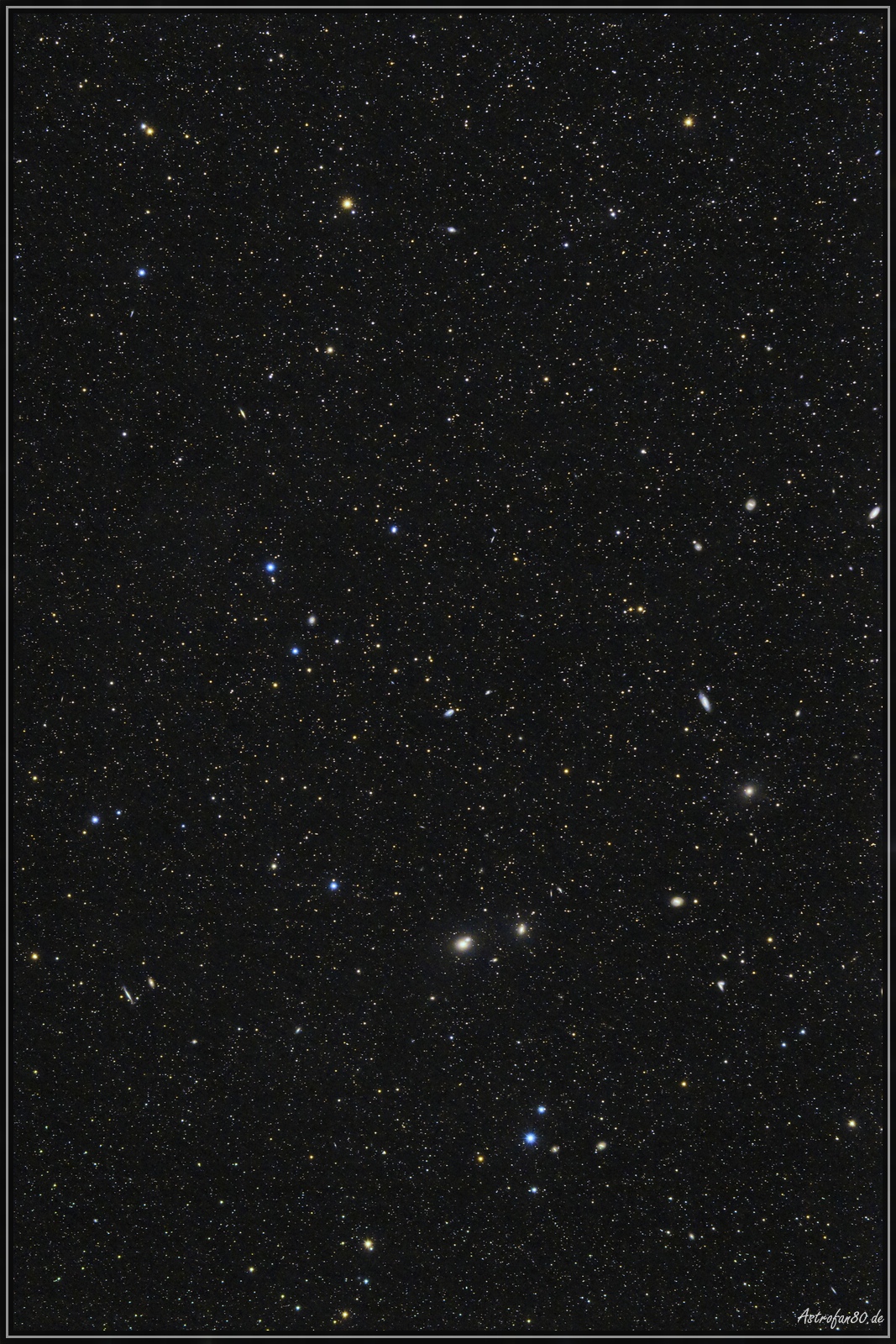
Even with telescopes with 10 to 12-inch apertures, the galaxy appears quite structureless and fairly homogeneous at high magnification. However, the center now appears significantly more pronounced. The brightness across the disk is somewhat asymmetric, with the northwestern quadrant being significantly brighter than the southeastern. In close proximity to Messier 59, just five arcminutes to the north, is the faint galaxy IC 809 (IC 3672). It is visible in telescopes with an aperture of eight inches, with an apparent magnitude of 13.2.
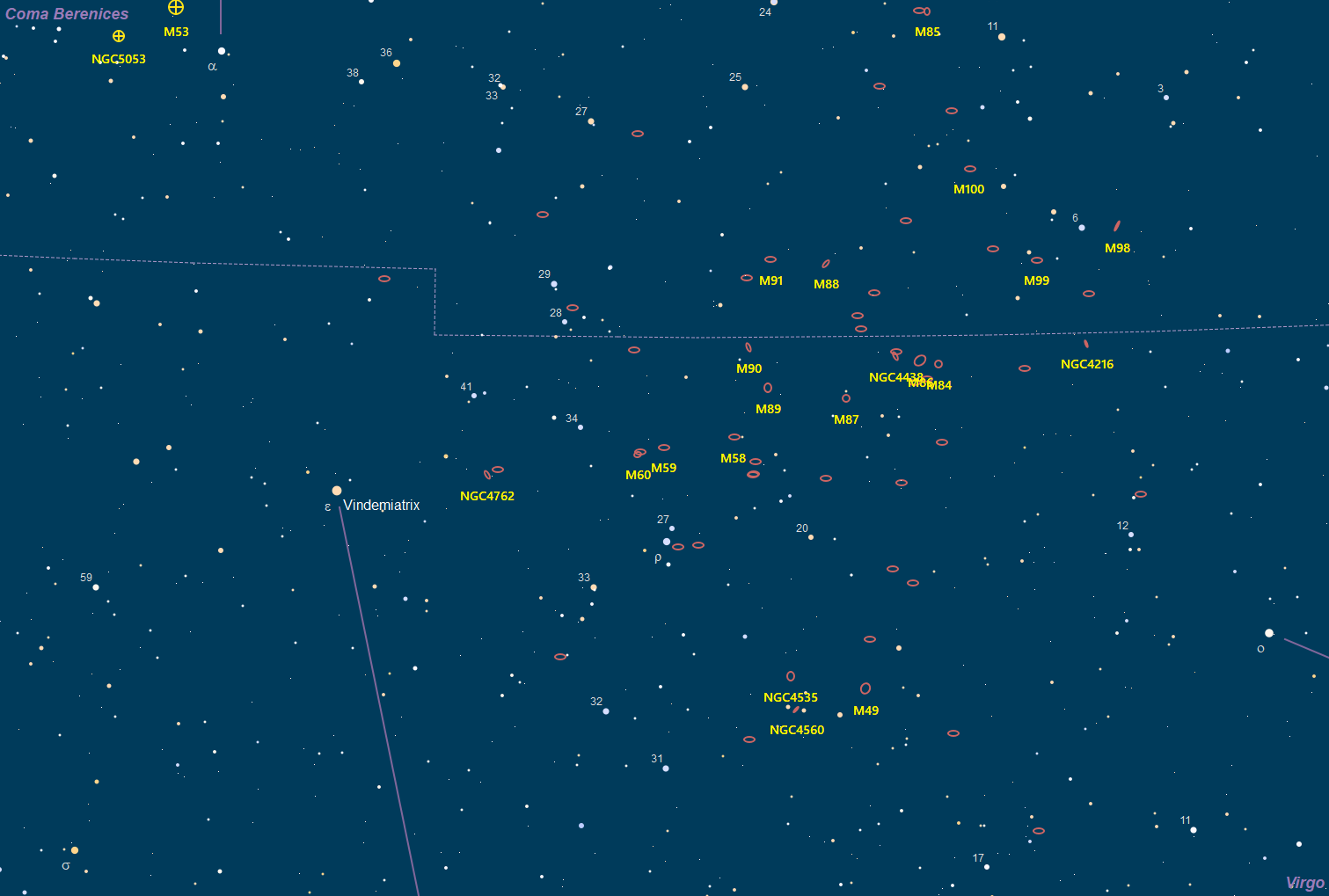
The best time to observe M 59 is during the spring months when the constellation Virgo is positioned moderately high in the southern sky. Many of the bright galaxies in the Virgo galaxy cluster lie along or near an imaginary line connecting Denebola (Beta Leo, 2.1 mag) with Vindemiatrix (Epsilon Vir, 2.8 mag). Messier 59 is located a few degrees west of Vindemiatrix and about one-third of the way along the connecting line between Epsilon Virginis and Beta Leonis. We center Epsilon Vir in the finder and sweep the telescope 5° westward. There, we find a triangle of stars of 6th to 7th magnitude around the 5 mag bright star Rho Virginis. Now we sweep the telescope another one and a half degrees north, where we arrive at the elliptical giant galaxy M 60. Messier 59 is located half a degree further west from M 60. M 58 is also just one degree west of it.
 Finder Chart Messier 59 (62.1 KiB, 48 hits)
Profile for Messier 59
Data and facts for the galaxy Messier 59 in Virgo
Object Name
Messier 59
Catalog Designation
NGC 4621, UGC 7858, PGC 42628, MCG 2−32−183, ZWG 70.223
Type
Galaxy, E5
Constellation
Virgo
Right Ascension (J2000.0)
12h 42m 02.2s
Declination (J2000.0)
+11° 38′ 50″
V Magnitude
9.7 mag
Surface Brightness
12.9 mag
Angular Size
5.4′ x 3.7′
Position Angle
165°
Absolute Magnitude
-20.714 mag
Diameter
75,300 light-years
Distance
52.2 million light-years
Description
B,pL,lE,vsvmbM,2 * p; B diff N;smooth arms
Discoverer
Johann Gottfried Köhler, 1779
Star Atlases
Cambridge Star Atlas: Chart 10
Interstellarum Deep Sky Atlas: Chart 45 & D2
Millennium Star Atlas: Charts 723–724 (Vol II)
Pocket Sky Atlas: Chart 45
Sky Atlas 2000: Chart 14
Uranometria 2nd Ed.: Chart 90