Exploring Life Beyond Earth: The Ambitious LIFE Mission
The LIFE mission is a groundbreaking European initiative aimed at exploring life beyond Earth by characterizing exoplanet atmospheres for biosignatures. Led by ETH Zurich, it seeks to answer if we are alone in the universe.
by Irene Parenti and Asia Liberti
In recent years, scientific interest has surged regarding the search for Earth-like exoplanets that could potentially harbor life. One of the most ambitious initiatives in this field is the LIFE project.
LIFE, which stands for Large Interferometer For Exoplanets, is a European space mission designed to investigate the existence of life beyond our solar system and explore the diversity of other possible worlds. Led by the ETH Zurich, the mission seeks to answer one of humanity's fundamental questions: Are we alone in the universe?
The primary goal of LIFE is to characterize the atmospheres of Earth-like exoplanets in search of biosignatures—chemical and physical traces that indicate the presence of life as we know it.
Operating mainly in the mid-infrared range (4 – 18.5 μm), LIFE will focus on a spectral band crucial for detecting the majority of thermal radiation emitted by Earth-like planets. This range contains essential molecular “fingerprints” for life, including carbon dioxide (CO2), water vapor (H2O), methane (CH4), and ozone (O3).
A significant challenge for this mission lies in its unique configuration: a fleet of five independent spacecraft. Four of these will function as light collectors, reflecting the signal from the exoplanet to a central fifth module. By positioning themselves at precise distances, the spacecraft will operate as a nulling interferometer, a technique that allows for the optical “cancellation” of the star's radiation, thereby isolating and examining the faint light emitted by the planet.
Currently, the mission is in the early stages of conceptual and technological development. If approved, it is not expected to launch until around 2050.
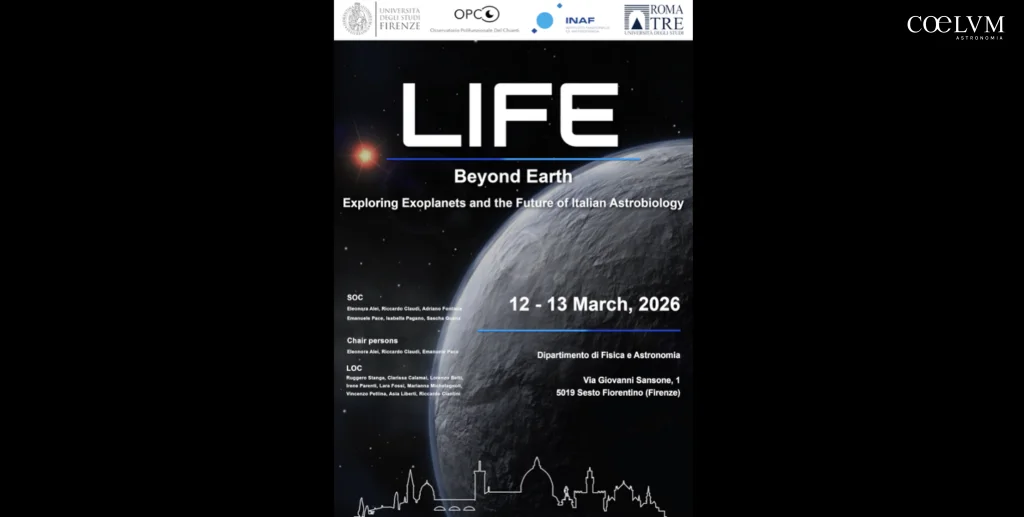
The first day of a recent conference featured an overview of the mission presented by Adrian Glauser from ETH Zurich, who is the Co-Principal Investigator. He detailed the mission's objectives and technical specifications. Key challenges for LIFE include resolving star-planet systems with small angular separations and detecting objects characterized by low contrast or intrinsic faintness. To address these challenges, the LIFE team is focusing on a telescope with high resolution, contrast, and sensitivity. The mid-infrared band will allow for direct observation of biomarkers such as oxygen.
As explained by Eleonora Alei, the science team leader, this choice complements the bands selected for NASA’s Habitable Worlds Observatory (HWO), which will operate in the ultraviolet (UV) and near-infrared (NIR) ranges. Both missions are currently in the design phase, and if approved, collaboration between the two observatories is expected to yield more accurate results than could be achieved independently.
Discussions during the conference highlighted the diverse scientific fields in which LIFE can collaborate.
The event concluded on March 13 with a debate aimed at revisiting themes discussed over the two days, fostering new collaborations among experts and young researchers. The potential for research is vast, encompassing both scientific and technological engineering aspects.
The conference attracted considerable interest, with around sixty participants, including a significant number of students and early-career researchers—reflecting the primary objective of the gathering. This event is not expected to be a one-off; the entire LIFE team is already working on organizing future meetings and potential summer schools.
For more information and updates on the mission's progress, visit: life-space-mission.com.
The article is published in COELUM 280 PRINT VERSION.