New Insights into Dynamo Effects from Large-Scale Jets
Researchers have discovered that large-scale jets significantly amplify magnetic fields, leading to a new dynamo scenario distinct from conventional models, with implications for various astrophysical phenomena.
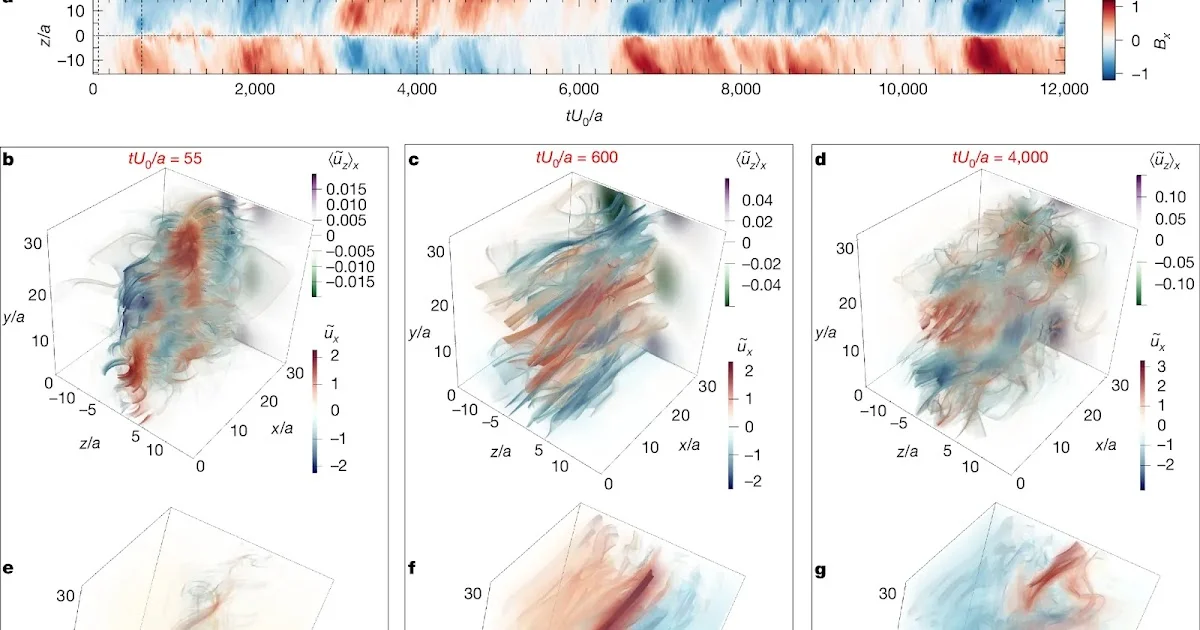
Recent research has unveiled that large-scale jets play a significant role in amplifying magnetic fields, leading to the development of a new dynamo scenario distinct from conventional models typically used for planetary and stellar dynamos. This study, published in Nature, is particularly relevant for understanding magnetic field amplification in various astrophysical contexts, including plasmas, planets, stars, neutron stars, and accretion disks around compact objects.
Magnetic fields are influential across multiple scales, affecting phenomena such as star formation, cosmic ray transport, charged particle acceleration, space weather, and dynamics within planetary atmospheres and laboratory plasmas.
The origin of cosmic magnetic fields has long puzzled scientists. Creating such large-scale fields requires moving matter or fluid flows. Cosmic-scale flows are typically driven by gravity and exhibit turbulence, characterized by chaotic changes in pressure and velocity. This turbulence tends to entangle and disorder magnetic fields on small scales. However, astrophysical magnetic fields often maintain an ordered structure at scales such as galaxies and beyond. Notably, small-scale flows and magnetic fields are usually of similar magnitude and, crucially, aligned. This alignment, known as Alfvénization, occurs naturally in the movement of magnetofluids—fluids that conduct electricity and carry magnetic fields. Yet, Alfvénization nearly negates the conventional dynamo mechanism proposed for amplifying magnetic fields, which involves turbulent flows bending initial magnetic fields to create loops that reinforce them. As a result, the generation of observed astrophysical magnetic fields has remained largely elusive.
In 1955, E. N. Parker proposed a theory of mean-field dynamo effects, parameterizing the impacts of small-scale turbulence. While this widely used theory successfully replicates large-scale observed fields, it struggles with parameter adjustments that lack justification from fundamental principles. Studies on turbulent flows reveal entangled magnetic fields that are twisted and fragmented into small-scale structures due to shear flow constraints.
In their research, Bindesh Tripathi from Columbia University and his colleagues investigated an unstable shear flow and developed an analytical theory alongside advanced three-dimensional simulations of turbulence, achieving resolutions of up to 4,096 × 4,096 × 8,192 grid points. Their findings demonstrate the generation of large-scale quasi-periodic magnetic fields from first principles. This generation occurs via mean vorticity effects, an additional mean-field dynamo process hypothesized in 1990.
The prior generation of large-scale three-dimensional jets, robustly produced as exact nonlinear solutions protected topologically by magnetohydrodynamic equations, is essential for this dynamo mechanism. The jet dynamo process applies to both laboratory and astrophysical shear systems, including binary neutron star mergers, where the dynamo effect likely operates on microsecond scales to produce some of the universe's most powerful magnetic fields within milliseconds.
Tripathi and his team conducted numerical simulations of shear flow in a magnetofluid, where the flow moves in opposing directions, akin to two-way traffic. Shear flows are common in nature and often lead to instabilities and turbulence. These simulations were run over extended periods, covering hundreds to thousands of instability growth times, demanding significant computational resources. The researchers utilized these models to identify naturally occurring processes in turbulence over long durations. They found that specific processes dominate among the complex interactions when comparing simulation behaviors with and without these processes. Additionally, they performed analytical calculations to establish the conceptual foundations of these processes.
In the numerical simulations, shear flow instability produces large-scale movements and turbulent structures of varying sizes. The large-scale motion, often viewed as primarily two-dimensional, generates three-dimensional structures, subsequently creating large-scale jets over extended periods. These jets are analogous to jet streams, fast-moving air bands in Earth's atmosphere. The zonal jets run roughly parallel to the shear flow and generate a large-scale magnetic field whose energy corresponds to the kinetic energy of the flow. Although Alfvénization contradicts the conventional mechanism proposed for magnetic field amplification, it supports the mechanism associated with shear flow instability and zonal jets.
This alternative magnetic field generation mechanism necessitates shear flow involving large-scale fluids moving at distinct velocities. Remarkably, this mechanism remains robust against parameter variations that influence the range of turbulent movements.
Neutron star mergers create a shear flow layer that persists long enough for the new magnetic field generation mechanism to produce fields potentially 10^16 to 10^17 times stronger than Earth's magnetic field. The same generation mechanism may also apply to the Sun, which exhibits large-scale latitudinal flows. The researchers note that other types of large-scale instability could generate shear flows similar to those that produced magnetic fields in their simulations.
Thus far, the fundamental process has been examined in an idealized system. To ascertain its functionality in specific astrophysical systems, additional effects present in those systems must be considered. While the simulations encompassed a broad range of parameters, they remain below certain extreme values observed in astrophysical contexts.
Furthermore, Tripathi's study offers a potential explanation for a puzzling laboratory measurement from 2012 regarding magnetic field generation by turbulent liquid metal. Rahbarnia et al. directly measured the transport of a vector magnetic field by isotropic turbulence in a high Reynolds number sodium liquid flow. They assessed the turbulent electromotive force by simultaneously measuring three components of velocity and magnetic fields and calculated correlations leading to the generation of a mean-field current. They concluded that the turbulent electromotive force tends to oppose and cancel the local current, effectively increasing the medium's effective resistivity, functioning as enhanced magnetic diffusivity, with significant implications for turbulent transport in astrophysical objects, particularly in dynamos and accretion disks.
However, Tripathi and his collaborators emphasize that further studies are needed to replicate all aspects of this experiment by applying their new generation mechanism. Meanwhile, the researchers plan to integrate their magnetic field generation mechanism into solar magnetism models, stellar evolution, neutron star mergers, and particle acceleration to compare predicted effects with observations.