VLT Confirms Young Star Orbiting Betelgeuse
The presence of a companion star orbiting Betelgeuse has been confirmed using the Very Large Telescope. This discovery sheds light on the dynamics of this supergiant star.
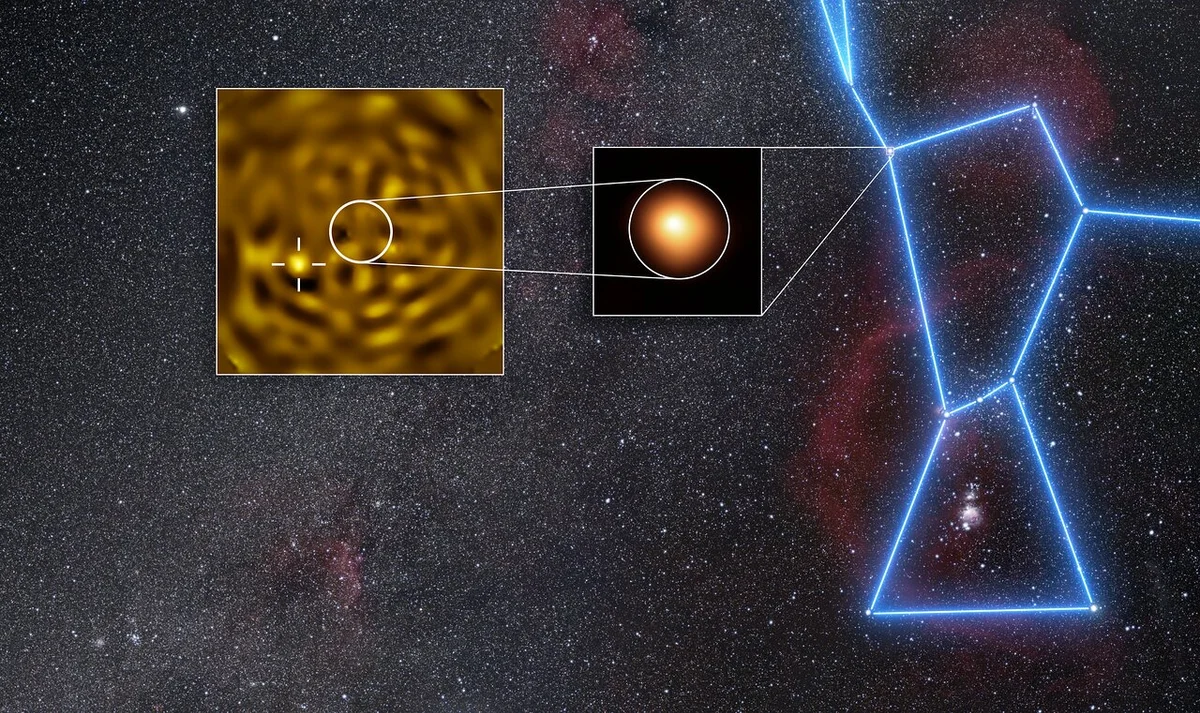
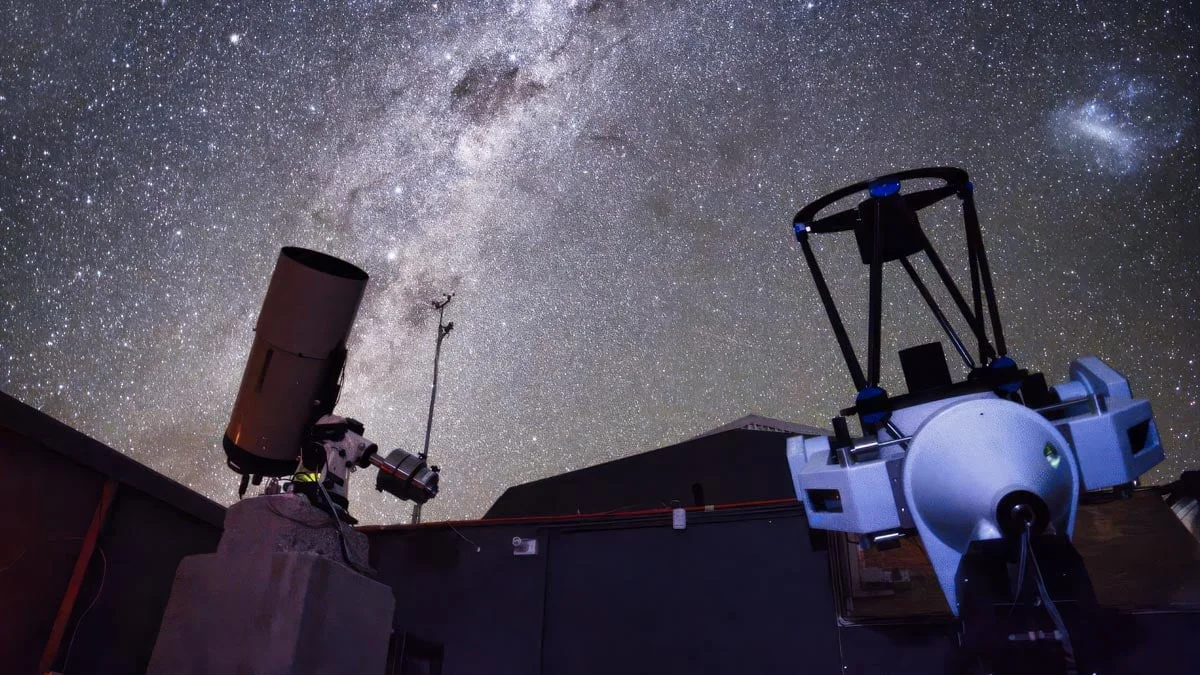
Recent observations using the Very Large Telescope (VLT) have confirmed the existence of a companion star orbiting Betelgeuse, the brightest star in the Orion constellation. This discovery was made possible through the SPHERE instrument, which employs techniques originally developed for exoplanet research.
After decades of speculation, including conflicting reports, the presence of an orbiting star around Betelgeuse has been validated. Astrophysicists Miguel Montargès, Anthony Boccaletti, Olivier Flasseur, and their colleagues successfully captured images of this companion star with a high level of confidence.
Remaining Uncertainties
The companion star is estimated to have a mass between 2.6 and 3.1 times that of the Sun, and it orbits at a distance of approximately 8 astronomical units from Betelgeuse, which is slightly less than the distance from Earth to Saturn. "This is a lower limit," Montargès noted, emphasizing that the exact separation and mass of the companion star are closely tied to our understanding of Betelgeuse itself.
One significant challenge in determining these parameters is the uncertainty surrounding Betelgeuse's distance from Earth. Montargès explained, "It may seem surprising for such a bright star, but we only know that Betelgeuse is located somewhere between 500 and 700 light-years away." This uncertainty arises from the unique characteristics of the supergiant star, which is one of the few stars that allows astronomers to observe its disk, revealing the vast movements on its surface. Consequently, its apparent motion in the sky over six months (parallax) is not as easily detectable as it would be for a point-like object. In astronomy, parallax is the most reliable method for calculating distances to celestial objects, provided they are not too far away.