Possible Exomoon Challenges Existing Definitions
Observations from the Very Large Telescope reveal a moon-like object orbiting a brown dwarf in the CD-35 2722 system, challenging existing definitions of moons and planets.
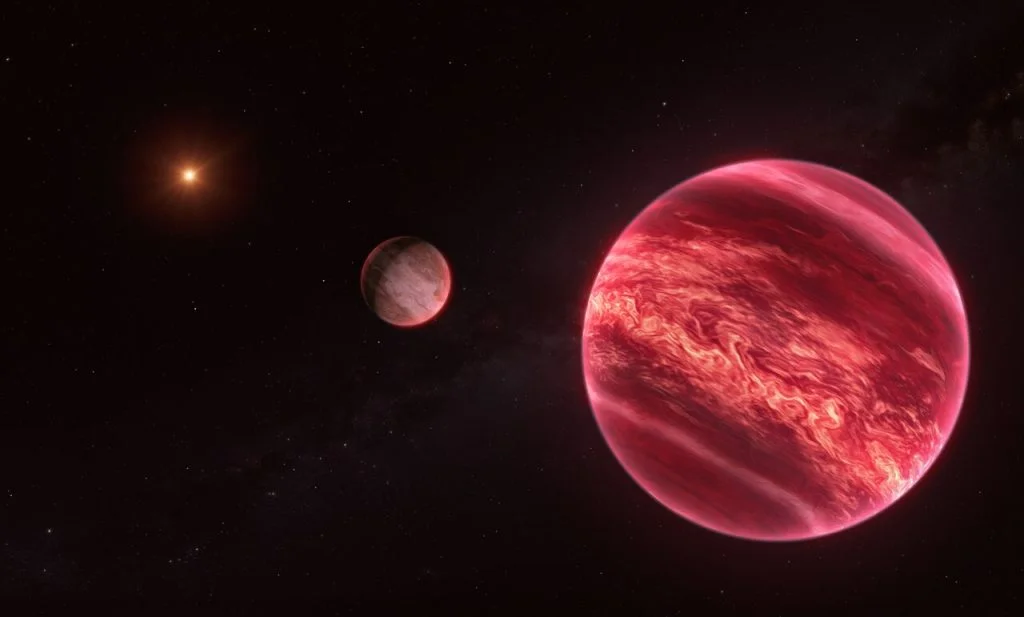
Recent observations using the Very Large Telescope (VLT) of the European Southern Observatory (ESO) have provided intriguing evidence of a moon-like object in the CD-35 2722 system. Unlike moons in our solar system, this newly identified object does not orbit a planet; instead, it revolves around a brown dwarf—a celestial body larger than a planet yet smaller than a star. If confirmed, this discovery could mark the first detection of a moon outside our solar system.
Kevin Hoy, an ESO student in Chile and the lead author of a study published today in Nature, describes the system he has been analyzing for months as "super remarkable" compared to our own. The most massive entity in this young system is the star CD-35 2722, which has about half the mass of the Sun. This star is orbited by a brown dwarf, which is more than 30 times the mass of Jupiter. The newly discovered object, referred to as an exomoon by the research team, has a mass at least that of Jupiter.
"This system is difficult to describe using terms based on our solar system, such as 'planet' and 'moon,'" explains Hoy, who is also affiliated with the Universidad Diego Portales and the Millennium Nucleus of Young Exoplanets and their Moons (YEMS) in Chile. He adds, "The exomoon is clearly massive enough to be classified as a planet. However, it does not orbit a star but rather an object that orbits a star." The classification of this exomoon, or natural satellite outside our solar system, raises questions due to the unique characteristics of its system compared to our own.
Alice Zurlo, director of YEMS and a co-author of the study, elaborates on the complexities of this satellite: "The satellite we describe is a gaseous giant that orbits an extremely massive companion, which itself possesses several times the mass of Jupiter."
Zurlo further explains, "In our solar system, there is a clear distinction between planets and the Sun, making the definition of objects like moons straightforward. In the CD-35 2722 system, where the boundaries between stars, planets, and moons blur, describing the entire system becomes significantly more complicated."
Despite the challenges in naming this object, astronomers have been striving for years to detect satellites beyond our solar system. However, none have been definitively confirmed to date. Among the over 6,000 exoplanets discovered, only a few exomoon candidates have been identified, and the evidence supporting them remains limited. Just a few months ago, a team led by Quentin Kral reported observations from the VLT Interferometer in the HD 206893 system, which suggested the presence of a satellite but did not provide conclusive proof.
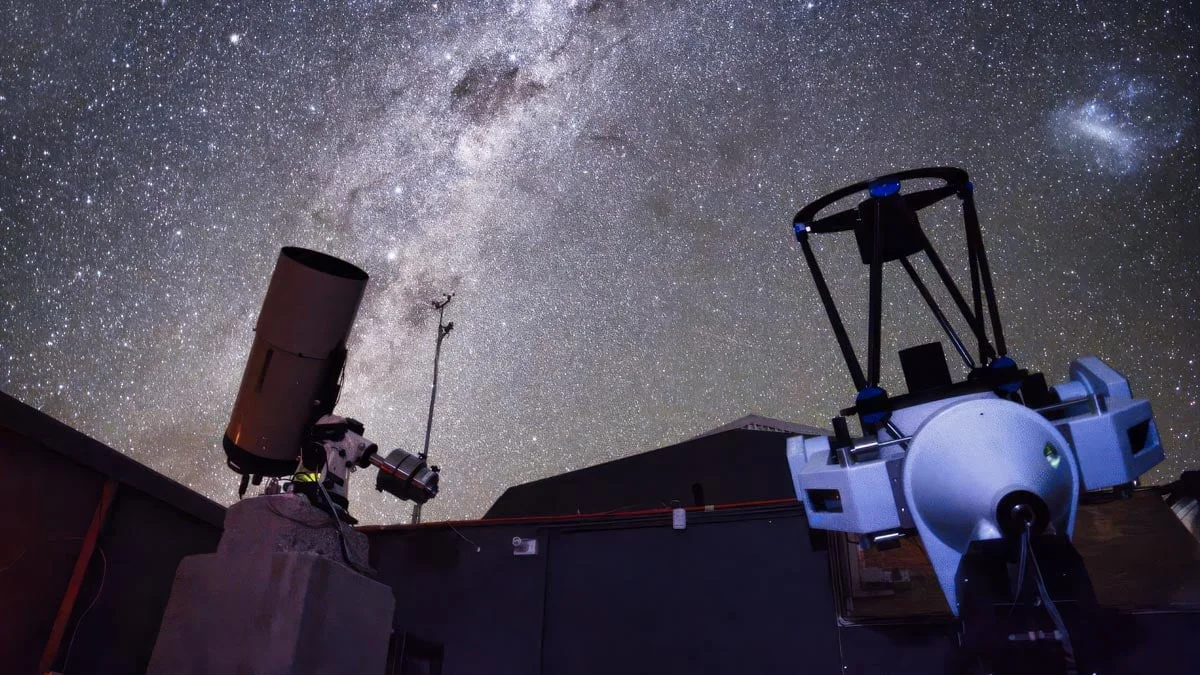
For their observations of CD-35 2722, Hoy, Zurlo, and their team utilized the CRIRES+ instrument at the ESO's VLT. They employed the same radial velocity method that was used to discover the first exoplanet orbiting a sun-like star: they detected minimal wobble movements of the brown dwarf caused by the orbiting object. The team sees this as strong evidence for the existence of this exomoon. "As exotic as it may be, this system is truly unique and represents a breakthrough—the first plausible detection of an exomoon," states Zurlo.
Beyond the excitement of discovering new classes of objects, confirming the existence of satellites in other planetary systems can enhance our understanding of their formation and evolution. The upcoming Extremely Large Telescope (ELT) from ESO, with its 39-meter mirror and advanced instrumentation, will be capable of detecting smaller exomoons. Discoveries made with the ELT will further prompt us to reconsider the classification of planetary objects from systems that differ from our own.
Endnotes
[1] A satellite is an object that orbits another object. It can be of natural origin (like our own Moon) or artificial (like a spacecraft). An exosatellite is a satellite outside our solar system. Generally, an exomoon refers to a natural satellite that orbits a planet or another object outside the solar system, though there is no officially recognized definition for an exomoon.
These research findings were presented in a study titled "Planetary-Mass Exosatellites Detected Around a Star’s Substellar Companion," published in Nature (DOI: 10.1038/s41586-026-10751-w).