NASA's MAVEN Mission Illuminates Martian Auroras
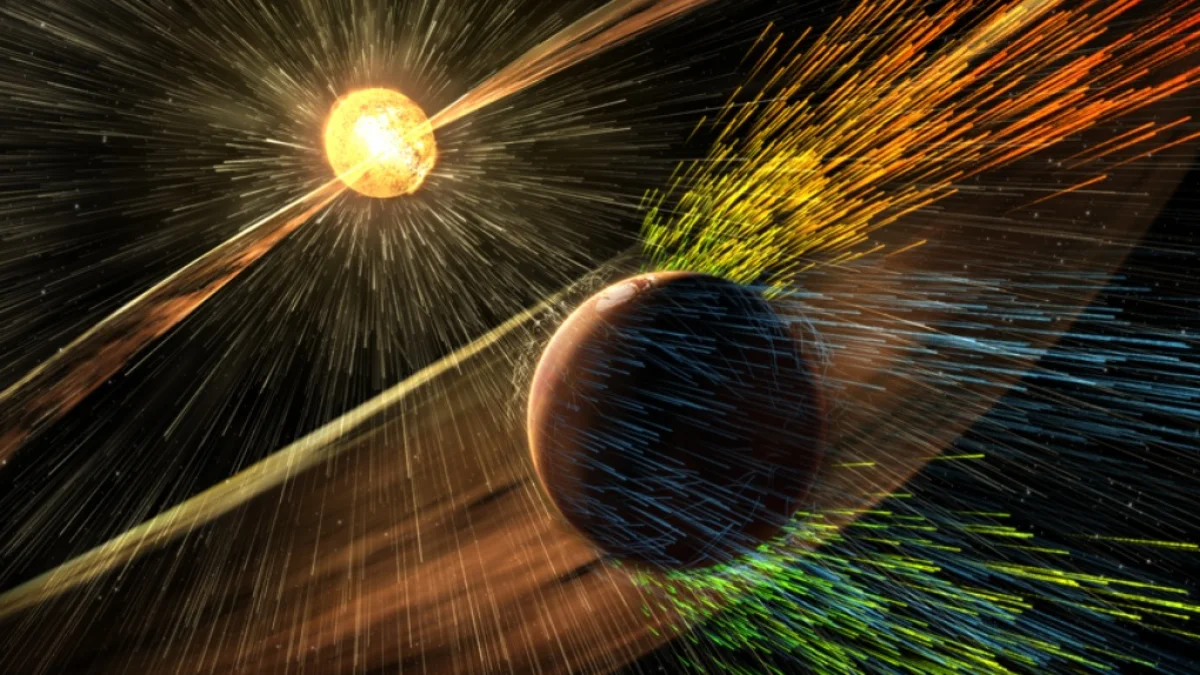
NASA's MAVEN mission reveals the mechanism behind Martian auroras, similar to Earth's Dungey cycle but on a smaller scale, due to the planet's crustal magnetic fields.
NASA's MAVEN Mission Illuminates Martian Auroras
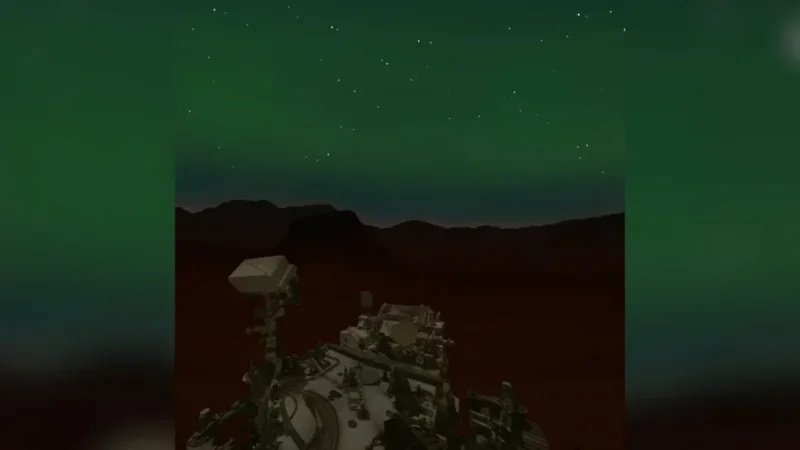
Researchers from NASA's MAVEN (Mars Atmosphere and Volatile Evolution) mission have made significant strides in understanding the mechanisms behind various types of auroras on Mars. Their findings reveal that these auroras form through a process akin to that found on Earth, albeit on a smaller scale due to the differing magnetic fields of the two planets.
A Miniature Dungey Cycle
On Earth, when solar magnetic field lines approach the planet's magnetosphere, they reconnect, injecting energy and mass that ultimately propel electrons into the atmosphere, resulting in auroras. This phenomenon is known as the Dungey cycle, which governs electric currents, particle acceleration, and plasma circulation within Earth's magnetosphere.
The recent study indicates that a reduced version of this cycle occurs above the intense magnetic anomalies found in the Martian crust, offering scientists a deeper understanding of the physical mechanisms that generate auroras on the Red Planet.
Mars' Miniature Magnetospheres
Unlike Earth, Mars lacks a global magnetic field produced by an active core. Instead, the planet features numerous "mini-magnetospheres" created by highly magnetized crustal regions that formed approximately 4 billion years ago when lava cooled in the presence of Mars' ancient global magnetic field, which later dissipated due to atmospheric erosion caused by solar wind.
MAVEN had previously detected localized auroras above these regions, somewhat comparable to polar auroras on Earth, but only now has the full mechanism of their formation been understood. To piece together the complete picture, researchers integrated data from multiple onboard instruments: the magnetometer and the solar wind electron analyzer, which were used to reconstruct the magnetic configuration and calculate electric currents, along with the STATIC instrument, which measured plasma flows in the ionosphere.
A Significant Contribution, Even After the Mission's Conclusion
MAVEN lost contact with ground stations on December 6, 2025, and NASA officially declared the mission concluded last June after confirming that the spacecraft was unrecoverable. However, the data collected over the years remains an invaluable resource for planetary science and for planning future missions to Mars. According to researchers, this discovery is a crucial step in understanding why Earth and Mars, despite being governed by the same fundamental physical laws, have evolved so differently. Gaining insights into how the solar environment interacts with the Red Planet is essential for upcoming robotic missions and human crewed explorations.
Source:
- https://science.nasa.gov/mission/maven/