NASA's Curiosity Rover Captures Stunning 1.8 Billion Pixel View of Mars
NASA's Curiosity rover has captured a stunning 1.8 billion pixel panorama of Mars, showcasing the Glen Torridon region near Mount Sharp, with insights into the planet's characteristics.
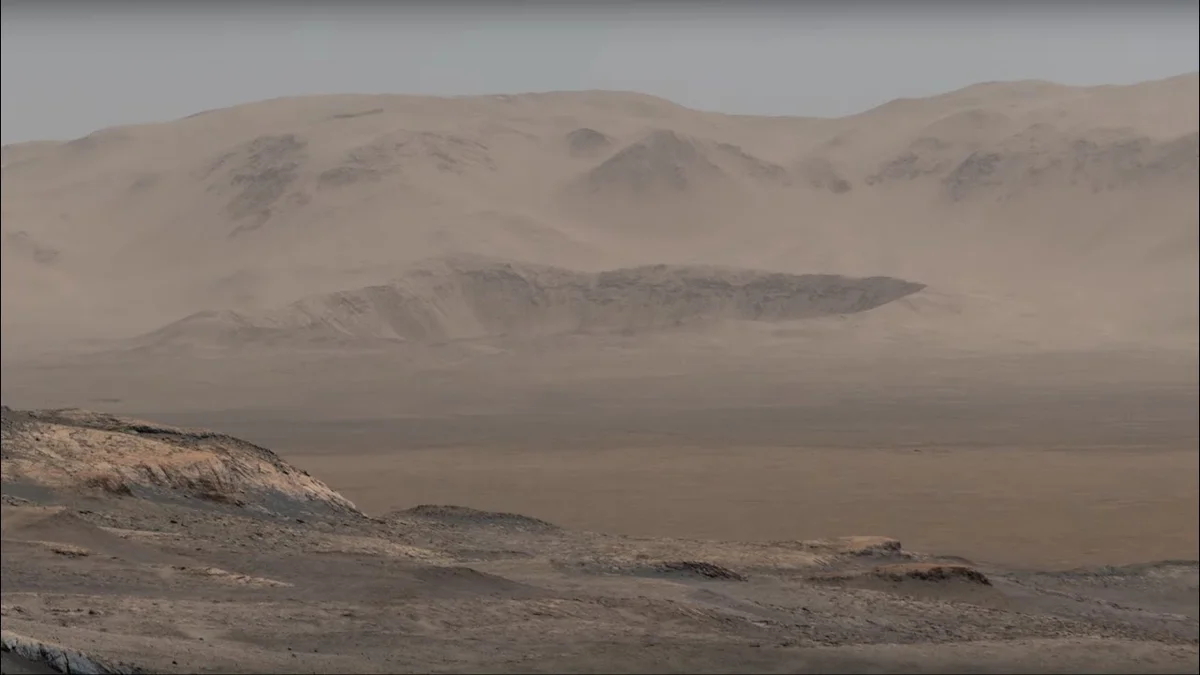
NASA's Curiosity Rover Captures Stunning 1.8 Billion Pixel View of Mars
Since its arrival on the surface of the Red Planet in 2012, NASA's Curiosity rover has continued to amaze us with its incredible images and scientific data. Its latest achievement surpasses previous efforts: a breathtaking panorama created from over a thousand individual photographs, resulting in a detailed image that boasts more than 1.8 billion pixels. These images were captured between November and December 2019, during a four-day period when the rover took photographs from noon to 2 PM. This remarkable view showcases the Glen Torridon region, located near Mount Sharp, named after the Scottish Highlands.
Insights into the Red Planet
Mars, with an average radius of 3,390 kilometers, is approximately half the size of Earth. The Red Planet orbits the Sun at an average distance of 228 million kilometers, which is equivalent to 1.5 astronomical units (AU)—with one AU being the distance from Earth to the Sun, or about 150 million kilometers. A single rotation of Mars takes about 24.6 hours, closely resembling a day on Earth (23.9 hours). The Martian days, referred to as sols, last for this duration, while a Martian year spans 669.6 sols, roughly translating to 687 Earth days. Mars has an axial tilt of 25 degrees relative to its orbital plane around the Sun, which is similar to Earth's axial tilt of 23.4 degrees. This axial tilt gives rise to distinct seasons on Mars, which last longer than those on Earth due to the planet's longer orbital period and elliptical, egg-shaped orbit. The ongoing missions exploring Mars promise to reveal even more exciting discoveries about this fascinating planet.