K2-18b: A New Frontier in the Search for Extraterrestrial Life
Exploring K2-18b, a potential candidate for extraterrestrial life, its characteristics, the Hycean hypothesis, and the significance of dimethyl sulfide in astrobiology.
1564 23/04/2025 22/04/2025
Astrobiology Planetary Atmospheres Exoplanets
In this article
- The Quest for Life Beyond Earth
- Characterizing K2-18b
- The Hycean World Hypothesis
- The Significance of Dimethyl Sulfide
- The Distance to Certainty
- Navigating Headlines and Hypotheses
- Looking Ahead to the Future of Astrobiology
The Quest for Life Beyond Earth
The ultimate goal of astronomical research may well be the proof that we are not alone in the universe. This profound question has captivated humanity for centuries. In recent years, the discovery of thousands of exoplanets beyond our Solar System has shifted this inquiry from a philosophical debate to a scientific endeavor. Among these distant worlds, K2-18b has recently emerged as a focal point of intense scientific interest and public fascination. Located approximately 124 light-years away in the constellation Leo, this planet has sparked hopes for its potential habitability, particularly following the possible detection of a molecule called dimethyl sulfide (DMS), which is primarily associated with life on Earth.
However, K2-18b's story exemplifies the complex and nuanced reality of the search for extraterrestrial life. There exists a significant gap between the promising but uncertain hints suggested by observations and the rigorous scientific proof required to confirm the presence of life. This article aims to explore K2-18b in detail: its known characteristics, the hypothesis of it being a Hycean world, the controversial detection of DMS, the reasons behind scientific skepticism, and the often misleading role of media communication. We will analyze how current data paints a scenario of possibility—of non-exclusion of life—rather than confirmed presence, highlighting the intrinsic challenges and current limitations in asserting the existence of life on distant planets.
The term habitable zone, where K2-18b resides, although scientifically defined in relation to the potential for liquid water, carries a strong narrative charge. It evokes in the collective imagination Earth-like conditions, fueling interest but also potential oversimplifications. Thus, it is crucial to frame this concept accurately from the outset, distinguishing it from the real and perhaps very alien nature of K2-18b.
Characterizing K2-18b
Before making hypotheses, let’s take a closer look at the planet that has garnered so much attention.
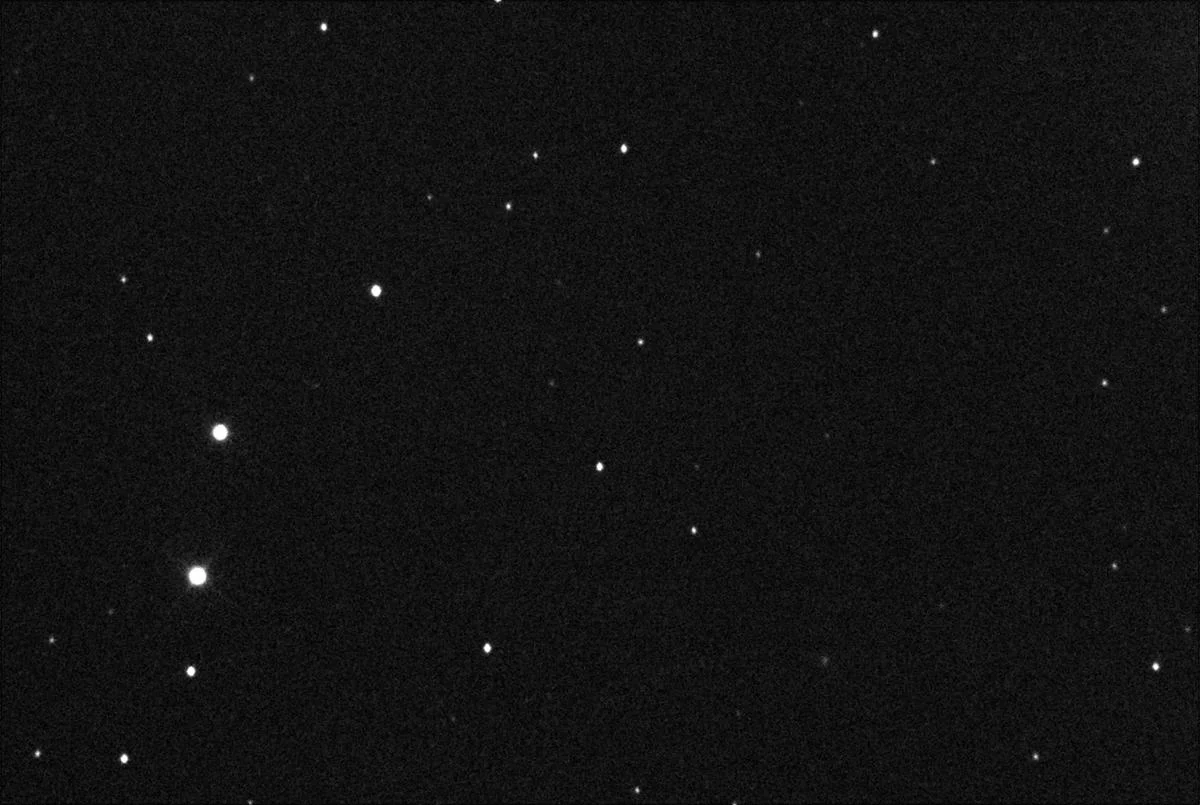
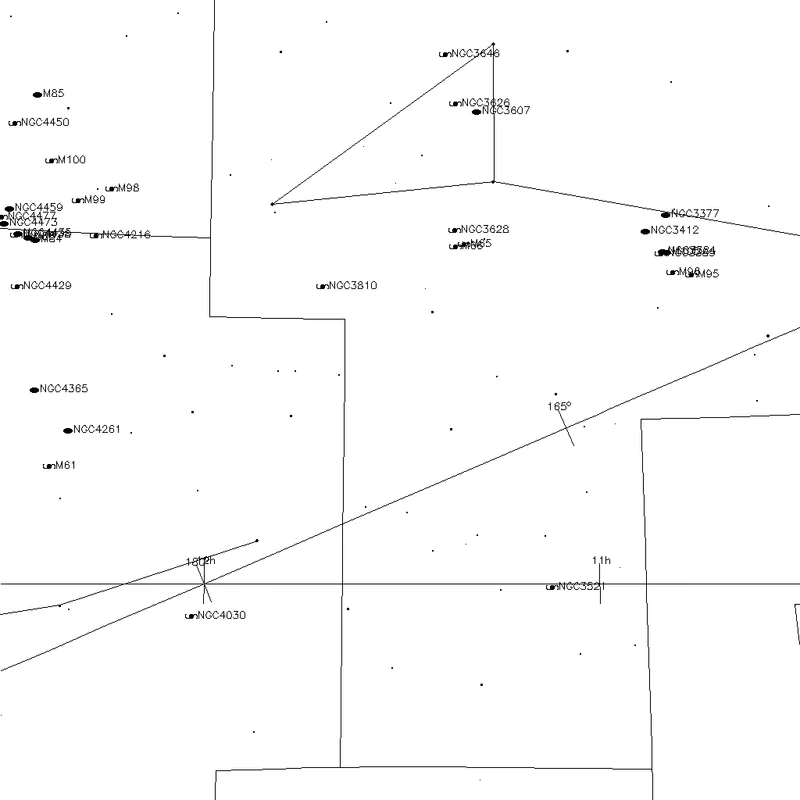 K2-18b was discovered in 2015 through NASA's extended Kepler mission (K2), orbiting a star of type M, K2-18, located about 120-124 light-years from Earth in the constellation Leo (at the center of the image on the right). The designation “b” follows the astronomical convention of assigning this letter to the first planet discovered in an exoplanetary system to avoid confusion with the star itself. Indeed, the system also contains a planet designated as “c.”
Physical and Orbital Characteristics
K2-18b's physical and orbital properties place it in a particularly interesting and poorly understood category of planets. With an estimated mass between 8.6 and 8.92 times that of Earth and a radius of approximately 2.37 to 2.6 times that of Earth, its corresponding average density is estimated to be around 2.7 g/cm³, which is less than half that of Earth (approximately 5.5 g/cm³).
This low value is a key indicator: it excludes a purely rocky composition similar to Earth and strongly suggests the presence of a significant envelope of volatile materials, such as extensive layers of light gases (hydrogen, helium) or deep layers of water and ice. This fundamental characteristic distinguishes it from terrestrial planets in our Solar System and moderates simplistic analogies with Earth.
Planets of these characteristics are variously defined as “Super-Earths” or, more frequently given its density and size, as “Mini-Neptunes.” It is important to emphasize that planets of this intermediate size between Earth and Neptune are common in the galaxy but absent in our Solar System, making them fascinating yet enigmatic subjects of study. Its size places it above the so-called “radius valley,” an area observed around 1.5-2 Earth radii where exoplanets are statistically less common. Being located above this valley suggests that K2-18b has likely retained a substantial atmosphere of hydrogen and helium since its formation, reinforcing its classification as a Mini-Neptune rather than a large rocky planet with a secondary atmosphere.
Orbit and Temperature
K2-18b completes an orbit around its red dwarf star in about 33 days, at a distance of approximately 0.14-0.15 Astronomical Units (AU). It receives a comparable amount of stellar radiation (insolation) to that of Earth (about 1.28 times that of Earth according to some estimates), placing it within the habitable zone of its star. Its equilibrium temperature is estimated to be around -2 °C (28 °F), but the actual surface temperature critically depends on the properties of its atmosphere, particularly the presence and extent of any greenhouse effect.
To better understand K2-18b’s peculiarities, it is useful to compare its key parameters with those of Earth and Neptune.
| Parameter | K2-18b | Earth | Neptune | |-------------------------------|----------------|-------|---------| | Mass (Earth=1) | ~8.6 - 8.9 | 1 | ~17.1 | | Radius (Earth=1) | ~2.4 - 2.6 | 1 | ~3.9 | | Density (g/cm³) | ~2.7 (calculated) | ~5.5 | ~1.6 | | Orbital Period (days) | ~32.9 | 365.25| ~60,190 | | Distance from Star (AU) | ~0.14 - 0.15 | 1 | ~30.1 | | Insolation (Earth=1) | ~1.0 - 1.3 | 1 | ~0.001 | | Proposed Planet Type | Super-Earth / Mini-Neptune / Hycean | Rocky | Ice Giant |
This table highlights K2-18b’s intermediate nature. It is significantly more massive and larger than Earth, but smaller and less massive than Neptune. Its density, closer to that of Neptune than Earth, is the element that most suggests a non-terrestrial composition, dominated by volatile elements.
The Hycean World Hypothesis
Given the data at hand, one intriguing possibility is that of a Hycean world.
The enigma surrounding K2-18b has led to the formulation of a fascinating hypothesis: that of “Hycean” worlds (a blend of the English words “hydrogen” and “ocean”). Coined in 2021 by a team led by Nikku Madhusudhan from the University of Cambridge, this term describes a hypothetical class of planets larger than Earth but smaller than Neptune, characterized by global oceans of liquid water beneath hydrogen-rich atmospheres.
K2-18b has quickly become the “primary candidate” for this planetary category, primarily based on analyses conducted with the James Webb Space Telescope (JWST). Initial observations using the NIRISS and NIRSpec instruments in the near-infrared revealed the presence of carbon-containing molecules, particularly methane (CH4) and carbon dioxide (CO2). This marked the first detection of such molecules in the atmosphere of an exoplanet located in the habitable zone.
A crucial element supporting the Hycean hypothesis has been the lack of detectable ammonia (NH3). Ammonia is a molecule one would expect to find abundantly in the deep atmosphere of a hydrogen-rich planet like a mini-Neptune. Its apparent scarcity in the atmospheric layers probed by JWST is interpreted by proponents of the Hycean model as an indication of the presence of a vast underlying ocean. Ammonia is indeed highly soluble in water, and a global ocean could serve as a “reservoir,” effectively removing it from the observable upper atmosphere. In this context, the absence of an expected signal (ammonia) becomes indirect evidence in favor of the presence of an ocean of water.
The situation regarding water vapor (H2O) is more complex and debated. Previous observations with the Hubble Space Telescope had suggested the presence of water vapor, but subsequent analyses based on JWST data have cast doubt on this interpretation, suggesting that the signal could be due to overlap with methane absorption bands. Some sources still mention the possible presence of water, while others emphasize its absence or low concentration in the upper atmosphere, possibly due to a “cold trap” mechanism that would condense it at lower altitudes. This uncertainty regarding water vapor remains an open point.
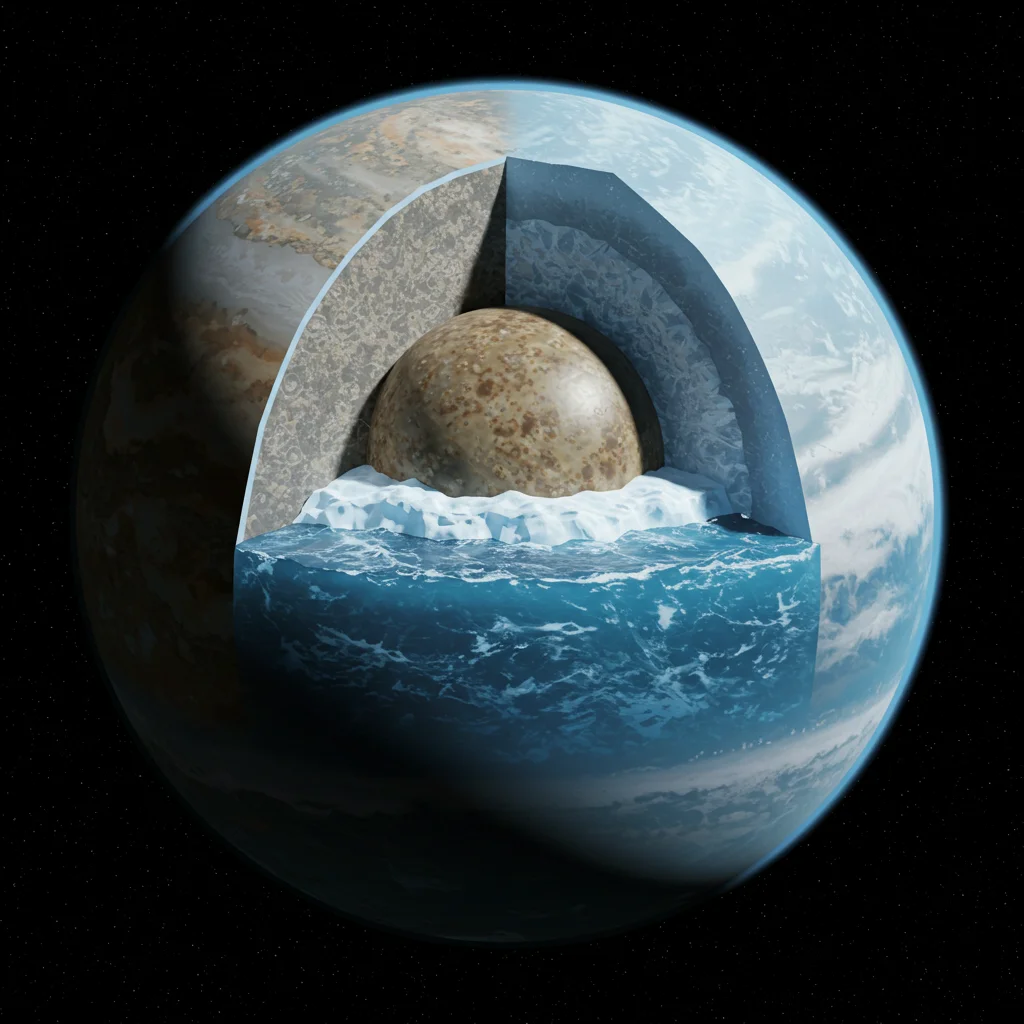
If K2-18b were indeed a Hycean world, its internal structure would likely consist of a rocky core, overlaid by a high-pressure ice mantle (similar to that of Neptune), topped by a global ocean of liquid water, and finally, a relatively thin yet hydrogen-rich atmosphere.
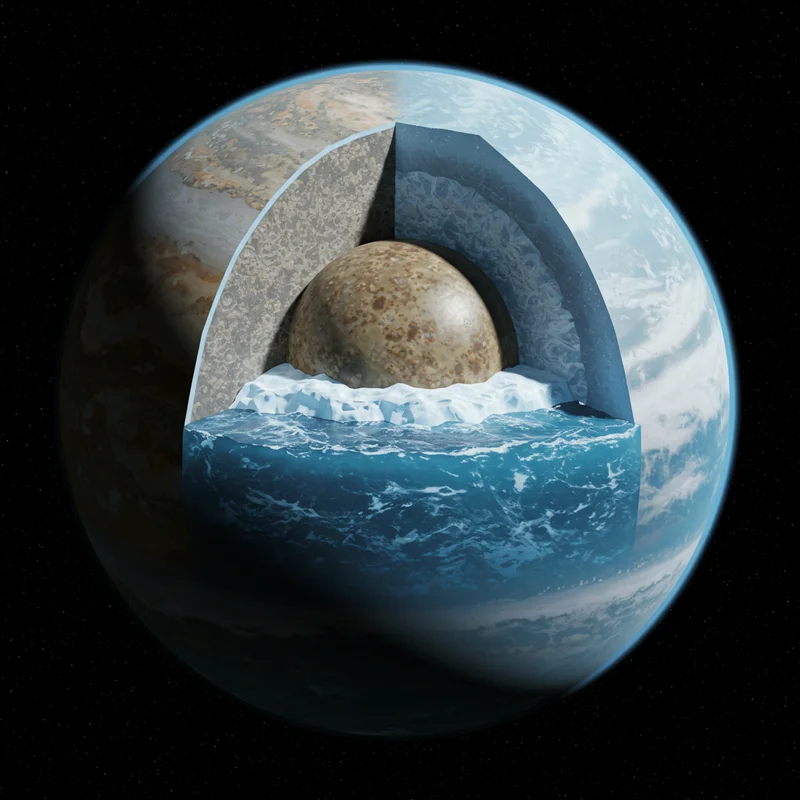 Artistic image of what K2-18b's structure might look like: the frontal zone shows a rocky core, an ice layer, and coverage by a global ocean. In transparency, the thin atmospheric layer.
It is essential to recognize that the interpretation of K2-18b's atmospheric data (presence of methane and carbon dioxide, absence of ammonia) as evidence of a Hycean world heavily depends on the predictions of the Hycean model itself.
Observational data “fits” the model because the model was built, in part, to explain precisely this type of atmospheric composition in the presence of an ocean. This creates a dynamic where the interpretation is intrinsically linked to the validity and uniqueness of the proposed theoretical model. Thus, the strength of the Hycean hypothesis is closely tied to the model’s ability to explain the data more convincingly than alternative models.
The Significance of Dimethyl Sulfide
The detection of one particular molecule has propelled K2-18b into the spotlight of scientific and media attention.
The element that has catapulted K2-18b into the center of media and scientific focus is the possible detection of dimethyl sulfide (DMS) and its chemical relative, dimethyldisulfide (DMDS), in its atmosphere.
On Earth, DMS (CH3SCH3) is a pungent-smelling molecule associated with the “smell of the sea,” produced almost exclusively by biological processes, mainly from marine phytoplankton and other bacteria during the decomposition of organic matter. Due to this strong association with life on Earth, DMS has long been proposed as a potential “biosignature,” a chemical indicator of biological activity on other planets.
The story of the detection of DMS on K2-18b began in 2023, when, alongside confirmed detections of methane and carbon dioxide through JWST’s NIRISS and NIRSpec instruments (operating in the near-infrared, the results generated excitement in the astrobiology community.
However, while the detection of DMS has generated enthusiasm, it has also drawn skepticism. Some scientists caution that the presence of DMS does not definitively indicate life, as it can also be produced through abiotic processes. This underscores the complexity of interpreting atmospheric data from distant worlds and the necessity for further observations to clarify the conditions on K2-18b.
The Distance to Certainty
Despite the intriguing possibilities presented by K2-18b, the certainty of life remains elusive. The scientific community continues to grapple with the implications of the findings and the potential for future missions that might provide clearer insights into the planet’s atmosphere and conditions.
In conclusion, while K2-18b stands as a promising candidate in the search for extraterrestrial life, the journey from hypothesis to confirmation is fraught with challenges. The ongoing exploration of this fascinating world will undoubtedly contribute to our understanding of life beyond Earth and the diverse environments that may host it.
Navigating Headlines and Hypotheses
As the excitement surrounding K2-18b grows, it is essential to navigate the media landscape critically. Headlines can often oversimplify complex scientific discussions, leading to misconceptions about the findings. A nuanced understanding of the research is vital for appreciating the implications of discoveries in astrobiology.
Looking Ahead to the Future of Astrobiology
The exploration of K2-18b and similar exoplanets marks a significant chapter in the quest to uncover the mysteries of the universe. As technology advances and our observational capabilities improve, the potential to discover life beyond Earth becomes increasingly tangible, igniting hope and curiosity about our place in the cosmos.