
Exploring the Zodiac: A New Exhibition at Berlin's Neues Museum
The Neues Museum in Berlin opens a new exhibition on the origins of the Zodiac, exploring its astronomical roots and cultural significance from March 21, 2026, to January 10, 2027.
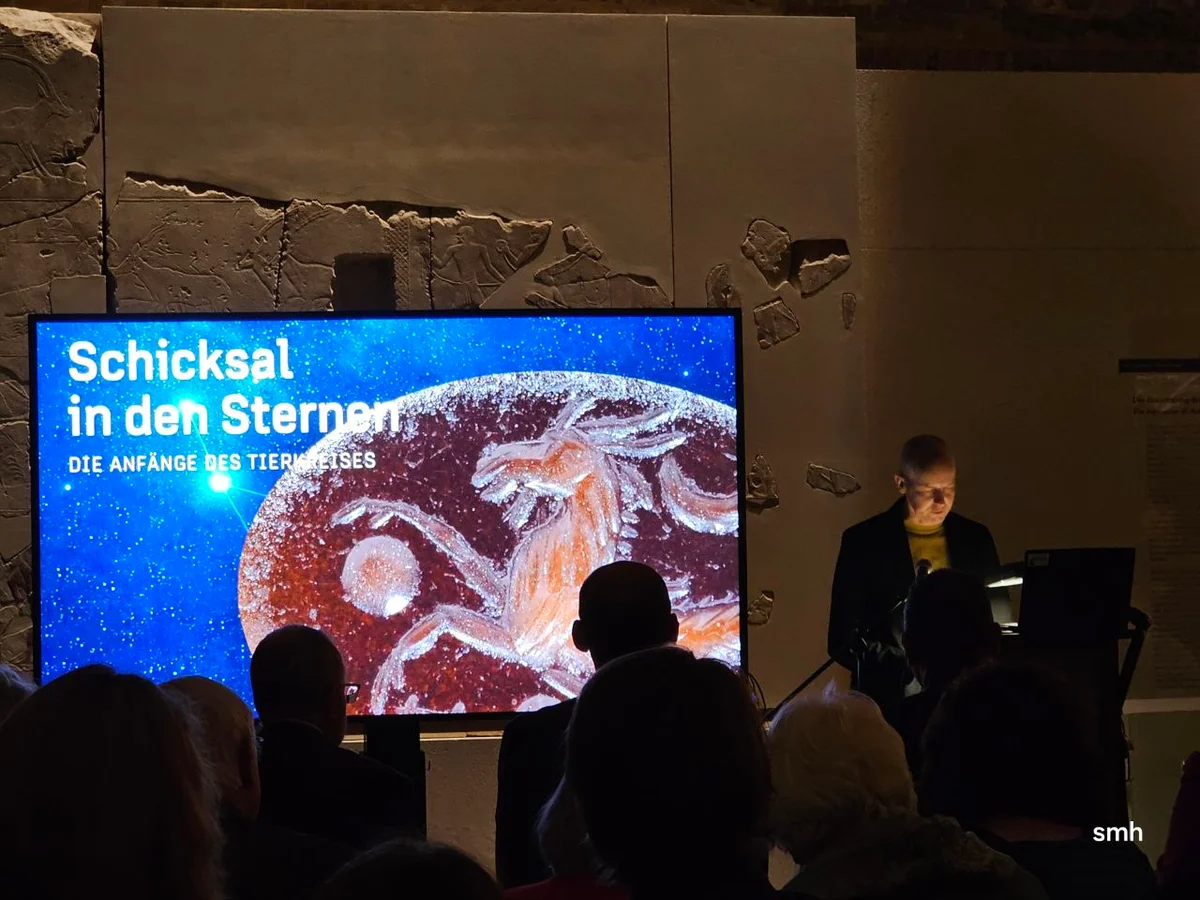
On the evening of March 20, coinciding with the vernal equinox, Berlin's Neues Museum unveiled a temporary exhibition titled "Das Schicksal in den Sternen – über die Anfänge des Tierkreises". This exhibition will be open to the public from March 21, 2026, to January 10, 2027, and will feature a series of monthly expert lectures (details available on the museum's website under "Für Erwachsene").
The opening attracted guests from various continents, including Africa (Egypt), America (USA), Asia (China), and Austronesia (Australia and Indonesia). The phrase "Ich bin ein(e) Berliner(in)" resonates with a sense of global openness and freedom, a sentiment that contrasts with the historical context of the Cold War.
The Origins of the Zodiac
The origins of the Zodiac pertain to an astronomical coordinate system rather than the fate predictions many associate with it today. The modern interpretation of astrology is a relatively recent addition to the ancient concept of the Zodiac, which originally served as seasonal weather calendars. Thus, the origins of the Zodiac are primarily observable "calendars in the stars."
What makes this abstract, non-observable, purely mathematical construct appealing enough to attract an international audience in Berlin? It is the captivating imagery: the stars themselves and the projections of human form recognition.
The exhibition emphasizes historical representations of Zodiac figures. For instance, a Babylonian Capricorn depicted on a Roman gem is featured on the promotional poster for the exhibition. Display cases include papyri, clay tablets, and coins that chronicle the evolution of the Zodiac from a mathematical concept to a cultural phenomenon, rapidly embraced in neighboring Eurasian cultures shortly after its invention in Babylon around 400 BCE. Artifacts such as the first known horoscope (on a 1st-century papyrus), Zodiac representations in Roman-era Egyptian temples, and mathematical tables for planetary movements showcase this development.

The Zodiac stands as one of the earliest examples of the visual appeal and pop culture potential of mathematics.
Notably, Dr. Hisham El-Leithy, Secretary General of the Supreme Council of Antiquities in Cairo, attended the exhibition's opening to welcome international guests.
A highlight of the exhibition is a meticulously restored 14-meter-long panoramic image of the Zodiac from Esna, created by a German-Egyptian team in Egypt.
Prof. Dr. Dr. Mathieu Ossendrijver, the lead researcher of the ERC-funded ZODIAC project at FU Berlin, explained the circular Zodiac from Dendera to Egyptian guests, noting the existence of a square version as well.
The curatorial team takes pride in the fact that all exhibited artifacts originate from Berlin's own collections. This showcases the long-standing excellence in research on ancient history in Berlin. The city has previously reconstructed the Ishtar Gate of Babylon and houses the famed bust of Nefertiti, underscoring its position at the forefront of ancient studies.
A Piece of the Sky
The exhibition's colors—blue and sand—symbolically blend sky and earth, bringing a piece of the heavens down to earth. This theme resonates with the numerous depictions of Zodiac motifs on coins, plates, and everyday objects, reflecting humanity's historical desire to claim a fragment of the sky.
The Zodiac is experiencing a resurgence as a transcultural phenomenon, often serving as a substitute or complement to other religions, particularly in times of crisis. As the world grapples with ongoing challenges, people instinctively seek comfort in something as intangible as the roots of these crises.
Astrology, in essence, can be viewed as a type of religion.
Conclusion
While amateur astronomers may raise objections regarding the association of the Zodiac with astrology, it is essential to recognize that the historical context of the Zodiac's development is rooted in a quest for understanding and prediction. As a historian of natural sciences, I explore the beginnings of modern scientific thought without conflating it with contemporary astrology. The distinctions drawn today often arise from narrow perspectives.
The Zodiac's mathematical underpinnings, such as those introduced by Ptolemy in his 135 CE star catalog, demonstrate its enduring relevance. Not everything associated with the Zodiac is astrology, and the historical exploration of these themes should not be viewed negatively—much like the study of other religions.
Enjoy the exhibition!