Exploring Jupiter's Atmosphere: Observations and Insights
An exploration of Jupiter's atmospheric dynamics through a series of observations, detailing the behavior of the Great Red Spot and other features over time.
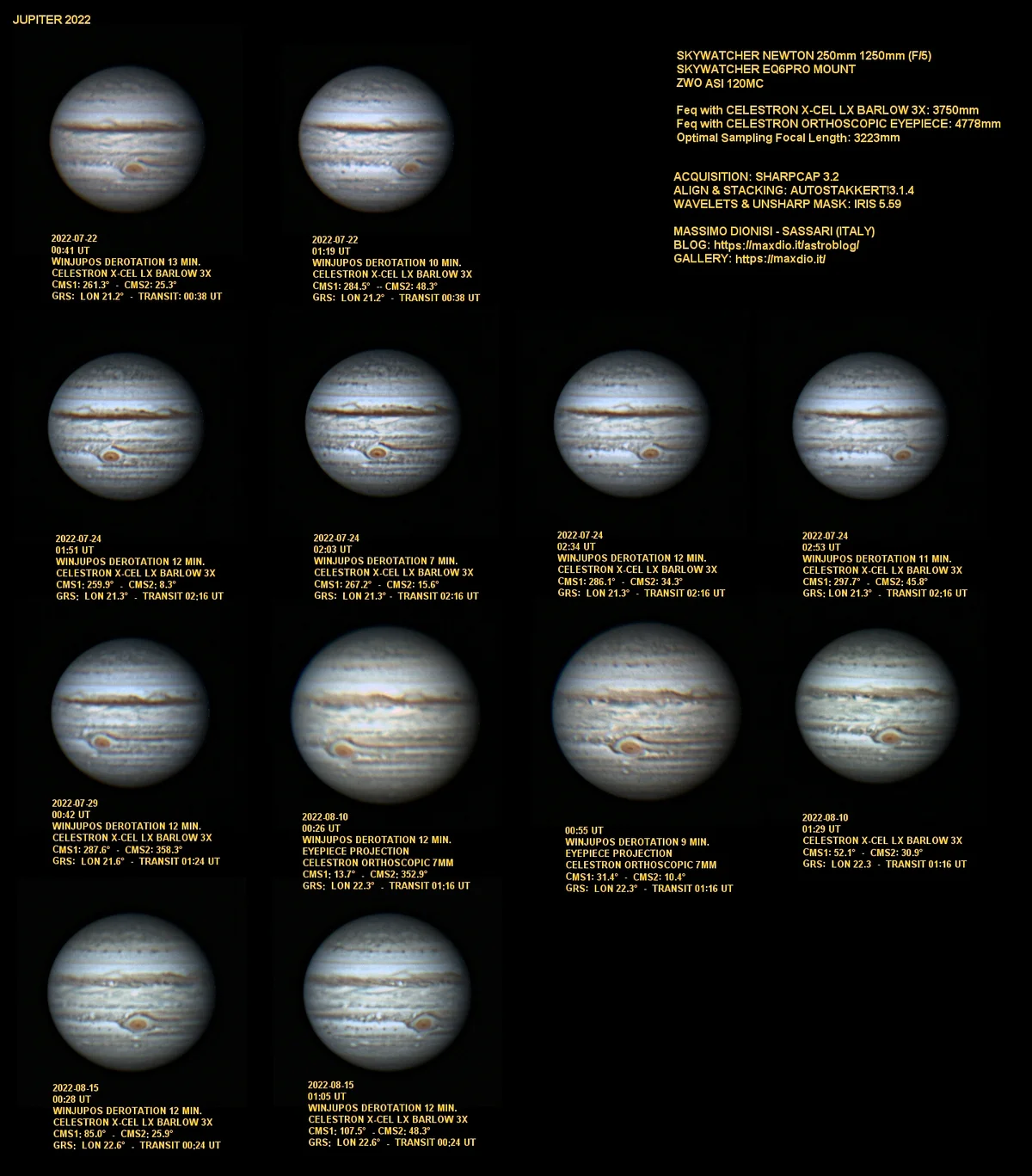
Sassari, August 19, 2022.
Greetings and happy weekend to all,
Recent weather conditions in Sassari and northern Sardinia have posed challenges for astronomy enthusiasts, prompting me to delve into the analysis of images and data collected thus far. One aspect I have always wanted to showcase is the dynamic behavior of Jupiter's atmosphere, particularly how its cloud structures, storms, and anticyclones change over short periods.
I have compiled a single image containing 12 captures of the giant planet, taken with my 250mm f/5 Newtonian telescope and ASI 120MC camera. Each image includes a brief description, detailing the observation moment and the longitudes passing through the center of the planet's disk, along with the longitude of the Great Red Spot (GRS).
As a gas giant, Jupiter lacks physical landmarks, such as those found on Mars or Earth, to establish a reference longitude. Therefore, the longitudes on Jupiter must be calculated from a predetermined zero longitude that passes through the disk's center, known as the Central Meridian (CM). From this point, the planet's rotation period is utilized to determine which longitude is at the Central Meridian and to track some relatively stable atmospheric features, such as the Great Red Spot and the White Oval Spots.
Even the Great Red Spot exhibits its own movement; in addition to being carried along by the planet's rotation, it also drifts in the opposite direction. This motion is gradual—consider that between the first observation date captured in the image (July 22) and the last (August 15), the Great Red Spot only shifted in longitude by 1.4° (from 21.2° to 22.6°).
Jupiter does not rotate as a solid body, leading to variations in rotation speed depending on latitude. At the equator, the planet completes a rotation in 9 hours, 50 minutes, and 30 seconds, while in the northern and southern temperate zones, the rotation period is slightly longer, at 9 hours, 55 minutes, and 40 seconds. Although this difference may seem minor, it significantly impacts observational data.
To account for these variations, two systems of longitude have been established (similar systems exist for other gas giants like Saturn): System 1 covers the area from the center of the North Equatorial Belt (NEB) to the center of the South Equatorial Belt (SEB), while System 2 pertains to all other latitudes on the planet. For completeness, there is also a System 3, which refers to Jupiter's inner regions and is measured via radio waves, thus not directly relevant for visual observers.
The visible notes accompanying each image provide this data, and I hope they are comprehensible even to those not deeply versed in astronomy. It is worth noting that I have only presented images of Jupiter featuring the Great Red Spot. This choice was made to provide clear reference points and to illustrate the atmospheric variations I mentioned earlier. The structures surrounding the Great Red Spot and, more broadly, the South Equatorial Belt, are particularly intriguing due to the atmospheric interactions occurring between the Spot and other formations.