Ancient Astronomy: A Glimpse into Early Cosmic Understanding
Explore the rich history of ancient astronomy, from early agricultural practices to celestial navigation, across various civilizations including the Egyptians, Greeks, Chinese, Maya, and Incas.
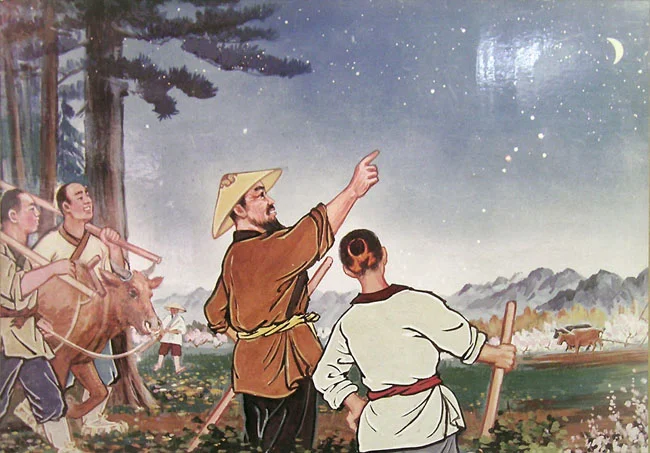
From the dawn of civilization, humanity has been captivated by the mysteries of the cosmos. This fascination is evident in the astronomical practices of ancient cultures, which laid the groundwork for our understanding of celestial phenomena.
Astronomy in Ancient Civilizations
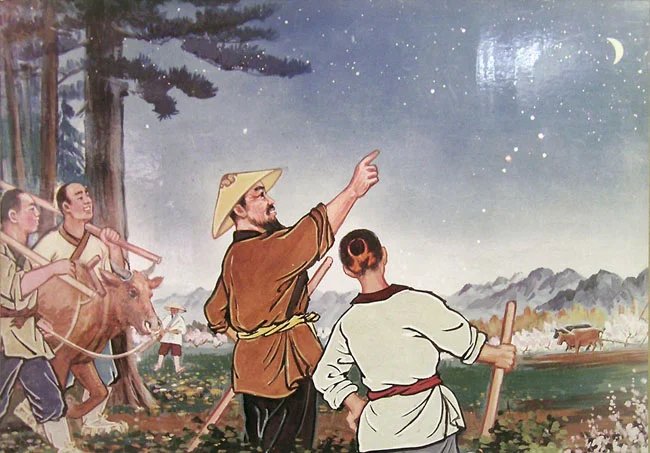
Primitive societies utilized astronomy to determine the best times for planting and harvesting crops, as well as for navigation during travels. The Sun, which delineated day from night, rose each morning in the East, traversed the sky, and set in the West. Observers noted that the duration of day and night varied throughout the year, with longer days occurring when the Sun rose further North and reached higher altitudes at noon. Conversely, during shorter days, the Sun rose in the South and did not ascend as high. This knowledge of the cyclical movements of the Sun, Moon, and stars proved vital for predicting seasonal changes essential for survival. The alternation of day and night was likely one of the first universal time units recognized by humankind.
Ancient astronomers recognized that the Sun followed an annual path across the celestial sphere, part of which is depicted in an image showing a blue band. They associated specific dates with constellations within this narrow belt, known as the zodiac. The second-century astronomer Ptolemy named the twelve zodiac signs: Aries, Taurus, Gemini, Cancer, Leo, Virgo, Libra, Scorpio, Sagittarius, Capricorn, Aquarius, and Pisces, although the Babylonians had previously established these names. The Sun's passage through the zodiac constellations occurs on dates differing from traditional markers. The ancient peoples' curiosity about celestial bodies led them to conclude that these objects moved in a regular manner, which was useful for defining time and navigation. Astronomy addressed the needs of early civilizations to accurately determine the timing of agricultural activities and celebrations, as well as to navigate long trade routes and journeys.
The Sun and Moon consistently traverse the zodiac from West to East. In contrast, the five bright planets—Mercury, Mars, Venus, Jupiter, and Saturn—also move Eastward against the backdrop of stars but exhibit retrograde motion toward the West, occurring at varying durations. This irregular movement of planets, characterized by periodic curves in their paths, led to the belief that celestial events, particularly planetary motions, were connected to human destiny. This belief, known as astrology, spurred the development of mathematical models to predict planetary movements and advanced the field of astronomy in ancient times.
Egyptian Astronomy
The Egyptians observed that stars completed a full cycle in just over 365 days. This solar cycle aligned with the seasons, and by 2500 B.C., they had developed a calendar based on this cycle, indicating systematic astronomical observation since the fourth millennium. The Egyptian civil year comprised 12 months of 30 days, plus five additional days known as epagomenal days. This resulted in a discrepancy of a quarter day per year, leading to a month being added every 120 years, ensuring that the civil and astronomical years would align after 1456 years. The Nile's annual flooding coincided with the visibility of the star Sothis (Sirius) just before sunrise, marking the start of the agricultural season. The Egyptian calendar divided the year into three seasons of four months each.
The orientation of temples and pyramids further illustrates the Egyptians' astronomical knowledge. Structures like the Great Pyramid of Giza were aligned with the North Star, enabling them to determine the onset of seasons based on the pyramid's shadow. They also utilized stars for navigation. Herodotus noted, "the Egyptians were the first of all men to discover the year, claiming it was derived from the stars." Their keen observations of celestial movements led to the creation of both lunar and civil calendars, influencing later systems such as the Julian and Gregorian calendars.
Greek Astronomy
In Greece, the foundations of what we now recognize as Western astronomy began to take shape. Astronomical observations primarily aimed to guide agricultural practices, prompting the development of a practical calendar for these activities. Homer's Odyssey mentions constellations like Ursa Major and Orion, illustrating how stars served as navigational aids. Although the tale of Thales predicting a solar eclipse on May 28, 585 B.C. is likely apocryphal, Filolaus (5th century B.C.), a disciple of Pythagoras, proposed that the Earth, Sun, Moon, and planets revolved around a central fire obscured by a 'counter-Earth.' This theory posited that the Earth's rotation every 24 hours accounted for the daily movements of the Sun and stars.
The most innovative ancient observer was Aristarchus of Samos, who suggested that celestial movements could be explained by the Earth rotating on its axis once every 24 hours and orbiting the Sun along with other planets. This heliocentric view was largely dismissed by Greek philosophers for nearly two millennia, favoring the geocentric model, which maintained that:
- Planets, the Sun, Moon, and stars move in perfect circular orbits.
- Their speeds are uniform.
- The Earth occupies the center of celestial motions.
Under these principles, Eudoxus (408 - 355 B.C.) envisioned the universe as a collection of 27 concentric spheres surrounding the Earth, which was also considered spherical. Plato and his student Aristotle (384 - 322 B.C.) expanded upon Eudoxus's model, adding at least fifty-five spheres, with Earth remaining stationary at the center.
Chinese Astronomy
Little is known about ancient Chinese astronomy. The Chinese viewed the universe as an orange suspended from the North Star, dividing their 284 constellations into 28 segments or houses. Their astronomical framework diverged significantly from Babylonian and Western models. The work Calendario de tres ciclos, attributed to Lió Hsin, chronicles Chinese astronomy from the third millennium. Imperial court astronomers documented extraordinary celestial phenomena, preserving records that allow researchers to verify the appearance of new stars, comets, and more. The unfortunate astronomers Hsi and Ho were executed for failing to predict a solar eclipse, highlighting the serious implications of their observations.
Subsequent models were developed to explain the Sun's passage across the horizon. The Kai t'ien model depicted the sky and Earth as concentric hemispheres, with the Earth's radius set at 60,000 li. However, this complex model fell out of favor over time. New concepts emerged, such as the hun t'ien theory, which posited that the universe consisted of two substances: yang and yin, representing movement and rest, respectively. Yang formed the heavens, while yin remained at the center, constituting the Earth, with living beings and planets embodying varying proportions of both.
The ancient Chinese conception of the universe is detailed in the Chou pei suan ching, a treatise from around the 4th century B.C. According to the Kai t'ien theory, the sky and Earth were flat and separated by a distance of 80,000 li (approximately 40,000 kilometers), with the Sun moving circularly in the celestial plane, creating day and night across China.
In pre-Columbian America, significant astronomical studies were also conducted. The Maya, for instance, recorded a lunar eclipse on February 15, 3379 B.C. They developed their own solar calendar and understood the periodicity of eclipses, inscribing formulas for predicting solar eclipses and the heliacal rising of Venus on stone monuments. While various ancient Mexican cultures reached a hieroglyphic phase, the Maya advanced to a syllabic-alphabetic writing system. Their base-20 numerical system, initially established by the Olmecs, was refined by the Maya during the 3rd and 4th centuries B.C.
Maya Astronomy
The Maya had a sophisticated understanding of astronomy, evident from at least the third millennium B.C. Their observations, including the lunar eclipse of 3379 B.C., demonstrate their ability to track celestial cycles with remarkable precision. The Maya solar calendar was more accurate than the one in use today. All cities from the classic period were oriented according to celestial movements, with many structures designed to reflect celestial phenomena on Earth. For instance, the Castillo of Chichén Itzá showcases the descent of Kukulkán, a serpent formed by shadows at the building's vertices during solstices. The Dresden Codex and numerous stelae contain calculations of lunar, solar, and Venusian cycles, as well as eclipse periodicity tables.
Inca Astronomy
In South America, the Central Andes were home to pre-Incan cultures that constructed remarkable sites such as the Nazca Lines and the Gate of the Sun in Tiahawanaco. The Inca Empire, the most notable civilization in South America, was centered in Cuzco, where Spanish colonizers documented the Temple of the Sun. This temple radiated forty-one axes, known as sequs, which were aligned with geomantic or astronomical significance, defining the valley's 328 huacas that served ritual and political purposes. The Incas understood the revolution of celestial bodies, further enriching the tapestry of ancient astronomical knowledge.