The Fascinating History of the Crab Nebula
Explore the captivating history of the Crab Nebula, from ancient observations of the Guest Star to its significance in modern astronomy.
The Fascinating History of the Crab Nebula
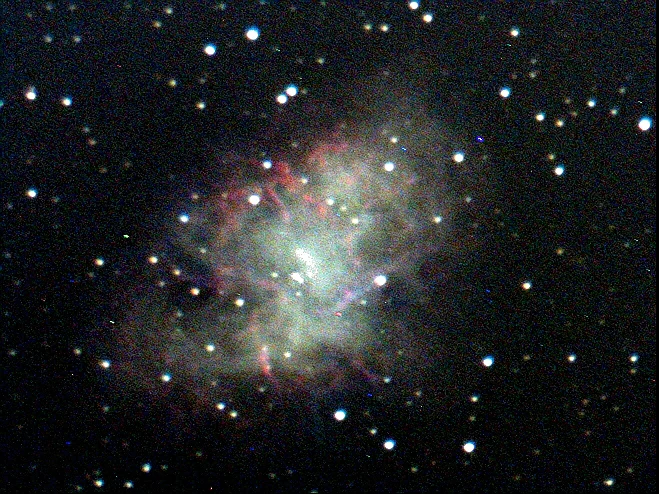
When I set out to write this article, I found myself at a loss for where to begin. Both the historical and scientific aspects of the Crab Nebula are equally captivating, making it challenging to choose a singular approach. Ultimately, I decided to start with my photographs of this extraordinary nebula before delving into its historical context and a light scientific examination.
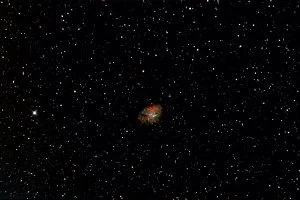
The image, captured on September 6, 2021, represents a composite of four exposures, each lasting 10 minutes, taken through a Skywatcher 250PDS telescope with a 250 mm aperture and a focal length of 1250 mm. The brightest star in the image, located on the left, is actually an object that cannot be seen with the naked eye and is identified only by its catalog number: HD37013, with a magnitude of approximately 6.9. This provides context for the scale of brightness we are discussing. The Crab Nebula, visible at the center and also known as Messier 1 or NGC 1952, is not visible without optical aid; at least a good pair of binoculars and dark skies free from light pollution are necessary to spot it. It may appear as a faint, small luminous patch that can be difficult to distinguish from surrounding point-like stars. To truly appreciate it, a reflector telescope with a diameter of at least 130 mm is recommended, where it may resemble a comet without a tail. A telescope with a diameter of 200 mm or more will provide a significantly better view. For those interested in locating this object, a useful star chart can be found at “Free Star Charts”: https://freestarcharts.com/images/Articles/Messier/Single/M1_Finder_Chart.pdf.
The nebula is situated within the constellation of Taurus, making it an excellent target for observers in the northern hemisphere during the winter months. However, to fully appreciate this remarkable celestial object, photography is essential. As seen in my image from September 6, 2021, the faintly luminous patch visible to the human eye, even with optical instruments, is resolved into a delicate intertwining of colorful textures. Despite this, the focal length of the telescope is still too short to highlight its structure adequately. Another photo I took on August 10, 2019, with a smaller telescope of only 200 mm in diameter but with a much longer focal length of 2000 mm, shows it with greater magnification.
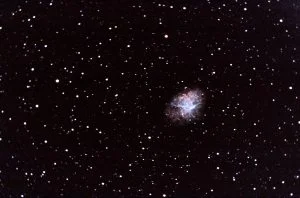
The Crab Nebula photographed with a 200 mm diameter Schmidt-Cassegrain telescope and a 2000 mm focal length, featuring multiple exposures totaling 40 minutes of integration time, using a CCD QHY8L camera cooled to -15°C with a UHC filter. Photo by Massimo Dionisi.
The higher magnification provided by this type of telescope—a Meade Schmidt-Cassegrain—comes at the cost of clarity and definition in the final image, as well as a significantly smaller field of view. The total exposure time for this photo was also 40 minutes, similar to the September 6, 2021 image; however, the color differences between the two images are also due to variations in post-processing. Raw astronomical images typically require processing to minimize background noise, both electronic and from natural sky background and light pollution; further processing can lead to considerably different final results, especially since these two images were captured with different instruments.
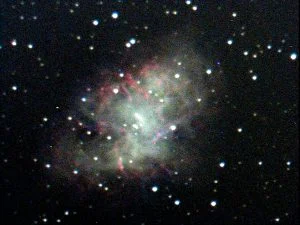
The Crab Nebula captured in October 2017 with a 200 mm diameter Schmidt-Cassegrain telescope and a 2000 mm focal length, featuring multiple exposures totaling 60 minutes of integration time, using a CCD Atik 16-C camera. Photo by Massimo Dionisi.
What makes this nebula so intriguing from both historical and scientific perspectives? First, it is important to note that the history of astronomy includes documentation of several ancient events observed by astronomers of the time. One of the most famous is that of the “Guest Star,” a “new” star never seen before, observed by Chinese astronomers in 1054 in the constellation of Taurus, as recorded in medieval Chinese chronicles translated into English by J.J. Duyvendak in 1942. The records from the Sung Shih, or the annals of the Song Dynasty, state:
“In the first year of the Chih-ho period, in the fifth moon, on the day of chi-ch’ou, a Guest Star appeared approximately a few inches southeast of Tien-Kuan. After more than a year, it gradually became invisible.”
The star referred to as “Tien-Kuan” was known to Greek astronomers as Zeta Tauri, and this is how we identify it today. The phrase “a few inches southeast” likely refers to a position on a celestial globe or armillary sphere, rather than a real celestial distance, which would have been indicated differently. Another reference, attributed to later observations between March 19 and April 17 in 1056, written by Chang Te-hsiang in the Sung hui-yao, states:
“During the third month of the first year of the Chia-yu period, the director of the astronomical office said: the Guest Star has become invisible, which is a sign of the departure of the Guest. Originally, during the fifth month of the first year of the Chih-ho period, it appeared in the morning in the east guarding Tien-Kuan. It was visible during the day like Venus, with rays pointing in all four directions. The color was white-reddish. It was seen for a total of twenty-three days.”
It was clear that something exceptional had occurred in the sky, not only to Chinese astronomers but also to Native Americans, who traced pictograms found at ruins in northern Arizona, in a cave at White Mesa (Utah) and on a wall of the Navajo Canyon (Arizona). However, there is no record of observations from European astronomers; it is believed that observations may have been made with written accounts of the event that later became lost, possibly due to the religious prejudices of the time. While we do not have definitive confirmation that the event described by the Chinese and the imagery passed down by Native Americans refer to the same occurrence, the probable contemporaneity of the observations supports this. The Native American pictograms depict the “Guest Star” near a crescent moon, and a historical reconstruction identifies a waning crescent moon in the constellation of Taurus, close to the aforementioned Zeta Tauri or Tien-Kuan, on the morning of July 5, 1054, just the morning after the Guest Star had appeared to Eastern astronomers. However, it should be noted that the orientation of the crescent moon appears reversed from what it should have been, leaving us uncertain whether the pictogram is a free interpretation by the artist or if it refers to another event entirely without any connection to particular celestial configurations.
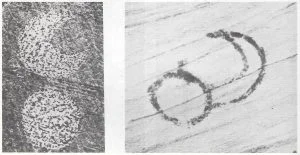
Pictograms from Native Americans that are believed to document the sky event of 1054. (from Burnham’s Celestial Handbook by Robert Burnham Jr., Vol. 3, Dover Publications Inc, New York, 1978)
What we do know for certain is that this “Guest Star” was visible even during the day for a total of twenty-three days and disappeared from view only after nearly two years—specifically, after six hundred fifty-three days. It rivaled the brightness of a full moon and was undoubtedly the most prominent object in the sky for a considerable time. But what does this story of the Chinese “Guest Star” and the Native American pictograms have to do with our Crab Nebula? Quite a lot, as it turns out, because they are essentially the same phenomenon, or rather one is the natural consequence of the other. That new star that “ignited” in the sky nearly a thousand years ago was none other than one of the most catastrophic phenomena known in the universe: a Supernova. In a previous article regarding the Helix Nebula, popularly known as the “Eye of God,” I discussed Novae, stars nearing the end of their life cycles that expel their outer layers in an explosive outburst, creating nebulas known as “planetary” due to their shape. A Supernova is a similar but vastly more violent phenomenon, where even the deeper layers of the star are involved in an explosion so powerful that the star can reach a brightness that surpasses that of the entire galaxy hosting it. What remains after such an event is a nebular remnant, also referred to as a “planetary nebula,” and this is precisely what we observe and photograph in the constellation of Taurus: a true “funeral pyre” of the exploded star; the gases that composed it have been violently expelled into interstellar space, creating the delicate web of luminous gas filaments we can observe today.
It took nearly seven hundred years after the event of 1054 for humanity to recognize the existence of the Crab Nebula. In 1731, British astronomer and physician John Bevis first observed it as a faint luminous patch, and it was independently rediscovered by French astronomer Charles Messier twenty-seven years later. In September 1758, he identified it in the sky and described it as:
“A nebulosity located above the southern horn of the constellation of Taurus. It contains no stars and appears as an elongated white light like the flame of a candle; discovered while I was observing the comet of 1758.”
The comet Messier was observing was the famous Halley’s Comet, during one of its numerous recorded passes near the sun in the history of astronomy, but it was also the first to be predicted by English astronomer Sir Edmond Halley in 1696 based on observations of comets in 1531, 1607, and 1682 that turned out to be the same object. At that time, comet observation was of utmost importance, often overshadowing other astronomical activities. Being able to name a comet was prestigious and brought honor not only to the astronomer who discovered it but also to their nation. However, no one had the slightest idea of what those luminous blobs scattered across the sky really were, and humanity was still taking its first steps in understanding the cosmos. Nevertheless, Messier was prudent and compiled a catalog of non-stellar objects he identified to exclude them when searching for comets in the night sky. He assigned the Crab Nebula, which was not yet known by that name, the catalog number 1, thus becoming the object Messier 1, as it is still identified today: indeed, this endeavor, which Charles Messier considered secondary, led him to a significant discovery in the history of astronomy.