An Introduction to Amateur Astronomy Observation
An overview of essential concepts for amateur astronomy, including telescope selection, resolving power, atmospheric effects, and light-gathering capacity.
An Introduction to Amateur Astronomy Observation
In my experiences within the field of astronomy, whether through direct interactions or social media engagements, I frequently encounter inquiries about purchasing a first telescope. This seemingly straightforward question conceals a complex topic that cannot be adequately addressed without a thorough discussion. Both parties often find themselves engaged in a lengthy dialogue necessary for achieving a minimum level of understanding and intellectual honesty.
In such instances, I am often tempted to direct individuals to specific websites that cover the topic in varying depths without delving into overly technical details. It is quite rare for newcomers to amateur sky observation to possess foundational knowledge in optics, physics, or astronomy. Therefore, a conversational approach devoid of complex formulas is certainly preferable. However, this method risks providing a partial service, leading novices to believe that even basic mathematics and optics are unnecessary, which can obscure essential elements that significantly impact subsequent choices. Conversely, some sites adopt a purely technical approach that, while formally commendable, may prove too challenging for a substantial portion of the audience. Thus, a middle ground is desirable, and I aim to contribute modestly to this broader effort of community service by offering an introduction to non-professional astronomy.
The Diameter of the Telescope
With these preliminary remarks in mind, we can explore the topic in its various facets, beginning with what is likely the most critical aspect: the telescope's diameter. This term refers to the diameter of the primary lens or mirror of our optical instrument, also known as the objective, which is intended to gather light from celestial bodies. We will later examine the differences between refracting telescopes and reflecting telescopes. The dimensions of the telescope's objective are fundamental to the entire optical system and provide immediate insight into its potential performance. It allows us to assess how much light the instrument will collect and helps calculate its resolving power, or its ability to visualize the smallest observable details. For instance, a 100mm diameter telescope will gather approximately 278 times more light than the human eye adapted to darkness, while a 200mm telescope will collect about 1,100 times more light. Additionally, a 100mm telescope will have a resolving power of around 1.2 arc seconds, while a 200mm telescope will reach about 0.6 arc seconds. The term "arc seconds" denotes an angular measurement where 1 arc second (represented graphically by double quotes ") equals 1/3600 of a degree.
Resolving Power
Let us delve deeper into the concept of resolving power: as mentioned, it is the ability of an objective to reveal fine details in an image. In astronomy, this can be illustrated by considering two closely spaced stars (binary stars) or the smallest structures visible on the Moon or the surface of a planet (such as craters). To calculate resolving power, an empirical formula attributed to the English astronomer William Rutter Dawes (1799-1868) is typically employed, known as the Dawes formula:
Pr = 120 / D
where Pr represents the resolving power in arc seconds and D denotes the telescope diameter in millimeters. This formula is quite approximate; the fixed term 120 is not universally constant, as some sources use values ranging from 115 to 138. A more refined formulation is credited to British physicist John William Strutt Rayleigh (1842-1919), a Nobel laureate in 1904, known as the Rayleigh criterion:
Pr = 1.22 * (L / D)
where L represents the average wavelength of visible light, which is approximately 550 nanometers (nm) or 0.00055 millimeters. The Rayleigh criterion is certainly more rigorous as it accounts for the wave nature of light, refraction, and interference. Images of stars should ideally appear as point sources without dimensions; however, even for the closest stars, their actual diameters are minuscule compared to the vast distances separating us from them. When examining a star's image through a telescope, it typically appears as a small luminous disk surrounded by one or more rings. The central disk is referred to as the Airy disk, while the outer rings are known as diffraction rings. This phenomenon arises from the wave properties of light and is not a defect of the optical system; it is entirely independent of the physical characteristics of the observed object. The Airy disk has fixed dimensions for each telescope and represents the minimum angular diameter of a source that the telescope can resolve. Any object with angular dimensions smaller than the Airy disk, such as a star, will still be displayed as a disk the size of the Airy disk. The approximate formula for calculating the diameter of the Airy disk is:
A = 2.44 * (L / D)
where L is the wavelength of visible light (550 nanometers) and D is the telescope diameter in millimeters; the result A is expressed in arc seconds. The concept of resolving power can thus be expressed in terms of a telescope's ability to separate two adjacent Airy disks.
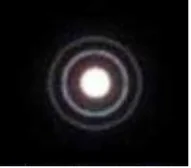
Image of a star's diffraction pattern as seen through a telescope, with the Airy disk at the center surrounded by diffraction rings; image sourced from the document “Astronomical Telescopes” by Giuseppe Cutispoto, INAF, Astrophysical Observatory of Catania.
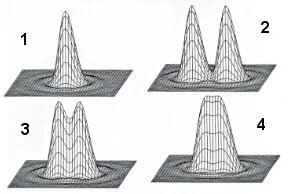
The Rayleigh criterion applied to the brightness profiles of Airy disks. In case 1, we have a single star; in cases 2 and 3, two stars that are increasingly closer but still resolvable; case 4 occurs when the two stars are very close, meaning their separation is below the diameter of the Airy disk, and they can no longer be seen separately. Image sourced from the document “Astronomical Telescopes” by Giuseppe Cutispoto, INAF, Astrophysical Observatory of Catania.
In common usage, the Dawes formula is preferred for its simplicity and immediacy; indeed, the results from both formulas do not differ significantly. However, it is important to consider that other factors can heavily influence a telescope's resolving power, with atmospheric turbulence being perhaps the most critical.
Seeing
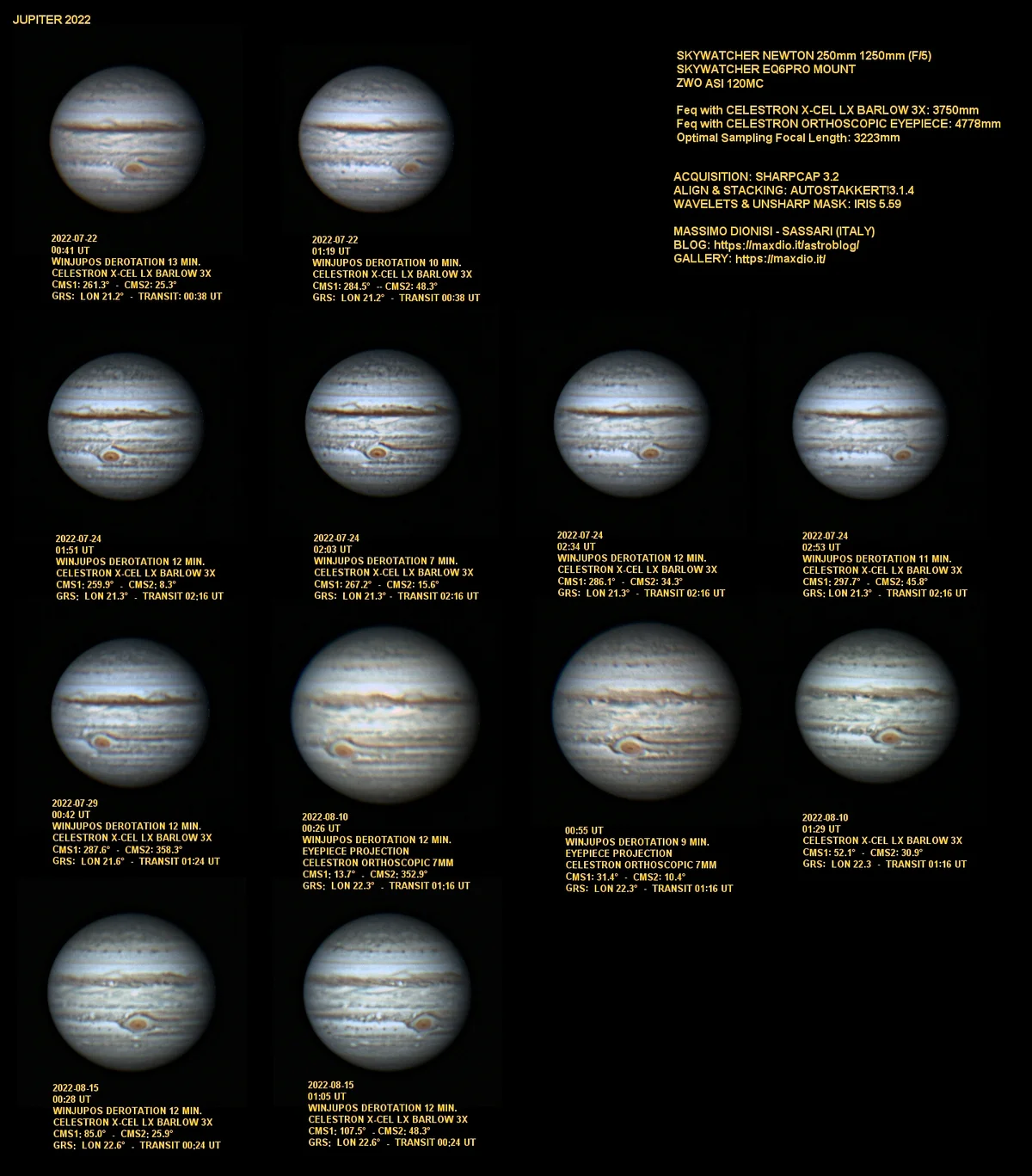
Our atmosphere, while protective and vital for life on Earth, poses challenges for sky observers. It acts as a lens that distorts the images of celestial bodies, introducing various disturbances that generally degrade visibility and sharpness. The term "atmospheric turbulence" refers to all phenomena of air agitation that cause stars to twinkle and distort planetary images, often hindering the visibility of finer details and effectively reducing the resolving power of any telescope. This is encapsulated by the English term seeing, which in this context refers to the degree of atmospheric turbulence or agitation, although its exact translation from English conveys a different meaning. To measure seeing, one typically uses the focused image of a star and evaluates the visibility of its Airy disk and diffraction rings. Two scales can be utilized for this measurement: one is the Antoniadi scale, developed by Greek-born French astronomer Eugenios Antoniadis (1870-1944), which consists of a Roman numeral scale from I (perfect, exceptional seeing) to V (maximum turbulence, poor seeing); a more comprehensive option is the Pickering scale, created by astronomer William H. Pickering (1858-1938), which ranges from 1 to 10, where 1 represents the worst seeing and 10 the best, extended and inverted compared to Antoniadi’s scale. Both scales are valid, but I personally find Antoniadi’s scale simpler, as overly detailed divisions like those in the Pickering system can confuse less experienced observers.
SEEING I Exceptional. Perfect, stable, and well-defined image for several minutes. Quite rare, occurring only about twenty nights a year in any given location.
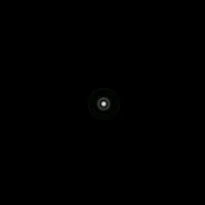
SEEING II Good. Long intervals of stable images, interspersed with brief moments of slight twinkling.
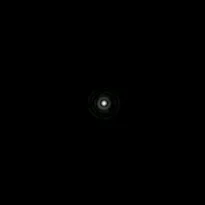
SEEING III Medium. Image disturbed by twinkling, with occasional moments of calm.
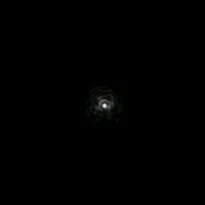
SEEING IV Poor. Image constantly perturbed by persistent twinkling.
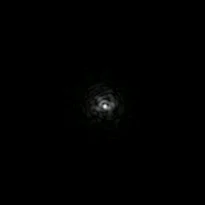
SEEING V Very Poor. Highly disturbed image.
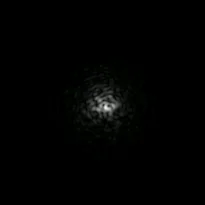
Antoniadi scale for measuring seeing, or the degree of atmospheric turbulence.
Ultimately, only in cases of seeing levels I and II will the actual resolving power be close to the theoretical values predicted by Dawes' formulas and the Rayleigh criterion. In all other cases, it will be limited by atmospheric turbulence. This consideration is crucial when making a final decision about a telescope. If the observing location consistently suffers from poor seeing and the instrument is intended primarily for planetary observation, investing in a large-diameter telescope would be futile, as it would likely be underutilized and difficult to transport to areas with better seeing due to its size. For visual observations of faint objects, known as Deep Sky observations, seeing is somewhat less critical; in this case, the telescope's ability to gather as much light as possible—therefore having a large objective diameter—is more important. However, the situation changes dramatically with astrophotography, where poor seeing can severely impact even medium and long exposure images.
Limiting Magnitude
At this point, it is essential to explore the second topic connected to the objective diameter of a telescope, namely its light-gathering capacity. This parameter will indicate how deeply one can probe with our optical instrument, specifically which faintest objects it can register. To evaluate this element, one must introduce the concept of magnitude. This term refers to the brightness, either apparent or absolute, of a celestial body, expressed according to a scale that traces its origins back to antiquity, specifically the Hellenistic period. Hipparchus of Nicaea (200-120 BC) was likely the first to use the magnitude system, assigning visible stars to “classes of brightness,” identifying the brightest as first-magnitude stars and the faintest as sixth-magnitude stars. This system, somewhat primitive and imprecise, was refined in modern times when Norman Robert Pogson (1829-1891) defined a first-magnitude star as being 100 times brighter than a sixth-magnitude star, establishing a logarithmic scale that continues to be used in contemporary astronomy.
Understanding these foundational concepts is crucial for anyone venturing into amateur astronomy. By grasping the significance of telescope diameter, resolving power, atmospheric conditions, and light-gathering capacity, aspiring astronomers can make informed decisions that enhance their observational experiences.