A Single Asteroid Impact May Explain Deimos' Unique Appearance
A recent study reveals that a single asteroid impact may have reshaped Deimos, Mars' outer moon, explaining its unique features and regolith layer.
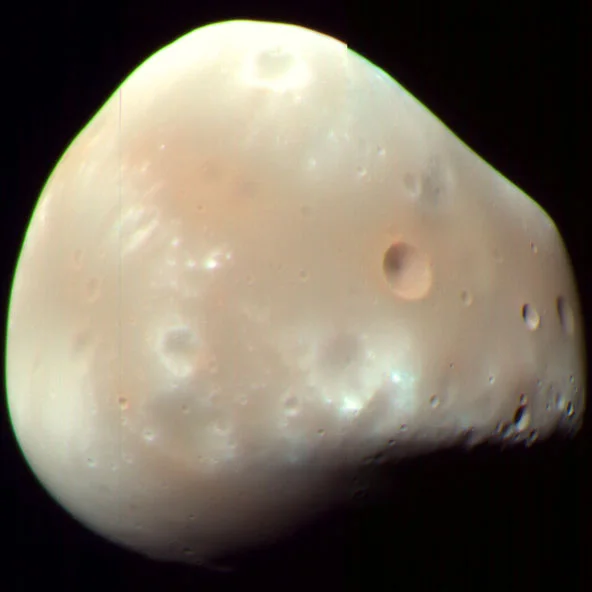
A recent study suggests that a singular asteroid impact may have significantly altered the surface of Deimos, Mars' outer moon. Published on August 18, 2026, in Nature Astronomy, the research indicates that an asteroid approximately 320 meters in diameter, striking at a 45-degree angle, is responsible for creating the moon's southern depression and the regolith layer that covers its smooth surface. This work represents the first scientific publication to utilize data from the European Space Agency's Hera mission, which is currently en route to the asteroid Dimorphos.
Deimos: A Martian Moon with Unique Features
Deimos, characterized by its potato-like shape, has a diameter of 12 kilometers and orbits Mars at an altitude of about 23,460 kilometers, which is roughly 20,000 kilometers from the planet's surface. Unlike its heavily cratered counterpart Phobos, Deimos exhibits a much smoother and dustier appearance, cloaked in a loose layer of debris known as regolith. A notable feature of Deimos is a striking 10-kilometer-wide basin near its south pole, resembling a saddle between mountainous regions.
Despite numerous space missions providing increasingly detailed images of Deimos over the years, the origins of its regolith layer and the southern depression had remained a mystery. Both Phobos and Deimos, named after the Greek terms for Fear and Panic, are thought to be captured asteroids from the main asteroid belt between Mars and Jupiter, or possibly from more distant regions of the solar system.
The Bern SPH Code: Simulating Asteroid Impacts on Deimos
The research team employed high-resolution computer simulations using the Bern Smoothed Particle Hydrodynamics (SPH) code, developed over two decades at the University of Bern. This software is designed to simulate collisions involving asteroids, comets, or planets by breaking down colliding bodies into millions of particles, with their interactions influenced by various reconfigurable variables, including gravity, density, and material strength. Notably, this method was also utilized to model NASA's DART spacecraft's collision with the asteroid Dimorphos.
Led by Dr. Sabina Raducan, the international research team collaborated with the Côte d'Azur Observatory, the University of Arizona, and the University of Tokyo. Raducan, who was a researcher at the University of Bern's Institute of Physics until October 2025, now serves as a program manager at the International Institute of Space Sciences and is a senior researcher at the Free University of Brussels.
The team constructed a detailed model of Deimos' shape using SPH particles, preparing the southern depression for impact simulations. They conducted around one hundred simulations, each lasting approximately a week, to explore various impactor masses and approach angles.
What is the Bern SPH Code?
The Bern Smoothed Particle Hydrodynamics code is a simulation software that recreates celestial bodies as millions of adhering particles. Their interactions are governed by programmable variables, including gravity, material strength, and cohesion. This tool allows for accurate modeling of cosmic impacts.
A Unique Impact Explains Deimos' Appearance
The study's findings strongly indicate that an asteroid striking at a 45-degree angle, with a diameter of about 320 meters (1,050 feet), caused the observed depression at the south pole in terms of both extent and shape, while also accounting for the thin regolith layer covering the entire moon. During the collision, substantial amounts of material were ejected across the surface, obscuring many existing surface features, in some areas to a depth exceeding 200 meters (650 feet).
Comparative analysis between the model and observations reveals that the upper layers of Deimos are exceptionally weak, and its internal structure is highly porous, effectively dampening the forces of impact. Physically, Deimos resembles more of a "rubble pile" asteroid than the Moon of Earth. However, this does not definitively classify Deimos as an asteroid; it may have also formed from material ejected during impacts on Mars.
Dr. Raducan, who also co-chairs the impact physics working group for the Hera science team, notes that the simulation aligns with brightness patterns observed across the moon's surface, which are linked to the gradual migration of regolith behaving more like loose dust than cohesive material. This explains how the southern depression smoothed out rather than retaining a distinct crater shape.
A Fragile Internal Structure Revealed
The ongoing presence of pre-impact craters suggests that Deimos possesses a relatively fragile nature. Impact shockwaves would resonate through a more solid body like the ringing of a bell, disrupting or erasing older features. Their survival indicates a highly porous and fractured interior that effectively absorbed impact forces at a sub-catastrophic scale.
Hera's Data: A Crucial Flyby in March 2025
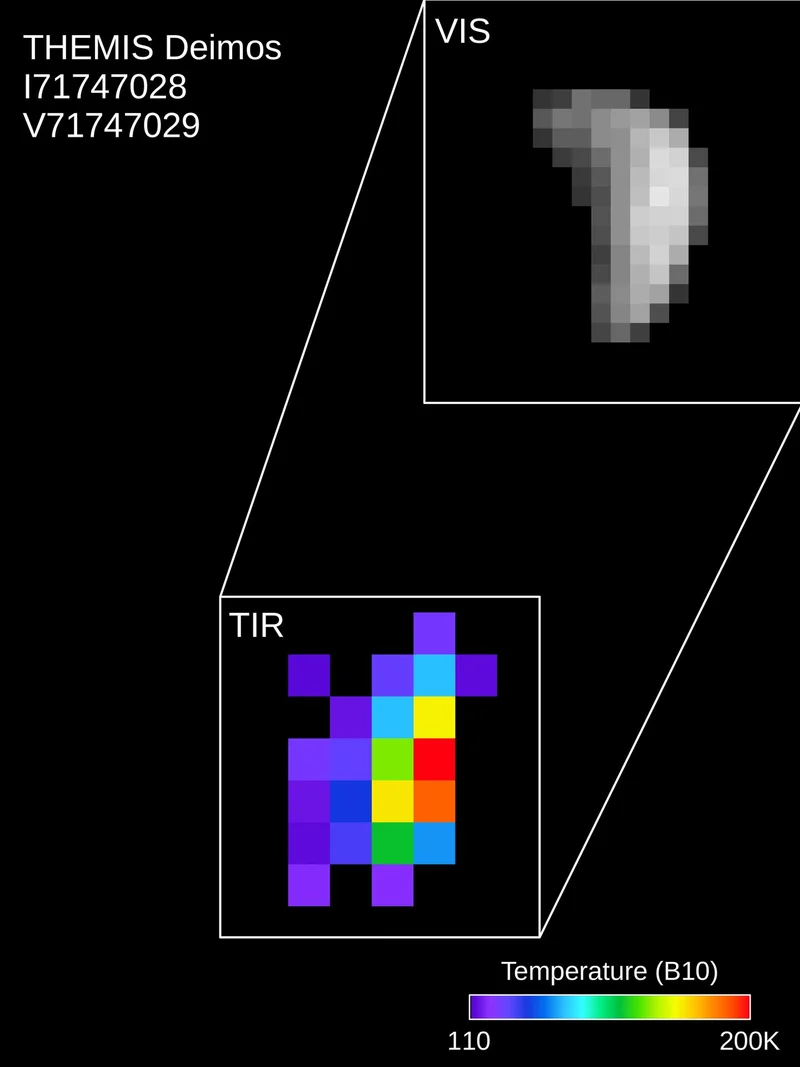
In March 2025, the Hera mission performed a flyby of Mars for a gravity assist maneuver towards its actual target, Dimorphos, providing a unique opportunity to closely observe Deimos. Hera approached Deimos on March 12, 2025, coming within 5,000 kilometers of Mars and approximately 300 kilometers of Deimos at its closest point, capturing images from about 1,000 kilometers away. The spacecraft successfully obtained excellent images of the red planet and its small moon.
This flyby allowed the Hera science team on the ground to utilize the spacecraft's scientific instruments on a target beyond Earth and the Moon for the first time. Deimos orbits approximately 20,000 kilometers from Mars' surface and is tidally locked, meaning that one side of the moon is rarely visible.
Predictions for JAXA's MMX Mission
The Japan Aerospace Exploration Agency (JAXA) is currently preparing for the Martian Moons eXploration (MMX) mission, slated for launch in June 2026. This mission aims to observe both Martian moons in detail and return samples from Phobos to Earth. The study presents significant and concrete predictions for the upcoming MMX mission, including the thickness and distribution of the regolith layer as well as the mechanical properties of Deimos' material, providing MMX with a clearer understanding of what its instruments, and ultimately the sample collection, can expect.
Mission Name Martian Moons eXploration (MMX) Agency JAXA (Japan) Planned Launch June 2026 Targets Phobos and Deimos Primary Objective Return samples from Phobos
While alternative explanations for Deimos' smooth surface and southern basin remain plausible, this study provides a unified explanation for both features and offers practical predictions that can be tested by future space missions. Nonetheless, Michael Kueppers, a project scientist for Hera at ESA, remarks that this simulation implies that Deimos is a rubble-pile body, akin to many asteroids.
Key Findings of the Study
High-resolution computer simulations using the Bern SPH code have demonstrated that the distinctive depression near Deimos' south pole was most likely formed by a single non-destructive asteroid impact, which also created the regolith layer present on Deimos. The study is published in Nature Astronomy.
Sources
- Phys.org, A single asteroid impact may explain the appearance of Mars' moon Deimos
- ESA, Hera's Mars flyby guided impact study of Deimos moon
- Scientific Frontline, Asteroid Impact Shaped Mars's Moon Deimos
- Nature Astronomy, scientific journal
- NASA Science, Deimos