A High-Resolution Map of Dark Matter Unveiled
A new study utilizing the James Webb Space Telescope has produced the most detailed map of dark matter to date, revealing insights into the structure of the universe and the role of dark matter in galaxy formation.
A groundbreaking new study has produced the most detailed map of dark matter to date, utilizing the advanced capabilities of the James Webb Space Telescope (JWST). Dark matter, which neither emits nor absorbs light, is crucial for understanding the evolution of galaxies and cosmic structures. Researchers have employed gravitational lensing—a phenomenon where the path of light from distant galaxies is bent by an intervening mass—to investigate this elusive substance. The findings are published in Nature Astronomy.
Diana Scognamiglio from the California Institute of Technology and her team analyzed images covering an area of 0.77° × 0.70°, gathered as part of the COSMOS study. By measuring the shapes of 129 galaxies per square arcminute, many independently in the F115W and F150W bands of Webb, the researchers achieved an angular resolution of 1.00 ± 0.01 arcminute.
Gravitational lensing alters the trajectory of light from distant galaxies as it passes through the gravitational potential of any mass in the line of sight, which includes ordinary baryonic matter (stars, gas, and dust) as well as dark matter. In the weak lensing regime examined in this study, this deflection results in a shear distortion of only a few percent in the apparent shapes of background galaxies. This distortion is about ten times weaker than the typical intrinsic ellipticity of galaxies, which is shaped by features such as spiral arms or bars.
The resolution of a weak lensing map corresponds to the area needed to encompass approximately 100 resolved background galaxies, ensuring that the shear signal exceeds the shape noise. This figure reflects a trade-off between spatial resolution and statistical uncertainty. The sensitivity of a weak lensing map also depends on geometry. Similar to a magnifying glass that works best when positioned midway between the eye and the object, gravitational lensing is more sensitive to mass located midway between the observer and the source galaxies. This behavior is described by the lensing efficiency function g(z), which peaks at redshifts lower than the typical distance of background objects, as outlined by the redshift distribution of sources n(z). For the JWST, the lensing efficiency peaks at z = 0.38, compared to z = 0.34 for the Hubble Space Telescope (HST) and z = 0.30 for the Hyper-Suprime Cam (HSC) on the Subaru Telescope.
Unlike most observables, weak gravitational lensing is insensitive to mass in the very nearby Universe, as the lensing efficiency drops to zero when the lens is close to the observer. Previous weak lensing maps were limited in terms of sensitivity, resolution, and area. Ground-based telescopes, even the best ones used in surveys such as HSC, Kilo Degree Survey, and Dark Energy Survey, must contend with atmospheric blurring and typically resolve only 7 to 19 galaxies per square arcminute.
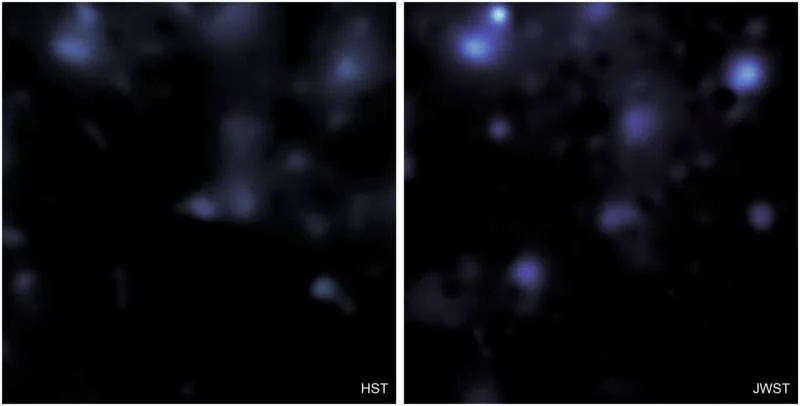
While these surveys cover large portions of the sky, they are constrained by coarse angular resolution and are primarily sensitive to low redshift structures. As a result, only the most massive and extended structures, such as rare superclusters with masses reaching 10^15 solar masses (M⊙), prominently appear on terrestrial weak lensing maps. The Hubble Telescope resolves the shapes of about 71 galaxies per square arcminute, allowing for maps with sufficient resolution of approximately 2.4 arcminutes to begin revealing clusters and filamentary features of the cosmic web.
The high-resolution, deep imaging of the JWST marks a significant advancement. It now enables the measurement of weak gravitational lensing effects from a much larger number of galaxies and at higher redshifts than previously possible. This improvement is reflected in the relative sensitivity to the lensing effect, where JWST surpasses both HSC and HST, particularly at higher redshifts.

Scognamiglio and her collaborators measured shear for 108 galaxies per square arcminute in each of the F115W and F150W bands of NIRSpec. The final catalog comprises unique sources in each band, along with common sources for which the shear estimates are averaged per galaxy, resulting in an effective density of 129 galaxies per square arcminute. The availability of repeated measurements in two bands helps reduce photon counting noise in shear estimation, although the dominant source of uncertainty remains intrinsic shape noise.
For the sample of galaxies whose shapes were measured, the median redshift is approximately z ≈ 1.15. From this dataset, the researchers constructed a detailed map of mass in the large-scale structure. Brighter regions indicate lines of sight with higher lensing convergence, which is proportional to the density of dark and luminous matter, multiplied by the sensitivity function g(z) and projected onto the sky.
Astrophysicists employ a multi-scale filtering technique that identifies structures at different scales, defined as spatial scales in angular units corresponding to physical sizes in the sky. This technique allows them to simultaneously identify both small features, such as halos around low-mass galaxy groups (~10^{13−14} M⊙) or high redshift (z ≈ 1.1), as well as the filamentary structures meant to connect them.
The lensing convergence map derived from the data reveals the projected distribution of total matter, both dark and baryonic. Fifteen previously known galaxy clusters detected with XMM-Newton and Chandra through their X-ray emission are all recovered with a detection signal-to-noise ratio greater than 3. This represents a substantial improvement over earlier reconstructions based on Hubble data, which had detected only 8 of these clusters.
Beyond isolated peaks, the convergence map based on Webb data reveals a network of extended and low-amplitude features connecting overdensities at the scale of clusters. These structures likely trace the cosmic web's dark matter filaments, too diffuse to emit significant X-ray radiation or host large galaxy overdensities. Their detection aligns with predictions of gravitational collapse in the ΛCDM model and reflects Webb's enhanced sensitivity to diffuse matter components that were not previously resolved by Hubble. A comparison with maps of X-ray overdensity significance and galaxy distribution illustrates the coupling between dark matter, hot gas, and luminous galaxies.
While some weak lensing peaks coincide with regions of high X-ray intensity and significant galaxy overdensity, Scognamiglio and her collaborators also identify mass peaks without clear counterparts in projected X-ray emission or galaxy distribution, such as at coordinates (RA, Dec) (150.21°, 2.06°) and (150.32°, 2.28°). These features may arise from underluminous structures or those dominated by dark matter, projection effects from multiple systems aligned along the line of sight, or mass concentrations at redshifts not optimally captured by galaxy density weighting.

Compared to Hubble, Webb offers approximately double the angular resolution, galaxy source density, and significant detections of gravitational lensing structures. At redshifts z ≳ 0.7, Webb's sensitivity for gravitational lensing exceeds that of Hubble by a factor of two, and that of major ground-based studies by a factor of ten. Large-scale structures of dark and baryonic matter appear aligned with theoretical predictions, and Webb allows for much more detailed revelations, extending into low-density regions and higher redshift regimes. This map provides a detailed view of the dark matter scaffolding that underpins galaxy formation and serves as a foundation for future studies on cosmic structure, feedback, and the evolution of the matter field over time.
In the future, Webb's enhanced sensitivity at redshifts 1 ≲ z ≲ 2 will enable tomographic reconstructions of the dark matter environments of galaxies during cosmic noon, the period when star formation peaked. Such measurements, not attempted in this study, could establish a direct link between large-scale structure and galaxy evolution, including the effects of active galactic nuclei feedback, gas cooling, and dark matter assembly.