Discovery of 31 Extremely Distant Quasars by Euclid
The Euclid space telescope has discovered 31 of the most distant quasars ever observed, including two that set new records for distance. This finding sheds light on the early universe and the growth of supermassive black holes.
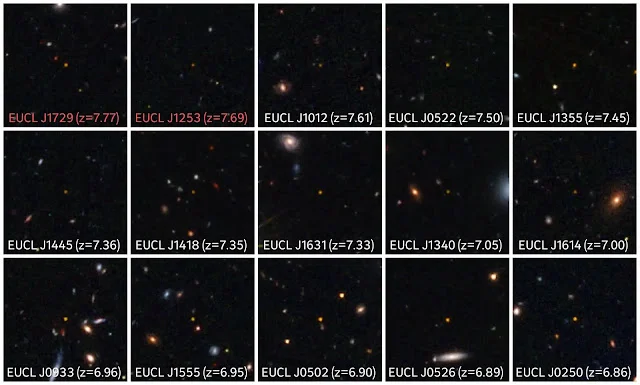
The Euclid space telescope has made a groundbreaking discovery of 31 of the most distant quasars ever observed. Among these, two quasars stand out as the farthest ever recorded, shining brightly when the universe was just 670 million years old, or about 5% of its current age. This significant finding has been published in Astronomy & Astrophysics.
Quasars are a transient phase in the life cycle of galaxies, during which massive amounts of material spiral into a central supermassive black hole, releasing an enormous amount of energy. In this phase, the galaxy's core can outshine the rest of the galaxy by hundreds or even thousands of times.
Launched in July 2023 by the European Space Agency (ESA), the Euclid telescope is positioned at the L2 Lagrange point. Its mission involves exploring the composition, history, and evolution of the universe by mapping its large-scale structure, aiming to unlock the mysteries of dark matter and dark energy. Euclid is tasked with observing billions of galaxies, which has facilitated the identification of numerous quasars.
A team led by Da-Ming Yang from Leiden University has utilized Euclid to uncover an unprecedented number of 31 new quasars in the primordial universe. This discovery is transformative, not only revealing these rare, luminous quasars but also shedding light on a significant portion of the ancient quasar population. Among the findings are 12 new quasars with a redshift greater than 7, corresponding to the first 770 million years of the universe's existence.
The two oldest quasars identified, EUCL J1729+6410 and EUCL J1253+7054, have redshifts of 7.77 and 7.69, respectively, setting a new record for the most ancient quasars ever discovered. Located over 13 billion light-years away, these quasars emerged during the early stages of the universe. They were selected from approximately 3,000 square degrees of sky covered in the first 1.5 years of the Euclid Wide Survey, marking the initial results of Euclid's high-redshift quasar search. Candidate selection employed various machine learning and probabilistic techniques applied to Euclid's images, supplemented by auxiliary data when available. Follow-up spectroscopic observations were conducted using the Keck, Magellan, and Large Binocular Telescopes (LBT).
Among the new discoveries, 12 quasars exhibit a redshift of z ≥ 7, more than doubling the previously known number of quasars at such redshifts. The quasar with the highest redshift, EUCL J1729+6410 at z ≈ 7.77, establishes a new record. Notably, it took astronomers over a decade to discover the first ten quasars with a redshift of 7 or higher, whereas Euclid has revealed more in just one year.
Many of the newly identified quasars fall within the lower end of the luminosity distribution. Additionally, two of these quasars show significant radio counterparts (> 5 σ) in the LoTSS catalog, highlighting the promising synergy between Euclid and the LOFAR network for identifying and characterizing high-redshift quasar populations (z ∼ 7 and beyond). These discoveries signify a substantial advancement in the study of the cosmic reionization era, showcasing Euclid's unprecedented capability to push the boundaries of quasar research based on redshift. Ongoing complementary observations are already underway, although many of these sources are faint and challenging to characterize spectroscopically. Instruments such as the JWST, NOEMA, and ALMA will be crucial for their future characterization.
The second oldest quasar discovered, EUCL J1253+7054, has already been the subject of a more detailed study by Silvia Belladitta and her collaborators. Their observations revealed that this quasar is embedded in a dusty, gas-rich galaxy where new stars are actively forming, providing insights into what the host galaxy of a primitive supermassive black hole might look like.
These findings clearly illustrate Euclid's transformative role in the discovery of high-redshift quasars. They pave the way for future follow-up studies on primitive galaxies hosting quasars, the growth of supermassive black holes, and the intergalactic medium during the reionization epoch.
Notably, the results presented align closely with predictions made by the Euclid collaboration in 2019. Astrophysicists had estimated that around 20 quasars with z ≳ 7 should exist within 3,000 square degrees in the telescope's J-band, and Yang et al. have identified 14 with this characteristic among their 31 new discoveries. It is important to note that the search and spectroscopic follow-up are ongoing (particularly in the southern hemisphere), and this comparison remains provisional; however, it may suggest that some existing quasar luminosity functions underestimate the number density at redshift z ≳ 7 for low-luminosity quasars.
In conclusion, the researchers estimate that as Euclid's observational area expands and confirmations progress, the first quasars at z > 8 are likely to be identified soon.