
Understanding White Dwarfs: Stellar Remnants in the Cosmos
A white dwarf is a stellar remnant formed when a star with less than 9-10 solar masses exhausts its nuclear fuel, marking a crucial stage in stellar evolution.
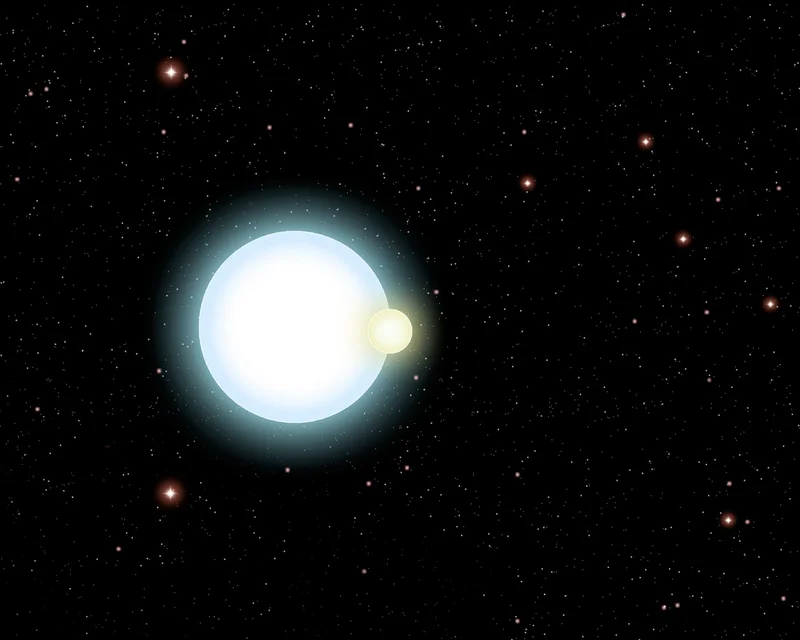
White dwarfs are stellar remnants that form when a star with a mass less than 9-10 solar masses exhausts its nuclear fuel. This phase represents a significant stage in the stellar evolution process that is expected to occur in approximately 97% of the stars we observe, including our Sun. Alongside red dwarfs, white dwarfs are among the most prevalent types of stars in the universe.
The composition of white dwarfs consists of atoms in a plasma state. As nuclear reactions cease in their cores, these stars lose their energy source that counteracts gravitational collapse. Consequently, a white dwarf compresses under its own weight, leading to a drastic reduction in the distance between atoms, which limits the movement of electrons.
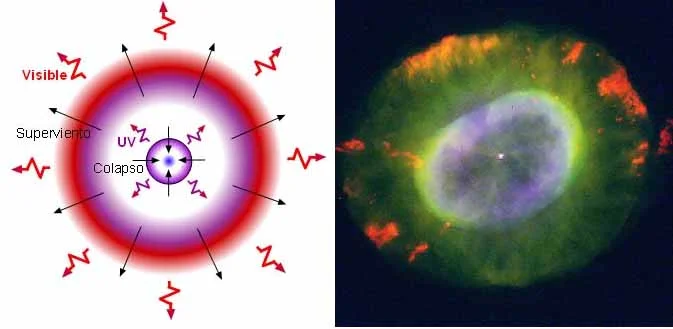
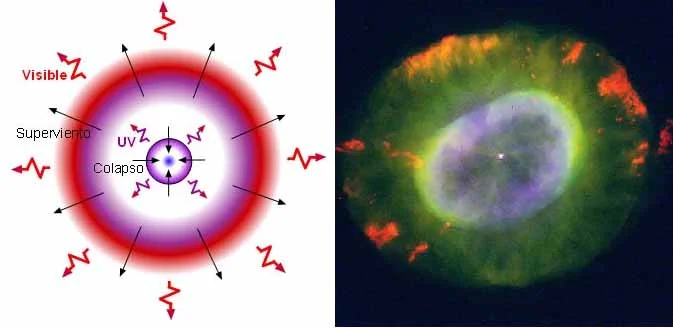
The formation of these celestial bodies is a gradual process. In mature stars, the outer layers expand significantly during their transition into asymptotic giant branch stars, eventually shedding their exhausted cores. Once fusion reactions conclude, the core contracts and heats up, although it does not reach the ignition temperature necessary for the next evolutionary phase. Before achieving this temperature, electrons undergo degeneracy, halting the process. This results in the creation of a white dwarf with an initial core temperature ranging from 100 to 200 million degrees, which will gradually cool over time. The expelled material will form a planetary nebula, with the white dwarf remaining at its center.
I have been surprised by white dwarfs, as I initially thought they were small; however, some can actually be larger than Earth and even exceed the size of the Sun.
Jesús Molina Collado 1º Bachillerato B