The Timeless Saga of War, Flight, and Displacement
Exploring the ancient saga of war, flight, and displacement through mythological narratives and their relevance in today's world.
This "timeless saga" does not refer to the latest installment of Star Wars that is currently being released. Rather, it draws from an ancient narrative that unfolded in the Mediterranean around three to four millennia ago, the very story that inspired this blog.
The themes of this saga—war, flight, and displacement—are as relevant today as they were in antiquity. While I will not delve into the intricate details of the Labyrinthiade here, I previously explored its multifaceted nature in 2007 at the inception of this blog, outlining five circles of characters.
In ancient times, conflict and flight were prevalent. The Minoans, who dominated the Mediterranean, defeated the Athenians and demanded hostages from the Greek city-state. These hostages were often sacrificed to the monstrous Minotaur within the labyrinth until Theseus turned the tide, slaying the beast. Following this victory, the prince fled with Princess Ariadne and the hostages to Athens via the island of Naxos.
Daidalos, the architect of the labyrinth commissioned by King Minos as a prison for the Minotaur, was himself a refugee. After being exiled from Athens for the murder of his nephew Perdix, he fled to Crete. There, he assisted Queen Pasiphaë in creating a wooden cow, which allowed her to mate with Poseidon's bull, resulting in the birth of the Minotaur. Eventually, Daidalos found himself imprisoned in the very labyrinth he had constructed. To escape, he fashioned artificial wings and fled with his son Icarus, who tragically perished in the sea, much like many modern refugees. Daidalos continued his flight across the Mediterranean, ultimately reaching Sicily.
Though not directly tied to the labyrinth narrative, the story of Medea resonates with themes of violence and displacement. As the stepmother of Theseus, she sought to eliminate him to secure the throne for her own sons. Previously, she had aided Jason in acquiring the Golden Fleece and bore him children. However, they were forced into a prolonged flight through Asia Minor. Eventually, Jason found acceptance in Corinth, while Medea, viewed as an outsider, was not welcomed. In a fit of rage, she murdered her children and fled to Athens.
The Relevance of Labyrinthine Motifs Today Medea's narrative frequently resurfaces in media, particularly in cases of maternal filicide, such as a recent incident in Franconia where seven lives were lost. Additionally, her story remains a staple in theater, currently showcased in Munich's Residenztheater through Franz Grillparzer's Golden Fleece, featuring the acclaimed Meike Droste. Simultaneously, the film Medea in Corinto has received praise in Munich as well (KLK in the Südd. Zeitung).
The tragic figure of Icarus also continues to capture public attention, recently featured in the Canadian Cirque du Soleil's production Varekai, where he falls from the sky as an angel with burnt wings.
The other antagonist of the Labyrinthiade, the Minotaur, has been examined by former Greek finance minister Yanis Varoufakis in his notable critique of contemporary global leadership. His book, The Global Minotaur, discusses themes of war and refugee crises, predating the recent turmoil in the Mediterranean.
Interestingly, I encountered the Minotaur again while searching for Christmas gifts for my grandchildren, particularly as one of them is a fan of the Percy Jackson series. The first book, The Lightning Thief, (adapted into a film by Chris Columbus) features a striking scene where the Minotaur kills Percy’s mother. Author Rick Riordan skillfully incorporates Greek mythology into a modern American context, revisiting the labyrinth motif in the fourth book, The Battle of the Labyrinth. In typical fashion, American blockbusters often neglect to depict the refugees produced by such wars, leaving their stories obscured, much like the narratives of those encountered in the Mediterranean and at Europe’s increasingly fortified borders.
I also stumbled upon Theseus in a more obscure context recently. As a teenager, I was captivated by the film A Matter of Life and Death by Emeric Pressburger and Michael Powell, which has now been restored and re-released on Blu-ray. The film chronicles the fate of an English bomber pilot during WWII, with the Jewish Pressburger fleeing the Nazis from Hungary. The film's score was composed by Allan Gray, who escaped from Poland, and the cinematographer was German refugee Alfred Junge. A subplot of the film involves a community theater group rehearsing Shakespeare's A Midsummer Night's Dream, which centers around the wedding of Theseus and Hippolyta, the Amazon queen.
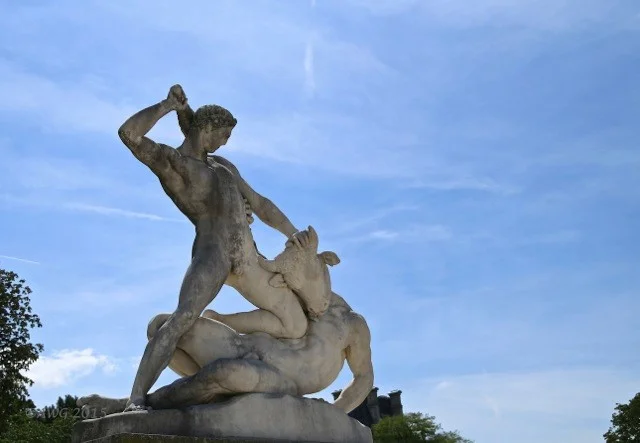
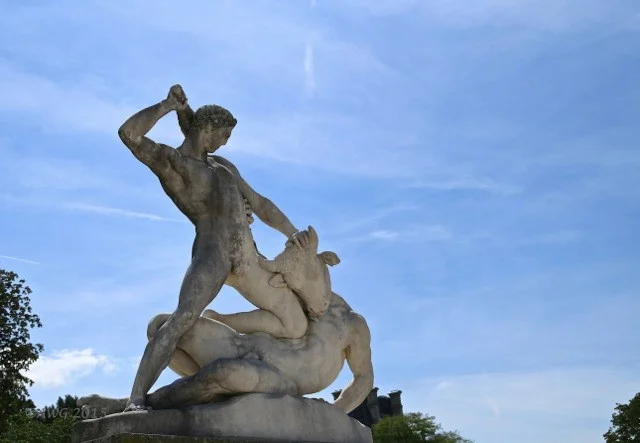 Image: Monument in Paris: Theseus slaying the Minotaur (Photo © August 2015 Andrea Wissler-Greif)
Serendipity at Play On August 17, 2015, well before the tragic events of November 13, Andrea Wissler-Greif shared a photo of the Minotaur from Paris. This was a nod to her participation in the three-year Minotaur Project writing workshop, where she had no idea how relevant her photo would become in light of the subsequent ISIS terrorist attack. The Minotaur serves as a quintessential symbol of the violence and destruction inherent in life, embodying the classic adversary in the hero's journey and aptly named the workshop.
Once again, serendipity played a role in this narrative.