The Constellations of June 2026: Scutum
Having passed the solstice, the sky begins to reveal its typically summer features. By midnight, the spring constellations will have disappeared, making way for Scutum and others.
Having passed the solstice, the sky begins to reveal its typically summer features. By midnight, the spring constellations of Gemini, Cancer, and Leo will have disappeared one after the other in the West, followed by Virgo, which will be resting on the horizon by midnight. Above, Bootes and Corona Borealis will also begin their descent in the southwestern sector of the sky.
Meanwhile, in the East, the Summer Triangle will be visible from sunset and throughout the night; after it, and by midnight, Delphinus, Equuleus, Pegasus, Capricornus, and Aquarius will also rise.
Still referencing midnight, the southern quadrant will still be dominated by Scorpius and Sagittarius, as well as – a little higher – Ophiuchus, Scutum, and Hercules. In the North, Cepheus will be near culmination, while Draco will still be high but descending. Lower down, towards the Northwest, Ursa Major will still be visible, while in the Northeast, Andromeda and Perseus will begin to rise; simultaneously, Cassiopeia and Camelopardalis will gradually gain height.
This month's focus will be on the constellation Scutum, which will transit the meridian during the central hours of the night in the second half of July.
THE CONSTELLATION SCUTUM
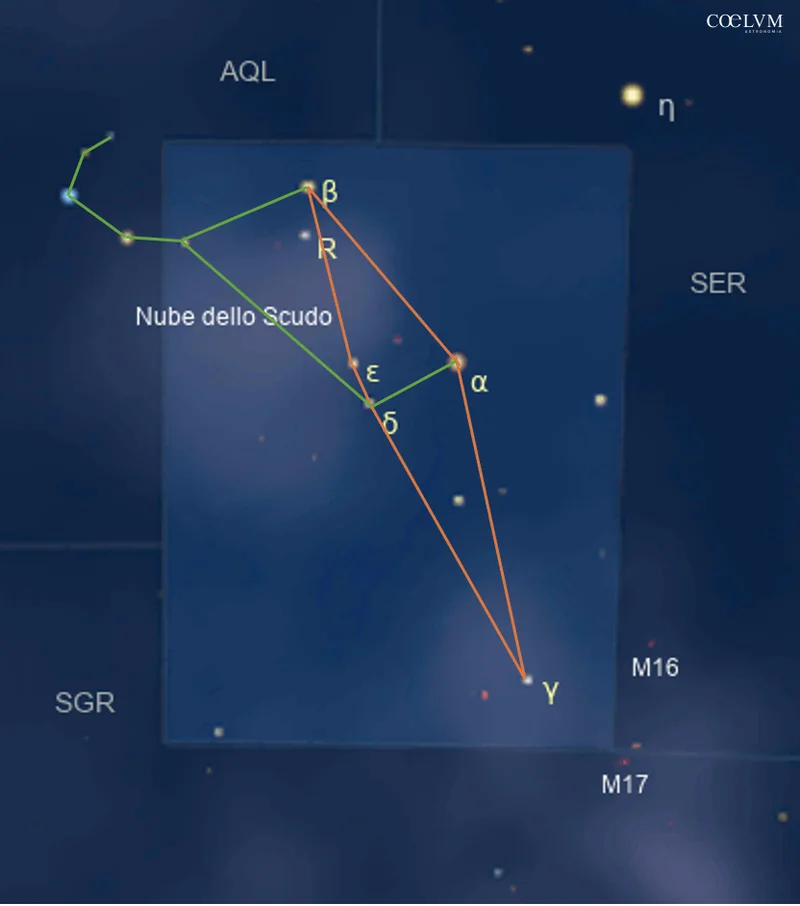
Scutum (in Latin Scutum, abbreviated Sct) is the fifth smallest constellation in the celestial sphere and is part of the "Hercules Family" in Donald Menzel's classification. It includes, in addition to Scutum, 18 other constellations: Hercules, Sagitta, Aquila, Lyra, Cygnus, Vulpecula, Hydra, Sextans, Crater, Corvus, Ophiuchus, Serpens, Centaurus, Lupus, Corona Australis, Ara, Triangulum Australe, and Crux.
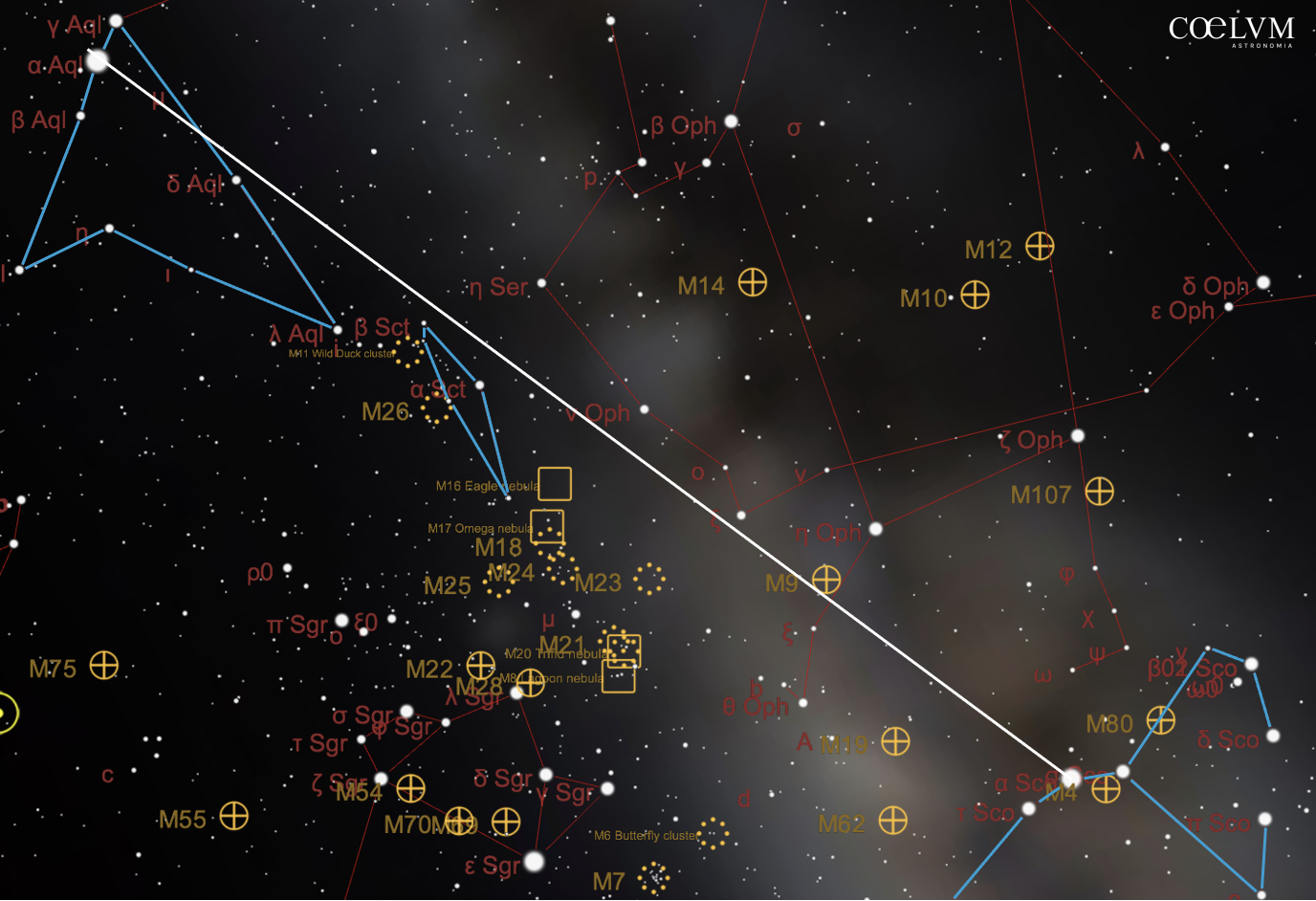
Returning to Scutum, its shape resembles – depending on interpretations – that of a flattened parallelogram similar to a kite or a rhombus. The constellation is located between Sagittarius, Aquila, Ophiuchus, and Serpens and can be identified by tracing an imaginary line connecting Altair (in Aquila) and Antares (in Scorpius), at about one-third of the length.
The stars that compose it, including Alpha, an orange giant 174 light-years away also known as Ioannina, are relatively faint with a magnitude greater than four.
Among them, notable stars include: Delta Scuti, a well-known pulsating variable star from which an entire category of variables takes its name; R Scuti, a semi-regular variable with a period of about five months and oscillations from fourth to eighth magnitude; and Stephenson 2-18, a red supergiant among the largest ever discovered (its estimated radius is about 2,150 times that of the Sun), located approximately 19,000 light-years from Earth.
DEEP SKY OBJECTS IN THE CONSTELLATION SCUTUM
Like Cygnus and Sagittarius, Scutum is traversed – along the Northeast-Southwest direction – by the Milky Way; one of the most interesting objects is indeed the Scutum Cloud, a concentration containing millions of stars, positioned near the galactic center.
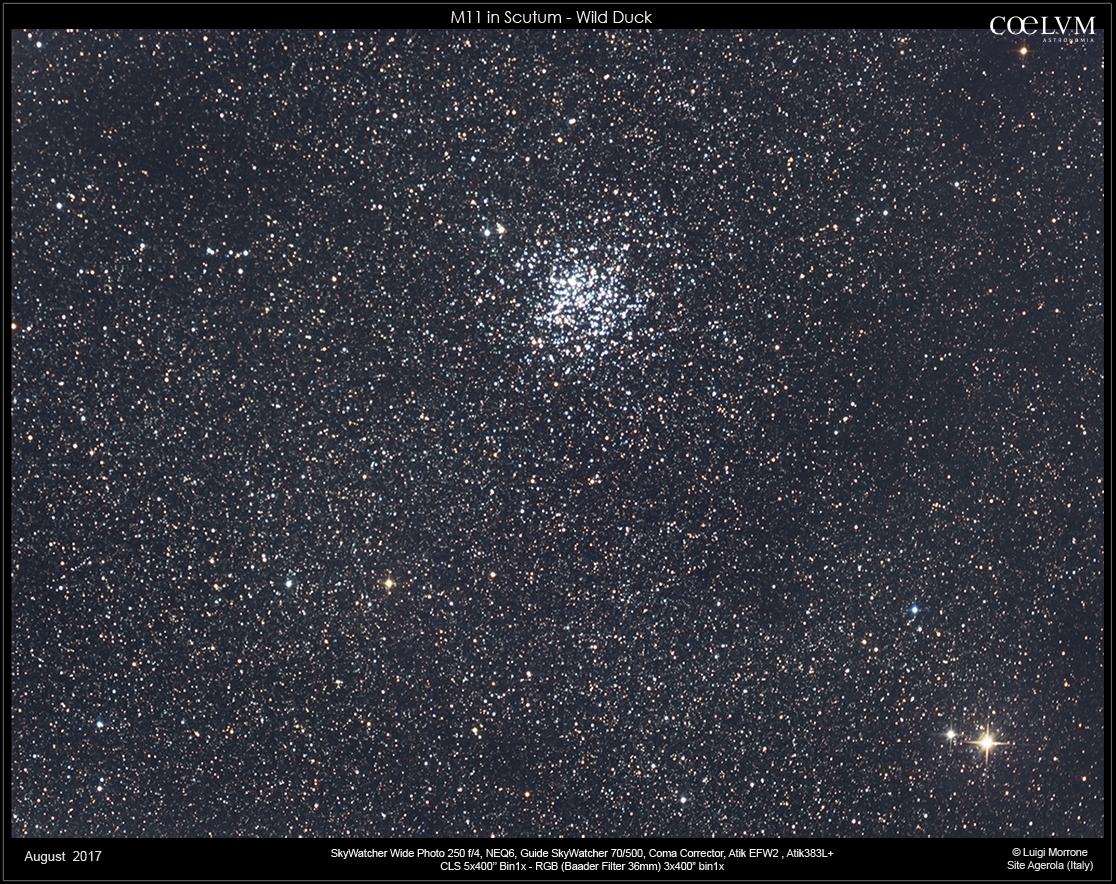
In addition to it, the constellation hosts two objects belonging to the Messier Catalog: M11 and M26. Both open clusters were discovered respectively by Gottfried Kirch in 1681 (and later included in the Catalog by Messier) and by Messier himself in 1764. The first, also known as the "Wild Duck" and with an overall magnitude of 5.8, contains about 2,900 stars (the brightest of which reaches magnitude 8.5); it has an estimated age of 250 million years and is located 6,000 light-years from Earth. M26 – at a distance of 5,000 light-years – is less bright and registers a low stellar density in the region near the core, likely due to a dark cloud of interstellar dust obstructing the line of sight; it should contain about a hundred stars and have an estimated age of about 89 million years.
Among the fainter objects in the constellation, there is also an open cluster, a globular cluster, and a planetary nebula.
NGC 6664, located a few arcminutes from the star Alpha Scuti, is an open cluster of a few hundred stars situated about 4,470 light-years from the Sun, thus located on the outer edge of the Sagittarius Arm.
On the other hand, NGC 6712 is a globular cluster – first described as such by William Herschel in 1784. It is located about 2.5° east of the star Delta Scuti; with an overall magnitude of 8.1 and an age of 12 billion years, it contains an estimated number of over 60,000 stars.
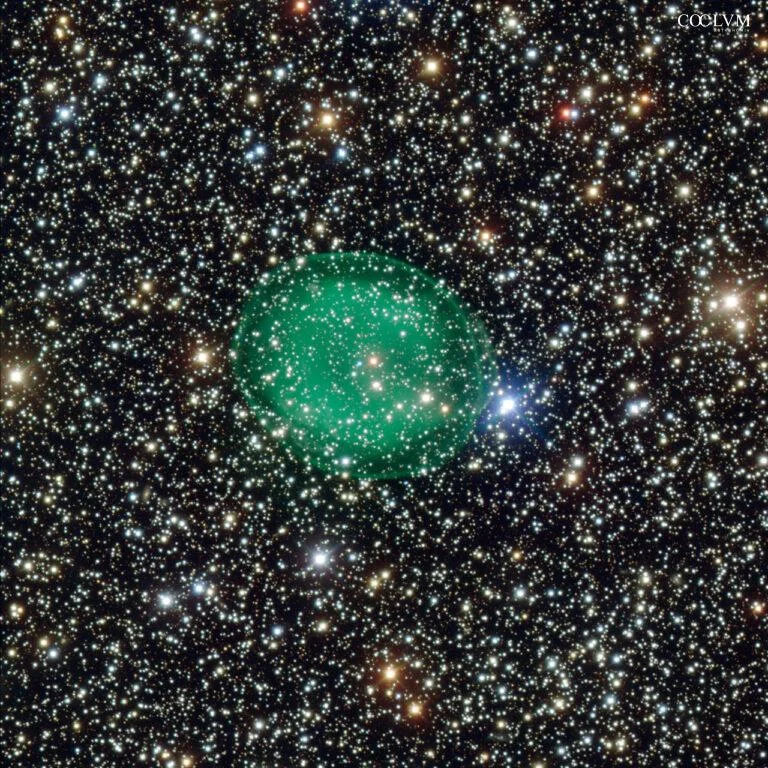
Finally, IC 1295 is a planetary nebula located about 3,300 light-years from Earth. Discovered in 1867 by American astronomer Truman Safford, it consists of the gas layers expelled by a star that has reached the final stages of its evolution. With an apparent magnitude of 12.5–12.7, it represents a challenge for visual observers; however, long-exposure images reveal its ring structure characterized by a particular greenish color, due to the intense ultraviolet radiation produced by the dying star.
MYTHOLOGY AND HISTORY OF THE CONSTELLATION SCUTUM
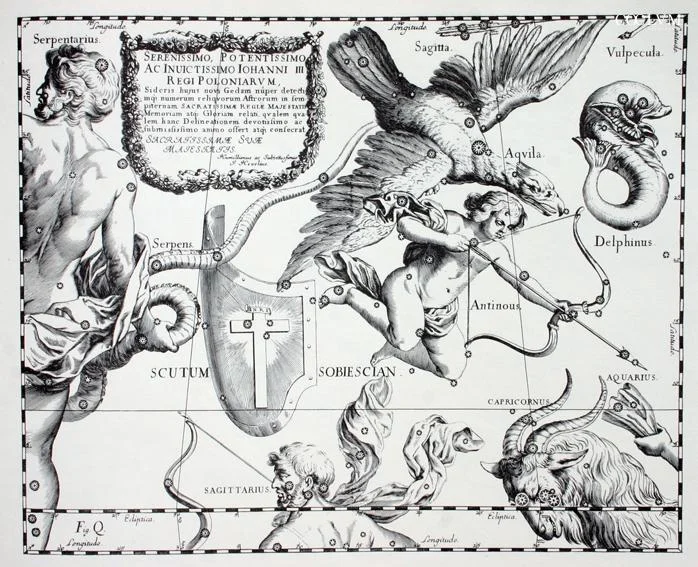

Scutum, now part of the 88 constellations approved by the International Astronomical Union, was not known in antiquity and was not included, for example, in Ptolemy's Almagest; some of its brightest stars were considered integral parts of Aquila, positioned immediately above. This constellation was introduced only in 1684 by Polish astronomer Joannes Hevelius and is one of the seven constellations he included in the posthumous work Firmamentum Sobiescianum, sive Uranographia, still used today – along with Canes Venatici, Leo Minor, Lynx, Lacerta, Sextans, and Vulpecula.
Originally cited by the full name Scutum Sobiescianum, it was dedicated to the last king of Poland, John III Sobieski (hence, also the name of the star Ioannina, literally "of John" in Greek), the victor of the famous Battle of Vienna in 1683, which marked the end of the Ottoman expansion into Europe. Together with Coma Berenices (see The Constellations of April 2026), it is one of the very few constellations that derive from historical figures.