The Galaxy Messier 91 - Spreewald-Spechtler
The galaxy Messier 91 (NGC 4548) is located in the southern part of the constellation Coma Berenices. It was discovered on March 18, 1781, by the French astronomer Charles Messier.

The galaxy Messier 91 (NGC 4548) is located in the southern part of the constellation Coma Berenices. It was discovered on March 18, 1781, by the French astronomer Charles Messier. It was the eighth and last nebula he found that March night. Messier described it as a nebula without stars, which is fainter than M 90. On April 8, 1784, the galaxy was independently rediscovered by the German-British astronomer Friedrich Wilhelm Herschel and cataloged as H II.120. He described it as large and round. The assignment of M 91 to the Messier catalog was long disputed. Messier mistakenly provided the coordinates of the object relative to M 58, although he actually meant M 89. Other observers could not find an object at the indicated location. Therefore, the galaxy was considered one of the lost Messier objects for almost 200 years, as it did not match any known object in the sky.
Initially, it was thought that the French astronomer had seen a comet or had observed M 58 twice, as suggested by the US astronomer Owen Gingerich. In 1969, the Texas amateur astronomer William C. Williams correctly assigned the nebula observed by Messier to NGC 4548. He wrote a letter to the American magazine "Sky & Telescope", in which he published his discovery. Messier had recorded the position of the nebula relative to M 89. Williams wondered if Messier should have written M 58 instead of M 89 in his records. He tested this hypothesis and achieved an accuracy of 0.1 arcminutes in right ascension and better than one arcminute in declination at NGC 4548, which is why Messier 91 is recognized today as NGC 4548. However, according to other sources, the nearby spiral galaxy NGC 4571 was also considered a candidate for M 91.
An Anemic Barred Spiral Galaxy in the Virgo Cluster
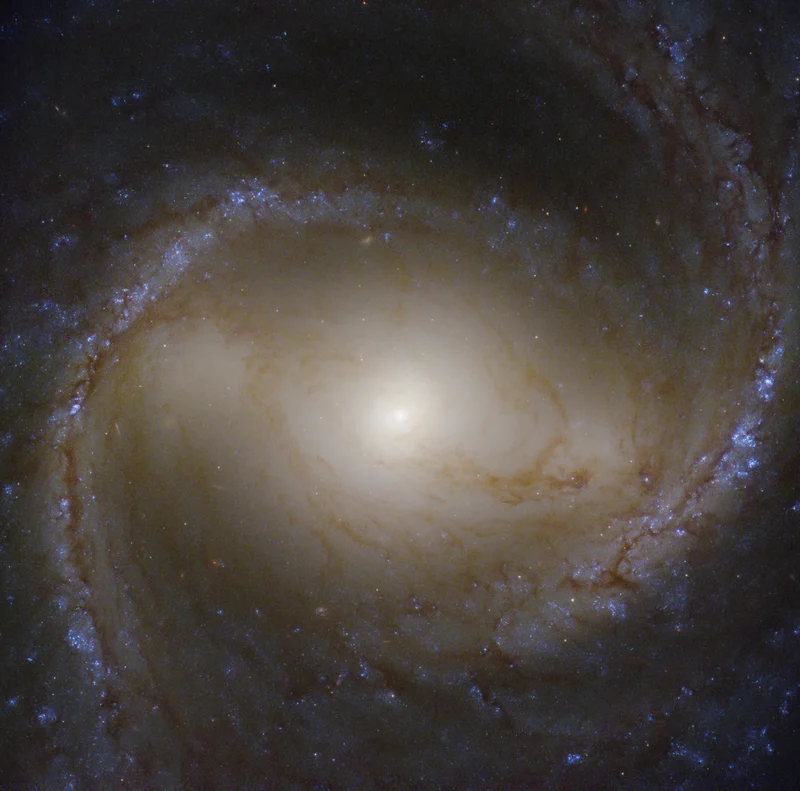
Messier 91 is considered the faintest of all objects in Messier's famous nebula catalog. It is a 5.2 x 4.2 arcminutes large, 10.1 mag bright barred spiral galaxy of Hubble type SBb. M 91 is located 52 million light-years from the Milky Way, in the southern part of the constellation Coma Berenices, as determined by observing its Cepheids. However, measurements of the fluctuations in its surface brightness suggest a greater distance of 63 million light-years. It is one of over a thousand galaxies that make up the Virgo galaxy cluster. This is a group of galaxies that are gravitationally bound to each other. M 91 is located in the Virgo A sub-cluster around the elliptical giant galaxy Messier 87. The galaxy is characterized by a prominent central bar structure. With a diameter of 83,000 light-years and a mass of about 80 billion solar masses, Messier 91 is comparable in size and mass to our own Milky Way system.
Compared to other spiral galaxies, its spiral arms contain little interstellar matter and HII regions. Furthermore, they exhibit a low star formation rate. The eastern arm has significantly more knots in its inner part than the western arm. The outer disk is asymmetric: the southeastern side is brighter than the northwestern side. Particularly in astrophotos, its striking bar and spiral structure stand out. Therefore, it appears rather inconspicuous in small telescopes. Due to its low surface brightness, it is a challenging object for visual observers.
Messier 91 is receding from us at 400 km/s. At the same time, the galaxy has a relatively high peculiar velocity of 700 km/s with respect to the Virgo galaxy cluster. Due to its low content of neutral and molecular hydrogen and its low star formation rate, it is referred to as an "anemic galaxy." Star formation is concentrated only in the areas where the spiral arms are connected to the bar. Additionally, it lacks pronounced H-II regions that would indicate active star formation in its spiral arms. Due to its high velocity through the galaxy cluster and interactions with the hot intergalactic matter present there, M 91 has lost most of its star-forming material. This process is referred to by astronomers as "ram pressure stripping."
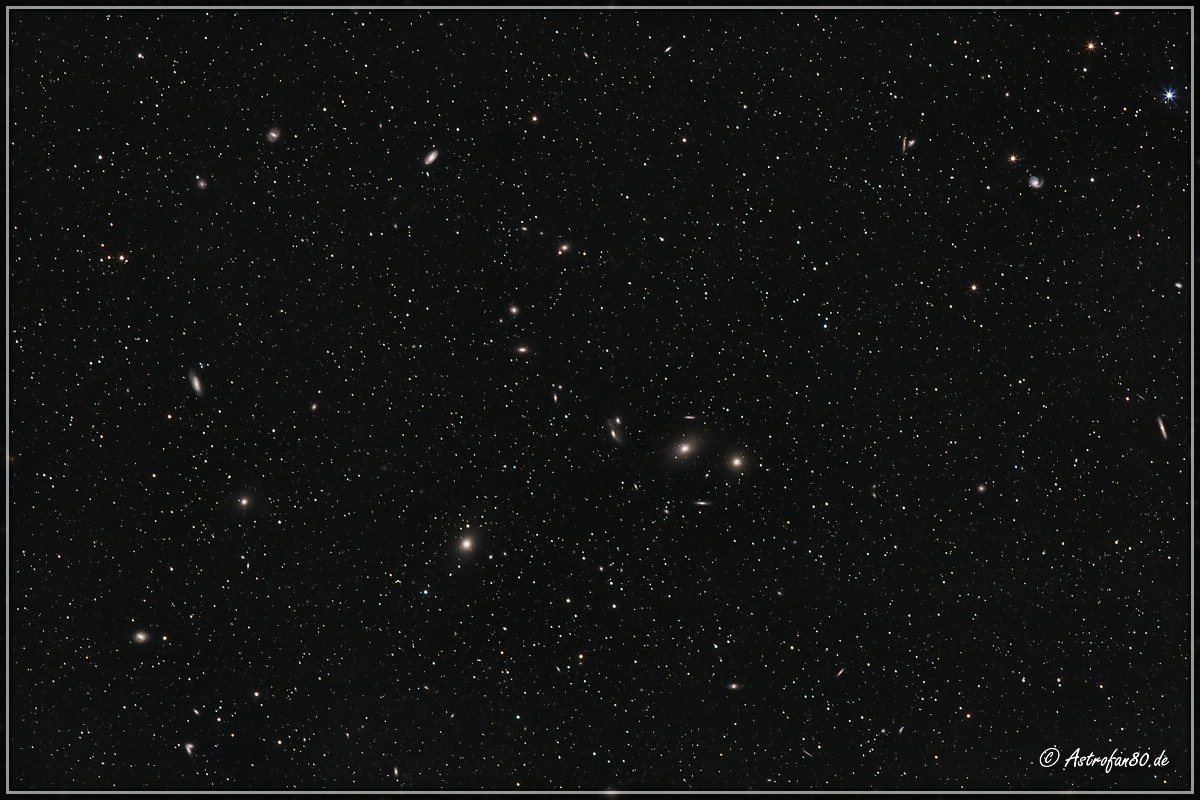
The galaxy belongs to the LINER type with an active galactic nucleus. This type of galaxy shows weak emission lines of low ionization degree of heavier elements in its core region. Furthermore, M 91 is also an active Seyfert galaxy, likely due to the supermassive black hole at its center, which is between 9.6 and 38 million solar masses. In 1994, Cepheid observations in M 91 were used with the Canada-France-Hawaii Telescope (CFHT) to calibrate the Hubble constant. Notably, M 91 is part of the so-called Markarian chain, a collection of galaxies that are part of the Virgo galaxy cluster. The chain is named after the Armenian astrophysicist Benjamin E. Markarian, who discovered that these galaxies move coherently. Additionally, no supernovae have ever been observed in its spiral arms.
Observation
Aside from the lack of reference stars that make locating the galaxy difficult, Messier 91 is one of the hardest Messier objects to find. For amateur astronomers with small optics, it is a challenge, as it has only low surface brightness. Moreover, the apparent brightness of the galaxy is at the limit of visibility with a 10×50 binocular. Even when observed with instruments such as an 80 mm refractor, M 91 is considered a rather difficult object to observe. Under good visibility conditions, the galaxy can be recognized with a small telescope with a 3 to 4-inch aperture and a 40 to 50-fold magnification as a round diffuse nebula spot with a brighter center. It forms an elongated Y shape with three brighter stars. Under less favorable conditions, M 91 appears only indirectly with a 3-inch aperture.

With telescopes between 6 and 8 inches and a medium magnification of about 70 times, not much more than a faint, rectangular nebula is perceptible. The object becomes noticeably brighter towards the center and appears somewhat longer than wide. The center is broad and bright. Under optimal conditions and good transparency, hints of the central bar can already be perceived with these apertures and medium magnifications. The galaxy appears as an elongated spot in a northeast to southwest direction. Its extended halo to the north and south is recognizable from an aperture of 8 inches and a higher magnification. Initial hints of its spiral structure can also be discerned on dark nights with telescopes from 10 to 12 inches aperture at least. Additionally, a star-shaped core becomes visible. With even larger telescopes, only the bright, elongated bar region of this galaxy can be seen under poor conditions, while under good conditions, the spiral arms become visible, which exhibit a nearly round to slightly elongated shape.
Messier 91 is best observed in the spring months and early summer when the constellation Coma Berenices is high in the sky. The galaxy is located about one degree north of the border between the constellations Coma Berenices and Virgo and near the connecting line between the galaxies M 89 and M 90. Unfortunately, there is no bright star near M 91 that could facilitate locating the object. To find the area of the sky where the galaxy is located, we connect the distance between Denebola (Beta Leo, 2.1 mag) and Vindemiatrix (Epsilon Vir, 2.9 mag). About 60% of this distance between the two stars is where the galaxy M 89 is located. Messier 91 is about two degrees north of this.
 Finder Chart Messier 91 (55.4 KiB, 20 hits)
Profile for Messier 91
Data and facts for the galaxy Messier 91 in Coma Berenices
Object Name
Messier 91
Catalog Designation
NGC 4548, UGC 7753, PGC 41934, MCG 3−32−75, VCC 1615, IRAS12328+1446, ZWG 99.96
Type
Galaxy, SBb
Constellation
Coma Berenices
Right Ascension (J2000.0)
12h 35m 26.4s
Declination (J2000.0)
+14° 29′ 47″
V Magnitude
10.1 mag
Surface Brightness
13.4 mag
Angular Size
5.2′ x 4.2′
Position Angle
150°
Absolute Magnitude
-20.987 mag
Diameter
83,000 light-years
Distance
52 million light-years
Description
B,L,lE,lbM; NGC 4571 @ 27.0′;H II 120;F outer arms in S pattern
Discoverer
Charles Messier, 1781
Star Atlases
Cambridge Star Atlas: Chart 11
Interstellarum Deep Sky Atlas: Chart 45 & D2
Millennium Star Atlas: Charts 725–726 (Vol II)
Pocket Sky Atlas: Chart 45
Sky Atlas 2000: Chart 14
Uranometria 2nd Ed.: Chart 91