The Globular Cluster Messier 68 - Spreewald-Spechtler
The globular cluster Messier 68 (NGC 4590), located in the southern constellation Hydra, was discovered on April 9, 1780, by the famous French astronomer Charles Messier.
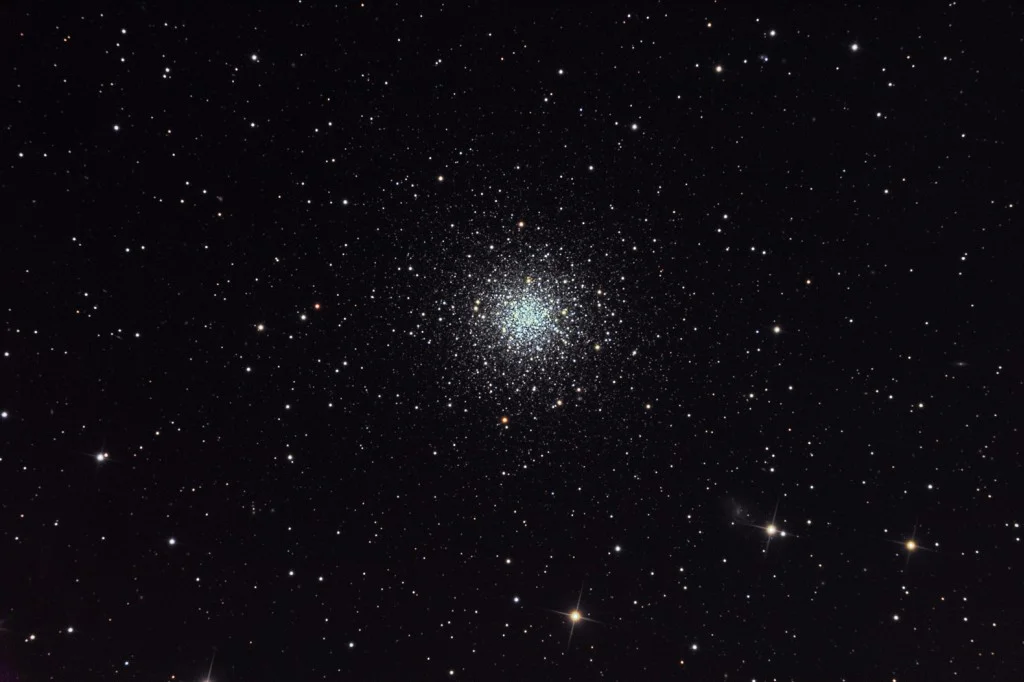
The globular cluster Messier 68 (NGC 4590), located in the southern constellation Hydra, was discovered on April 9, 1780, by the famous French astronomer Charles Messier. Messier described the cluster as a very faint nebula without stars, situated below Corvus and Hydra near a sixth-magnitude star. The object was very difficult to see in his refractor. In contrast, the German-British astronomer Friedrich Wilhelm Herschel described the object as a beautiful collection of stars that appeared extremely rich, compact, and compressed, to the point where most stars seemed to merge with one another. Herschel was also the first observer to resolve the star cluster into its individual stars. His son John cataloged the cluster in 1836 as h 3404. He later included it as GC 3128 in his General Catalog. He noted: "Clearly resolved into stars of 12th magnitude, very loose and ragged at the edges." Admiral William Henry Smyth, who observed the globular cluster in 1837, mistakenly attributed the discovery of M 68 to Messier's friend and colleague Pierre Méchain. This attribution has been adopted by numerous later sources.
A Metal-Poor Globular Cluster from Another Galaxy
Messier 68 is a typical globular cluster of the outer galactic halo, with an apparent size of 11 arc minutes in the sky. With an apparent brightness of 7.3 magnitudes, it can be easily found with binoculars on dark and clear nights. M 68 is a less concentrated globular cluster of concentration class X. It is located at a distance of 33,580 light-years from Earth, on the opposite side of the galactic center, and has a true diameter of about 106 light-years. It likely hosts more than 100,000 stars. Its total mass is estimated to be 223,000 solar masses. M 68 contains 25 stars that are brighter than 14.8 mag. In total, around 2,000 stars of the cluster are observable with amateur instruments. Due to its southern position in the sky, with a declination of -26.7°, the object is relatively difficult to observe from Central Europe.
The star cluster orbits the center of our Milky Way within 500 million years, with a high orbital eccentricity of 0.5 and an inclination of 30°. This causes it to temporarily move over 100,000 light-years away from our home galaxy and then approach it again to within 30,000 light-years. At the same time, M 68 is among the most metal-poor globular clusters in the Milky Way. This means that its stars' spectrum contains very few heavy elements that are heavier than hydrogen and helium. On average, each of its stars contains about 1/170 as much metal per unit of hydrogen as our Sun. Interestingly, however, M 68 exhibits an increased silicon abundance, similar to Messier 15 in the constellation Pegasus, in contrast to titanium. This unusual chemical enrichment may be attributed to contributions from supernovae with somewhat more massive progenitors. M 68 may be undergoing core collapse and shows signs of rotation. Additionally, it is suspected that the star cluster became part of the Milky Way system when a small dwarf galaxy was consumed by our home galaxy in the past.
In 2015, up to 50 variable stars were identified in the star cluster, most of which are of the RR Lyrae type. These variables are extremely important for distance ladders in the universe. 27 of these stars were discovered by American astronomer Harlow Shapley. Six of these stars belong to the SX Phoenicis type and exhibit short pulsation behavior as well as strong amplitude variations. Furthermore, over 250 giant stars with an absolute brightness of 0 magnitude or brighter have been counted in Messier 68. Thus, it has about half as many bright giant stars as the significantly more famous globular clusters Messier 3 in Canes Venatici or Messier 13 in Hercules. According to estimates, the star cluster is 11.2 billion years old. This age is comparable to that of other globular clusters in our galaxy, whose ages range from 10.24 billion years (NGC 1261 and NGC 3201) to 13.95 billion years (NGC 6171).
At the edge of the star cluster, 7.4 arc minutes northeast of M 68, lies the small red star FI Hydrae. This star is not a true member of the star cluster and is located far in the foreground. It is a Mira-type variable star. It appears very reddish and has a period of about 324 days. It has an amplitude of 7.2 mag and can reach a brightness of 9 magnitudes at its maximum. This significantly alters the appearance of the star cluster.
Observation
Messier 68 is located very far south of the celestial equator. For this reason, it is best observed from the southern hemisphere. From Central Europe, the mighty globular cluster fades into the haze of the horizon. Under optimal conditions and with very good horizon visibility, M 68 can be recognized as a fuzzy star with a standard 7×50 or 10×50 binoculars. Even with larger binoculars, it appears only as a diffuse nebula. In a 3 to 4-inch refractor, a bright center is recognizable, surrounded by a fuzzy halo that gradually fades towards the edges. At 80x magnification, the outer region of the cluster already appears slightly grainy, especially when observed from southern latitudes of the Earth. A 5 mag bright star is located directly southwest of the cluster.
By at least a 6-inch aperture, under nights with good transparency and visibility, and at a high magnification of about 120x, the first individual stars should be recognizable in the outer regions. The brightest cluster member reaches a brightness of 12.6 magnitudes. Additionally, the cluster now appears more oval than round. Northwest of the center, five arc minutes away, is a reddish star. With an 8 to 10-inch aperture and a 150x magnification, the outer regions of the cluster are clearly resolved into individual stars. Even in the mottled center, individual stars flash behind a nebula of unresolved stars. When M 68 is high in the sky, for example in Namibia, it can even be completely resolved into individual stars in the center. With even larger telescopes of 12 to 14 inches aperture, a rich globular cluster is revealed. With this instrumentation, a complete resolution of the core region is also possible from Central Europe. Its core appears quite loose and not compact. The brightest section is shifted northwest. There, the stars concentrate in a wedge-shaped pattern between dark strands and arcs of brighter stars.
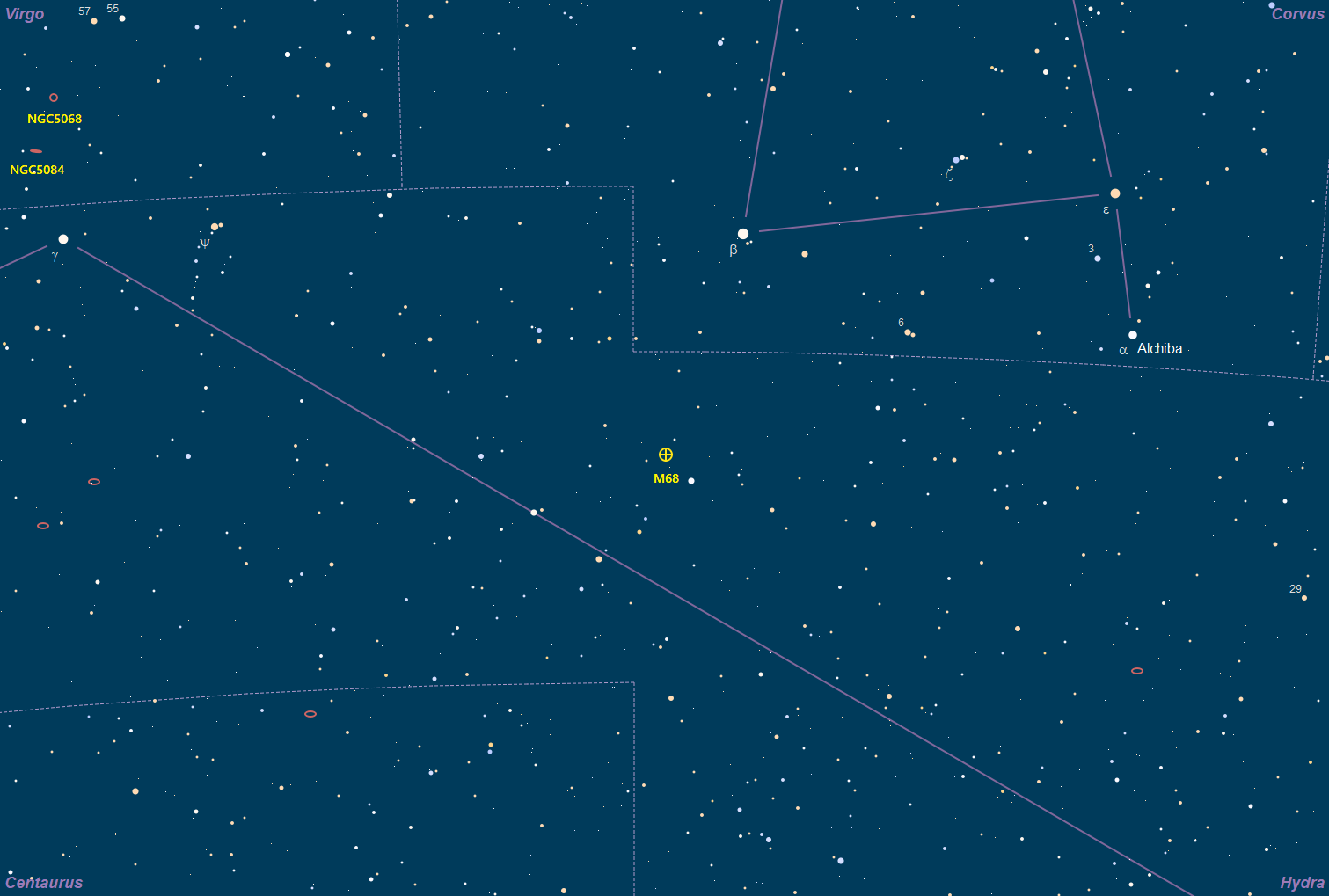
Hydra is the largest constellation in the night sky. The best time to observe Messier 68 is during the spring months. In Namibia, the star cluster even reaches the zenith. Messier 68 is a relatively difficult object for Central European observers. At its meridian passage, in the eastern part of the constellation Hydra, it does not reach a great height above the horizon. This significantly affects its brightness due to the denser atmospheric layers. To locate it, it is best to start from the constellation Corvus. From there, follow a line that extends from the star Delta Corvi (2.9 mag) toward the star Kraz (Beta Cor, 2.7 mag). Extending this line another 4.5 degrees southward reveals a double star (ADS 8612) with a brightness of 5.4 magnitudes. M 68 is located about 45 arc minutes northeast of this star.
 Finder Chart for Messier 68 (52.5 KiB, 49 hits)
Factsheet for Messier 68
Data and facts for the globular cluster Messier 68 in Hydra
| Object Name | Messier 68 |
|---------------------|---------------------------------|
| Catalog Designation | NGC 4590, GCL 20, ESO 506-SC30 |
| Type | Globular Cluster, X |
| Constellation | Hydra |
| Right Ascension | 12h 39m 28.0s |
| Declination | -26° 44′ 32″ |
| V Magnitude | 7.3 mag |
| Surface Brightness | 13.0 mag |
| Angular Size | 11.0′ |
| Diameter | 106 light-years |
| Distance | 33,600 light-years |
| Description | B,pL,R,vmbMBN,rr; * mags 17… |
| Discoverer | Charles Messier, 1780 |
| Star Atlases | Cambridge Star Atlas: Chart 11, 16 & 17
| | Interstellarum Deep Sky Atlas: Chart 81
| | Millennium Star Atlas: Charts 869–870 (Vol II)
| | Pocket Sky Atlas: Chart 47
| | Sky Atlas 2000: Chart 21
| | Uranometria 2nd Ed.: Chart 150 |