The Galaxy Messier 100 - Spreewald-Spechtler
The spiral galaxy Messier 100 (NGC 4321), located in the constellation Coma Berenices, was discovered on March 15, 1781, by French astronomer Pierre Méchain. It is a member of the Virgo Cluster and is known for its prominent spiral structure and starburst activity.
The spiral galaxy Messier 100 (NGC 4321), located in the constellation Coma Berenices, was discovered on March 15, 1781, by the French astronomer Pierre Méchain, along with M 98 and M 99. Following his own observation on April 13 of the same year, his friend and colleague Charles Messier eventually included the object in his famous nebula catalog just before completing the third and final edition of his catalog. He described M 100 as a faint nebula without stars in the ear of Virgo. The German-British astronomer Friedrich Wilhelm Herschel described M 100 as "a nebula with a diameter of about 10 arcminutes" and added that "in its center lies a small, bright cluster of supposed stars." His son John cataloged the galaxy as h 1211. He later included it as GC 2890 in the "General Catalogue." The spiral structure in Messier 100 was first observed in 1850 by the Irish astronomer William Parsons, the 3rd Earl of Rosse. It was one of the 14 spiral nebulae he discovered and described. He compared the central part to a planetary nebula while clearly recognizing the spiral structure of the halo. Other Messier galaxies listed by William Parsons included M 58, M 63 (Sunflower Galaxy), M 74 (Phantom Galaxy), M 77 (Cetus A), M 88, and M 96.
The Brightest Spiral Galaxy of the Virgo Cluster
The galaxy is a "Grand Design" barred spiral galaxy of type SAB(s)bc with an apparent diameter of 7.5 x 6.1 arcminutes and a brightness of 9.3 mag. Thus, the galaxy can already be found in small telescopes. Only about 10% of all spiral galaxies belong to the group of "Grand Design Spirals." It possesses features of Messier 51 in the Hunting Dogs and Messier 101 in the Great Bear. Like M 51, they are characterized by particularly prominent and well-defined spiral arms. M 100 is located in the southern part of the constellation Coma Berenices, at the border with the constellation Virgo. It is a member of the Virgo Cluster, which contains approximately 1,500 to 2,000 galaxies and is located at a distance of 56 million light-years. It stands at the far northern edge of this large collection of galaxies, far from the densely populated center of the cluster. At the same time, it is the brightest spiral galaxy of the cluster. It has a true diameter of nearly 118,000 light-years, a mass of about 200 billion solar masses, and an estimated 400 billion stars. Thus, Messier 100 is approximately the same size as our own Milky Way system. It has a similar luminosity to the Andromeda Galaxy (Messier 31). However, absolutely speaking, M 100 is significantly brighter than our Milky Way and ranks among the most luminous galaxies in the Virgo Cluster.
Messier 100 is a starburst galaxy. Star formation has occurred in several bursts predominantly within a ring of tightly wound spiral arms near the core over the last 500 million years. This phenomenon is likely caused by density waves moving through the galaxy. At the center of Messier 100 lies a supermassive black hole with an estimated mass of 25 million solar masses. In long-exposure images, the two clearly visible spiral arms appear complex, showcasing numerous prominent blue knots. These are massive star clusters of young, very hot, blue supergiants. They are active star formation regions, where deep narrowband images reveal red-emitting nebulae. Additionally, some weaker, fragmented spiral arms can be recognized branching off from the two main arms.
The slight asymmetries in both the spiral structure—the main arms appear slightly curved—and in the core region of the galaxy are attributed to tidal forces. These are caused by the spatial proximity of other galaxies in the Virgo Cluster. The asymmetry is also characterized by the fact that the southern side of the galaxy disk contains more young stars. At the center, a weakly defined, bar-like structure with a length of one kiloparsec is visible, which has been confirmed through observations in other wavelengths. M 100 also exhibits characteristics of a LINER galaxy. Its core contains an emission spectrum characterized by broad lines of weakly ionized atoms. Messier 100 is significantly larger than what is typically seen in conventional photographs. Deep images have shown that most of its mass is concentrated in the weaker outer regions, which have a diameter of 167,000 light-years. Like most spiral galaxies in the Virgo Cluster, M 100 shows a deficiency of neutral hydrogen gas compared to similar isolated galaxies. Therefore, the galaxy shows no signs of star formation in the remaining part of the disk. While traversing the Virgo Cluster, Messier 100 experiences a tidal pressure that strips its gas.
The galactic plane of Messier 100 is tilted by more than 60° to our line of sight. Thus, we have a very good view of the disk of this large spiral galaxy. For this reason, it was selected as part of the "H0 Key Projects" to measure the Hubble constant. Using the Hubble Space Telescope, 20 Cepheids in the galaxy disk were resolved, allowing for a very accurate distance determination based on the period-luminosity relationship. M 100 is likely somewhat closer to us than the central region of the Virgo Cluster with the two elliptical giant galaxies M 86 and M 87. Using the period-luminosity relationship of the Cepheids, its distance was determined to be 52.5 million light-years. However, this contradicts the distance of 66.5 million light-years calculated through recalibration of the Hubble parameter. Messier 100 is also considered the main galaxy of a smaller collection of world islands predominantly consisting of dwarf galaxies. This galaxy group is referred to as Holm 387. Two satellite galaxies of Messier 100 are known: one is NGC 4323, which is connected to M 100 by a bridge of matter. The other is the SA0 spiral NGC 4328, which can already be seen indirectly with an 8-inch aperture. However, due to its significantly lower redshift, this galaxy must be a foreground object.
Seven Supernovae in 120 Years
In 1979, the supernova SN 1979C was discovered in Messier 100. It reached a maximum brightness of 11.6 magnitudes. Using the X-ray telescope XMM-Newton, it was found that the Type II supernova (core-collapse supernova) still shines as brightly in X-ray light as it did at the time of the explosion. The progenitor star, with 18 solar masses, likely emitted a strong stellar wind 16,000 years ago. Due to the supernova explosion, the gas surrounding the star causes an afterglow in X-ray light. This is already unusual, as most supernova events fade relatively quickly within a few months. The remnant of the star has likely collapsed into a black hole.
In addition to SN 1979C, six other supernovae have been detected in M 100. The first was discovered in March 1901 and is designated SN 1901B. This was a Type I supernova that reached a brightness of 15.6 mag. In February and March 1914, the supernova SN 1914A was discovered, which reached a maximum brightness of 15.7 mag. However, its type could not be determined. The supernova SN 1959E reached its maximum brightness of 17.5 mag in August 1959 before it was actually discovered in February 1960. It was also of Type I. On February 7, 2006, the supernova SN 2006X was registered, which had a maximum brightness of 14.1 mag. The supernova SN 2019ehk was discovered on April 29, 2019, reaching a brightness of 15.8 magnitudes. It was of Type Ib. On January 7, 2020, the most recent supernova in Messier 100 was found. SN 2020oi reached an apparent brightness of 13.2 mag and was of Type Ic.
Observation
With a 7×50 or 10×50 binoculars, Messier 100 is difficult to recognize, as it has only a low surface brightness when viewed head-on. It can be seen much more easily with a 16x70 Fujinon binocular. It appears there as a round, nebulous spot. With a telescope with a 3 to 4-inch aperture and moderate magnification, only the inner region of the galaxy can be recognized as a slightly oval light spot with central condensation. Even at high magnification, the galaxy appears only as a pale sphere with a soft core and almost star-like center. M 100 forms a flat, isosceles triangle with two bright stars. With an aperture of 6 to 8 inches and magnifications of 100 to 200 times, the brightest parts of the spiral arms can already be discerned as shadowy nebular structures in the galaxy disk. The core area appears star-like. The core appears quite bright and is also surrounded by a nebulous halo. To the west of the core, a bright spot is visible where the spiral arms begin. The galaxy disk itself is relatively bright with an outwardly extending halo.
Under very good conditions, individual dust structures in the galaxy disk can be detected with an aperture of 10 to 12 inches, tracing the spiral arms. These appear as brighter areas to the east and west of the core. With an aperture of 16 to 20 inches, the two weak and tightly wound spiral arms peel away from the galaxy halo. They complete a full rotation around the center. The northern arm is weaker, while the southern is significantly better defined. The central region of the galaxy is characterized by a nearly circular, bright halo. The central region contains a star-like core and also appears slightly mottled. At the western edge of Messier 100, several stars are surrounded by a number of weaker galaxies. These include NGC 4322 (13.9 mag), NGC 4328 (13.3 mag), NGC 4312 (11.8 mag), and IC 783 (13.5 mag).
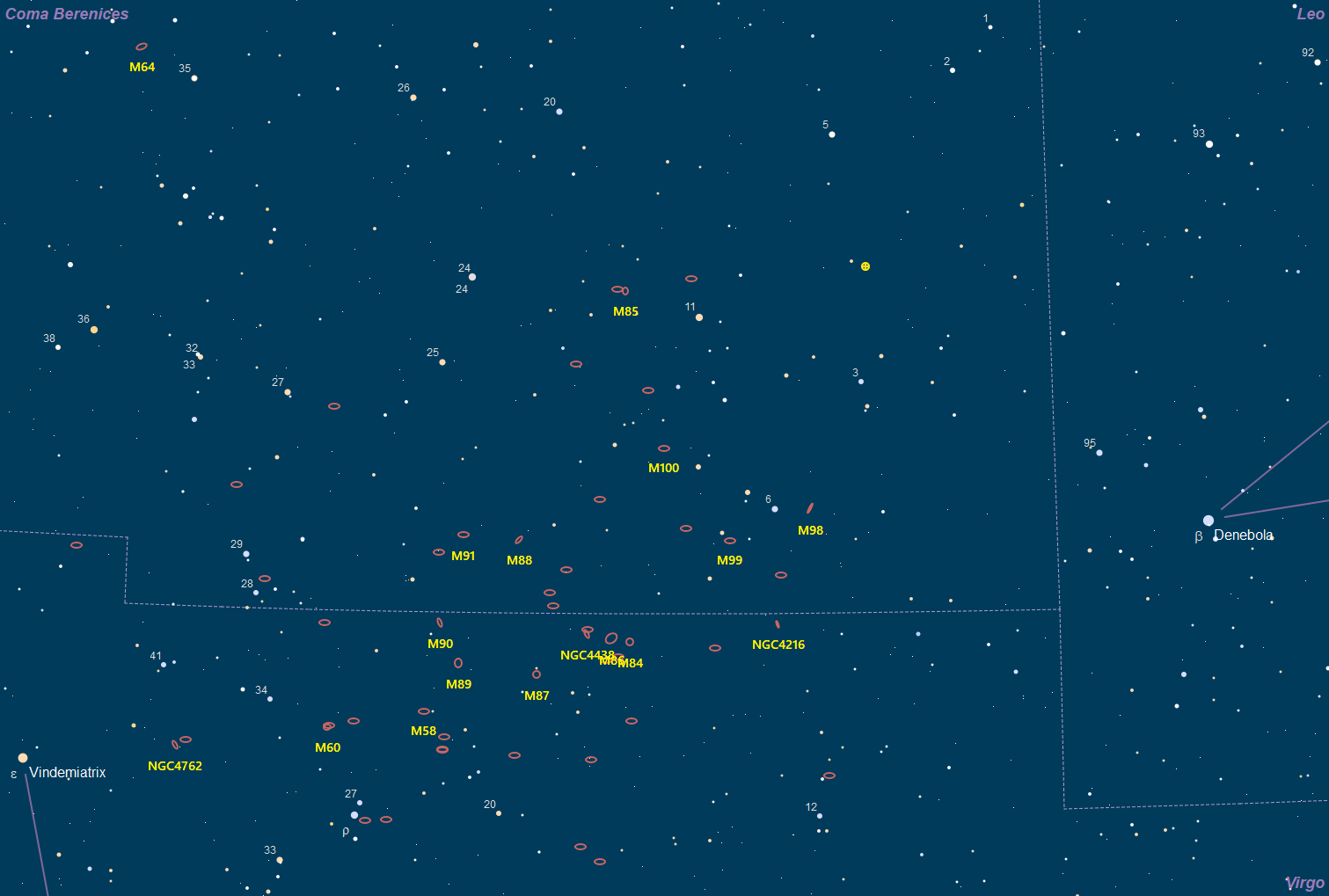
The best time to observe Messier 100 is during the spring months. The galaxy is located near the galactic north pole, about 2° southeast of the 4.7 mag bright star 11 Comae Berenices and northeast of the connecting line between Denebola (Beta Leo, 2.1 mag) and Vindemiatrix (Epsilon Vir, 2.8 mag). Denebola is about 8.4° west of M 100. We start at Beta Leonis, which we set in the finder. We then swing to 6 Comae Berenices (5