Tanabata/Qixi: The East Asian Festival of Stars and Love
Each year on July 7, Japan celebrates Tanabata and China observes Qixi, the Festival of Stars, entwining astronomy, mythology, and the custom of writing wishes for the future.

Every year on the seventh day of the seventh month (commonly observed as July 7), Japan celebrates Tanabata and China commemorates Qixi (七夕), known as the Festival of Stars. This cherished traditional event intertwines astronomy, mythology, and the custom of writing down wishes for the future, akin to a mid-year reflection that combines elements of both the European New Year's wishes and Valentine's Day. Notably, this festival occurs just after the International Kissing Day on July 6. The heart of this East Asian celebration revolves around an ancient tale of a couple who can only meet once a year.
A Love Story in the Sky
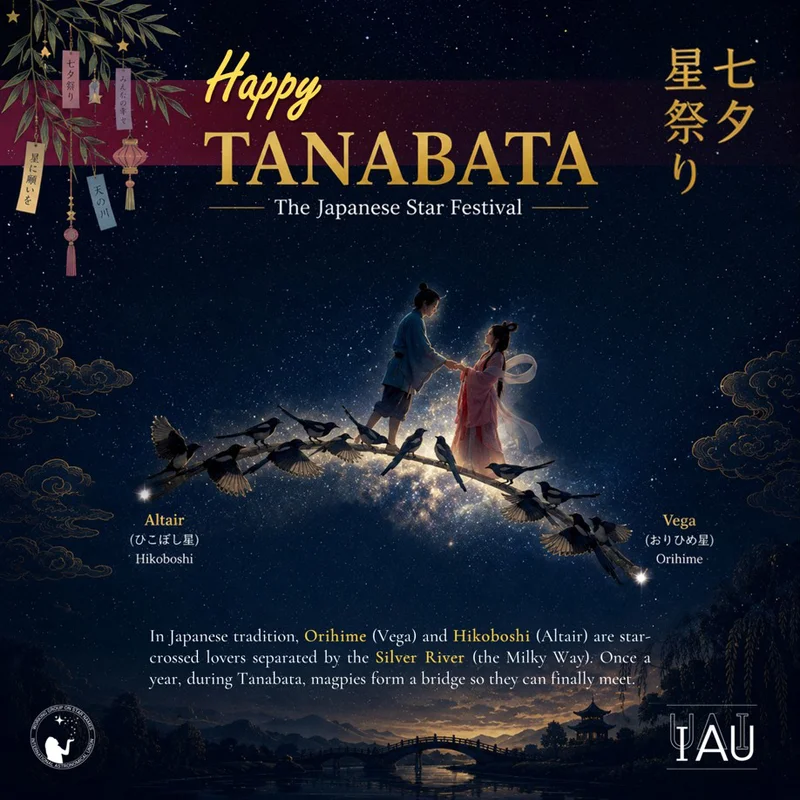
According to legend, Orihime (織姫) or Zhīnǚ (织女), the princess of weaving, is the daughter of the King of Heaven. Day after day, she crafted beautiful garments along the banks of the Milky Way. On the opposite side lived Hikoboshi (彦星) or Niúláng (牛郎), a diligent cowherd.
Their fateful encounter led them to fall deeply in love. However, their devotion to each other caused them to neglect their responsibilities, prompting the King of Heaven to separate them, banishing them to opposite sides of the Milky Way. In Japan, Orihime and Hikoboshi are represented by the stars Vega and Altair. In the Chinese narrative, the girl, Zhīnǚ, is not only associated with Vega but is also depicted in a trio of stars that symbolize her outstretched arms toward her beloved.
Once a year, on the seventh day of the seventh month, the couple is allowed to reunite. According to one version of the tale, magpies form a bridge across the Milky Way to facilitate their meeting. If it rains on this day, the bridge may be washed away, forcing the lovers to wait another year for their reunion. Alternatively, the rain might signify the difficulties they face, or even symbolize the tears of the lovers.
From China to Japan
The festival's roots trace back to the Chinese Qixi Festival, or the "Festival of the Seventh Night." Initially, this celebration in China was linked to women, crafts, skills, love, and the observation of stars, with weavers symbolizing wisdom. In recent times, it has been largely rebranded as the "Chinese Valentine's Day."
In the 8th century during the Nara period, the tradition made its way to Japan, where it merged with local customs and court ceremonies. Over the centuries, Tanabata evolved into a folk festival, a summer celebration characterized by the central feature of making wishes.
Unlike shooting stars, which are fleeting in Europe, the stars Vega and Altair remain ever-present:
Wishes to the Heavens
The most well-known Japanese custom involves writing wishes on narrow, colorful strips of paper called tanzaku (短冊). These are hung on bamboo branches adorned with intricately folded paper ornaments symbolizing luck, health, success, or prosperity. Different regions, such as Sendai and Shonan, have their own variations of this tradition, with some even observing it in early August according to the traditional lunar calendar.
As today marks the seventh day of the seventh month, it may be the perfect evening to jot down a wish and send it skyward, while keeping an eye out for Vega and Altair, the two stars that, according to legend, are allowed to meet only tonight.
Post Scriptum
For those who miss the opportunity on July 7, the lunar calendar allows for a celebration of the "seventh day of the seventh month" again this year on August 19.