Partial Solar Eclipse - August 12, 2026
On August 12, 2026, Germany will experience a partial solar eclipse, with 88.2% coverage expected in Offenbach. This event serves as a rehearsal for enthusiasts preparing for a total solar eclipse in Spain next year.
On August 12, 2026, Germany is set to witness a partial solar eclipse, a celestial event that promises to be significantly more impressive than the last one in 2021, which featured only about 11% coverage. This time, locations like Offenbach are expecting an impressive 88.2% coverage, making it a more visually striking experience. Meanwhile, Spain will have the opportunity to observe a total solar eclipse, not just this year, but also in the following year.
As I plan to travel to Spain next year with some fellow astronomy enthusiasts to experience the total solar eclipse, the upcoming partial eclipse in Germany serves as a perfect rehearsal for our equipment and observation techniques.
Finding the Right Observation Spot
Before the event, it was crucial to identify a suitable location with a relatively unobstructed view to the west, as the eclipse is scheduled to occur around sunset. To aid in this, I installed the app "Sun Surveyor" on my smartphone. This application projects the current sun position or that of any chosen date directly into the camera view of the smartphone. Equipped with this tool, I quickly found an ideal spot at a parking lot near a restaurant called Käsmühle in Bieber.
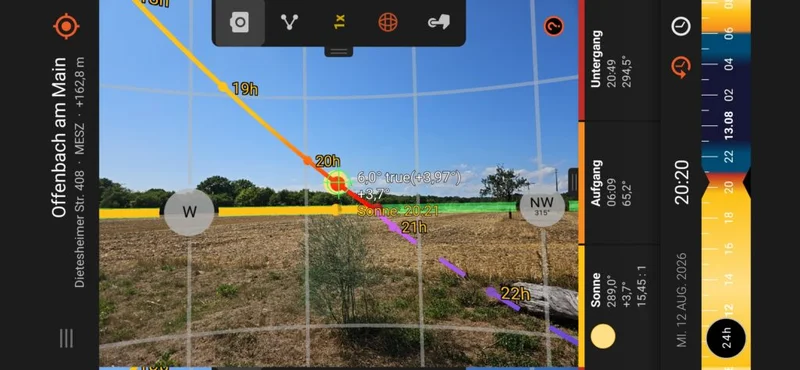
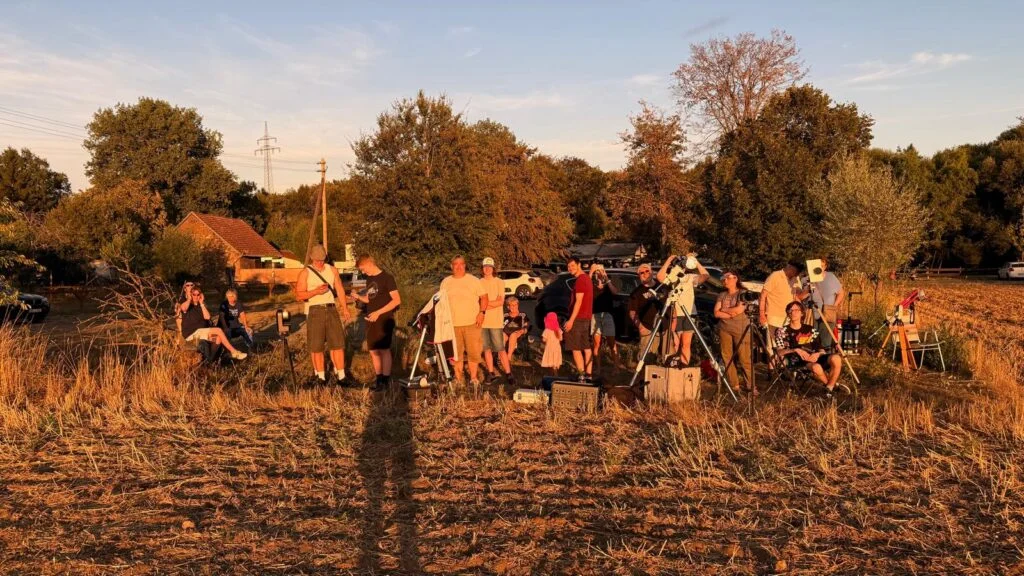
We arranged to meet at the parking lot on Wednesday at 6 PM. Joining me were Andy with his girlfriend and son, Jana, my son, and my mother with a friend. Later, my colleague and his family, along with a few others we hadn't met before, joined us.
Setup and Initial Observations
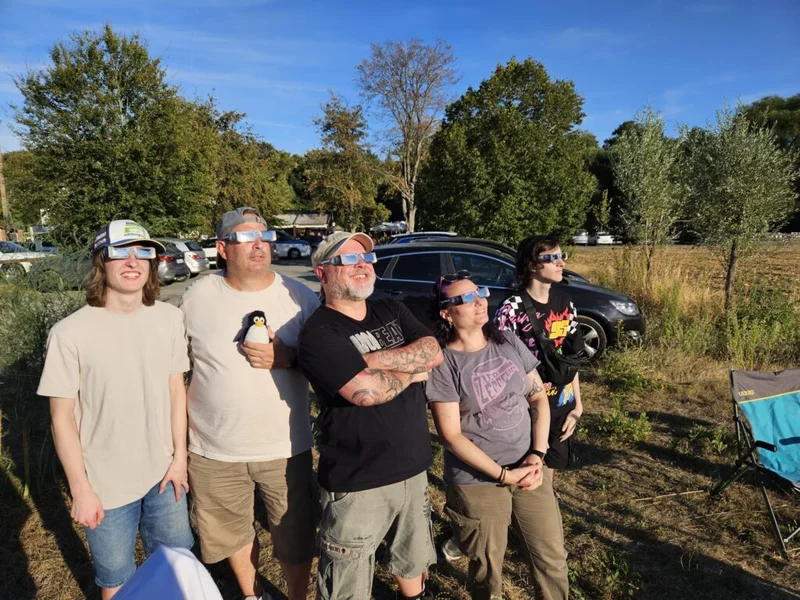
Upon arrival, Andy and I set up our equipment. My son Ben helped me with the setup of our telescopes. I had brought along a small H-Alpha telescope, the Seestar S50, and a dozen eclipse glasses. The Seestar was intended for a time-lapse recording. Before the eclipse began at 7:19 PM, we were able to observe a massive prominence through the H-Alpha telescope.
As the clock approached 7 PM, more enthusiasts arrived—some equipped with photography gear, while others carried only eclipse glasses. The atmosphere was friendly and relaxed, fostering quick conversations among attendees. Finally, the moment arrived, and we watched in awe as the moon slowly began to obscure the sun.
We tracked the progress of the eclipse using the eclipse glasses and through the H-Alpha telescope. Occasionally, I checked in on Andy's recordings as well.
The Climax
As the event reached its peak, noticeable changes in temperature and light conditions became apparent. Despite it not being a total eclipse, the temperature dropped, and the light took on an unusual reddish hue, quite different from a typical sunset.
Around 8:30 PM, the sun began to dip behind the treetops. I wrapped up my time-lapse recording with the Seestar and continued to observe with the eclipse glasses for as long as possible.
Results of the Rehearsal
Unfortunately, my rehearsal didn't go as smoothly as planned. The Seestar encountered issues with solar tracking during the time-lapse recordings, causing the sun to jump erratically in the captured video. Although I managed to correct some of these issues through extensive post-processing and frame removal, the outcome was not what I had envisioned. For future events, I might opt for individual shots and compile them into a video instead. Here’s the result of the video recording along with a collage featuring selected frames from the video:
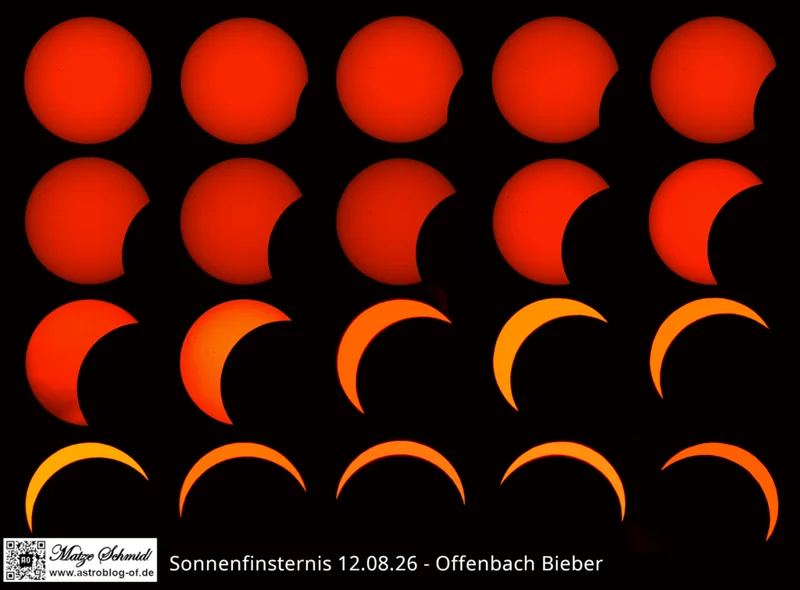
Image Sources
- Sun Surveyor: Matze Schmidt
- SoFi2: Jana
- 26–08–12_SoFi: Matze Schmidt
- SoFi1: Gregor K.