Night Sky in Danger: Satellite Flood Threatens Astronomy
A new study by the European Southern Observatory (ESO) reveals that plans to place over 1.7 million satellites in Earth orbit could have devastating effects on astronomy, highlighting the need for stricter regulations.
A new study by the European Southern Observatory (ESO) concludes that current plans to place over 1.7 million satellites in Earth orbit – including extremely bright objects – would have "devastating consequences for astronomy." To permanently secure the observation of the night sky with modern telescopes, the study suggests that the number of satellites in Earth orbit should not exceed 100,000 faintly glowing objects that are not visible to the naked eye. For the first time, the investigation quantifies the exact extent to which large and bright satellite constellations interfere with astronomical observations by brightening the night sky. These same satellite networks have previously raised concerns regarding their impacts on health and the environment.
Since 2019, the number of satellites in Earth orbit has rapidly increased to over 14,000 today, significantly driven by SpaceX's Starlink telecommunications satellites. At the same time, planned satellite projects have drastically increased both quantitatively and in terms of their potential impacts. "So far we have been able to manage the situation, but it is becoming increasingly critical," emphasizes Olivier Hainaut, who is involved in developing recommendations to mitigate the effects of satellite networks on astronomy. While companies like SpaceX have taken measures to reduce the brightness of their satellites, with the current proposals, according to Hainaut, "the limit of what astronomy can cope with has been exceeded." Hainaut, an astronomer at ESO for over 30 years, is the author of the peer-reviewed study on the impacts of satellite constellations, which has been accepted for publication in the journal Astronomy & Astrophysics.
SpaceX plans to launch one million additional satellites for space-based data centers into orbit, fundamentally changing the appearance of the sky. The new study shows that hundreds, and at certain times even several thousand, satellites would be visible over a large part of each night – corresponding to the number of stars that can be seen with the naked eye under good conditions. Other planned satellite networks, such as Cinnamon by E-Space and the Chinese systems CTC-1 and CTC-2, would add hundreds of thousands of additional satellites to Earth orbit, further exacerbating the problem.
The US startup Reflect Orbital also intends to launch a network of very large, mirror-like satellites. These are designed to reflect sunlight at night and produce beams of light with a diameter of at least five kilometers on the Earth's surface. The company plans to begin with a prototype in orbit later this year and expand the fleet to 50,000 satellites by 2035. These objects would be the brightest ever to be in orbit – with grave consequences for the preservation of the dark night sky. Hainaut's calculations show that the complete constellation would fill the night sky with hundreds of extremely bright, visible satellites. Viewed directly from within such a light beam, the sunlight-reflecting satellite would appear four times brighter than the full moon. Even if no satellite directs its beam directly at an observer, each one would be as bright as the planet Venus, the "morning star." From a city affected by light pollution like Munich, these hundreds of satellites would be the only "stars" still visible in the night sky.
These endeavors, combined with other projects examined in the study, would drastically brighten the night sky. This hinders humanity's ability to observe faint cosmic objects – including distant galaxies, Earth-like planets around other stars, and even asteroids that could potentially be dangerous to Earth.
Bright Trails and Brightened Sky
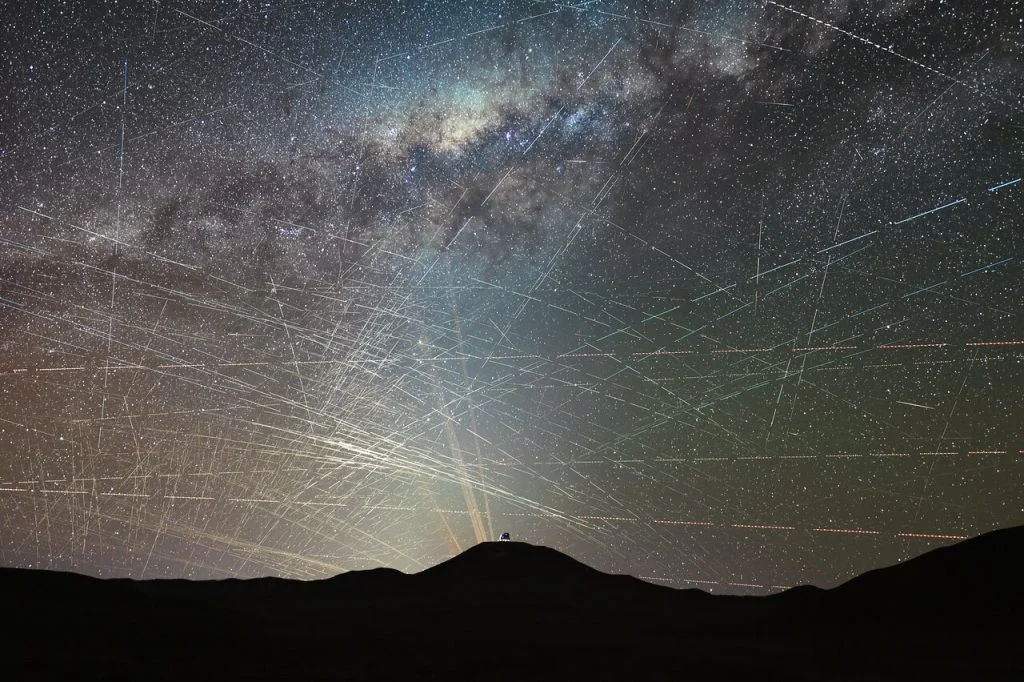
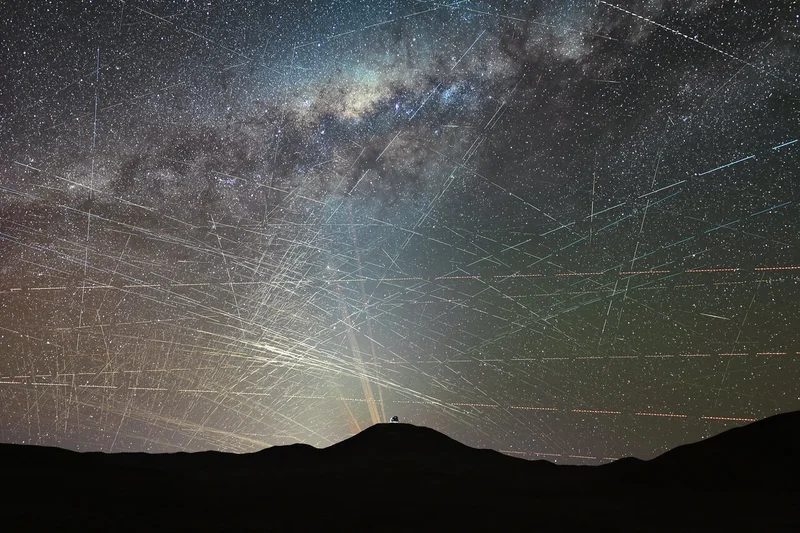
Hainaut explains: "Satellites illuminated by the sun are many times brighter than distant galaxies. When a satellite crosses our field of view, it leaves a bright streak on the image, obscuring everything behind it."
To calculate the extent of this and other effects of satellite networks on astronomical observations, Hainaut simulated the positions, movements, and brightness of all current and planned satellite constellations.
For SpaceX's planned satellite network, he found that dozens of satellite trails would appear on every image taken two hours after nightfall with the Very Large Telescope (VLT) of the ESO at the Paranal Observatory in Chile. This corresponds to a loss of usable field of view of up to 28%. This calculation assumes that the satellites are so faint that they are not visible to the naked eye under good conditions. If they were only slightly brighter, some instruments would be affected even more severely: For a camera like that of the Vera C. Rubin Observatory of the US National Science Foundation (NSF), most images could become unusable for several hours each night.
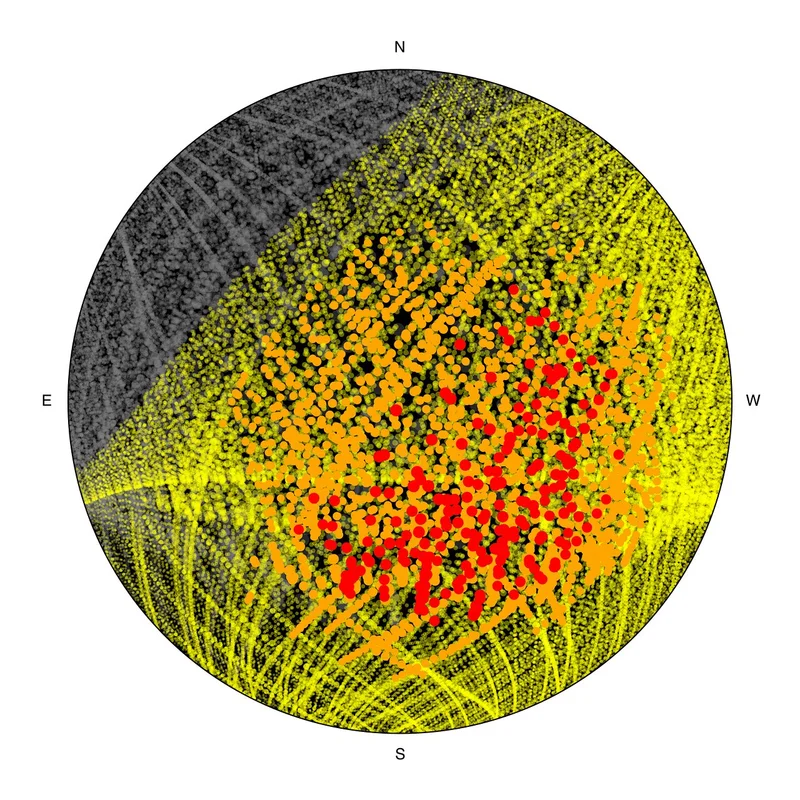
In Hainaut's simulations, it was assumed that no satellite from Reflect Orbital directs its beam directly at or near an observatory. Nevertheless, even the trail of a single mirror satellite could ruin an observation with a camera like that of the Rubin Observatory. If the complete fleet of Reflect Orbital were in orbit, every single image from such a camera would be lost as soon as the satellites are illuminated by the sun.
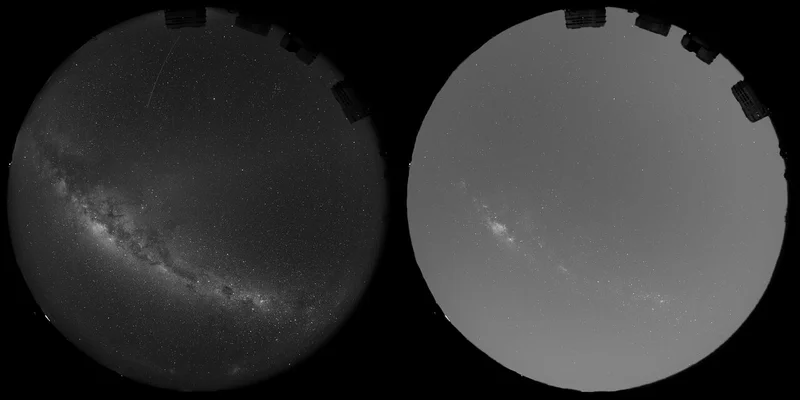
However, it is not just the crossing orbits of the satellites that limit astronomical work; their light can pollute the entire sky. Satellites that are too faint to be directly perceived create a veil of "diffuse" light, while the light from brighter satellites is scattered in all directions as it passes through the atmosphere. Both effects increase the background brightness of the night sky overall. This study for the first time considers the effects on astronomy caused by the contribution of satellite constellations to the overall background brightness of the sky, revealing the full extent of satellite-induced light pollution.
Particularly extremely bright constellations like those from Reflect Orbital would have a significant impact on the background brightness of the sky. With a total fleet of 50,000 Reflect Orbital satellites, the sky would be brightened overall by three to four times.
Limiting the Number of Satellites to Protect the Night Sky
Hainaut concludes that the planned 1.7 million new satellites will have drastic consequences for ground-based astronomy. These effects can only be averted by limiting the total number of existing and future satellites to 100,000. Additionally, these must be so faint that they cannot be perceived with the naked eye from a dark location. "This is not a rigid limit in the sense of: 99,999 is good and 100,001 is bad. Of course, I would prefer 50,000," says Hainaut. "But at 100,000, the losses are roughly on par with other technical failures, such as equipment malfunctions." He adds, however, that the satellites must have an apparent brightness of fainter than magnitude 7. If some of them are brighter – that is, above the visibility threshold of the naked eye – the allowable total number would need to be set significantly lower.
Both SpaceX and Reflect Orbital, which are responsible for the far-reaching of the new proposals, have submitted applications for their launches to the US Federal Communications Commission (FCC). The new study served as a basis for the ESO, in collaboration with the British Royal Astronomical Society and the International Astronomical Union, to provide an official statement to the FCC regarding these plans.
"The FCC has received over 1,800 statements on Reflect Orbital and nearly 1,500 comments on SpaceX's application," explains Betty Kioko, a liaison for institutional affairs at the ESO, who coordinates the organization's response to the applications. "The ball is now in the FCC's court, and we are waiting to see what decisions are made regarding both applications. For optical astronomy, this poses an existential threat, and we hope that the regulatory authorities share this assessment."
"Astronomy provides enormous value to humanity – in scientific, technical, economic, and educational terms – and helps us understand our place in the universe," says ESO Director General Xavier Barcons. "The large number of planned satellites in low Earth orbits calls this capability into question. This underscores the need to limit future satellite launches and requires close collaboration among astronomers, engineers, satellite operators, and other stakeholders to implement stringent countermeasures."
"The deployment of thousands of satellites has economic, ecological, and astronomical consequences," adds Hainaut. Light pollution from extremely bright satellite networks can disrupt health and life on Earth by disturbing biological rhythms and ecosystems. Large constellations also directly affect air quality – on one hand, due to the numerous rocket launches required to establish and maintain thousands of satellites, and on the other hand, due to the atmospheric burden created when satellites burn up upon re-entry at the end of their lifespan. "My area of expertise is astronomy, so I quantify the effects on astronomy," explains Hainaut. "I hope that professionals from other disciplines will assess the remaining impacts in their respective fields."
Hainaut summarizes: "Low Earth orbit is a cosmic coastline of immense value for modern life – from global connectivity to our unobstructed view of the universe. We must consider the ecological and visual footprint of these satellite networks and take action to protect our night sky."