Lunar Eclipse on March 14, 2025: What to Expect
On March 14, 2025, skywatchers will witness a lunar eclipse, a captivating astronomical phenomenon. This article explores what a lunar eclipse is, why it occurs, and the visibility conditions for this event.
On the morning of March 14, 2025, skywatchers will have the chance to witness a lunar eclipse, an always fascinating astronomical event, though visibility conditions can vary significantly depending on timing and the geometry of the occurrence.
What exactly is a lunar eclipse? Why does it happen, and what are the necessary conditions for observing it? This article delves into these questions to provide a clearer understanding of the upcoming event.
What is a Lunar Eclipse?
A lunar eclipse occurs when the Moon passes through the Earth's shadow, temporarily darkening its surface. This phenomenon can only take place during the full moon phase, when the Sun, Earth, and Moon are nearly perfectly aligned. Depending on how much of the Moon enters the Earth's umbra, three types of eclipses can be observed:
- Total Lunar Eclipse: The Moon is completely engulfed in the Earth's shadow, taking on a characteristic reddish hue due to the scattering of sunlight through the Earth's atmosphere.
- Partial Lunar Eclipse: Only a portion of the Moon enters the shadow, leaving part of the disk illuminated.
- Penumbral Lunar Eclipse: The Moon passes through the Earth's penumbra, resulting in a slight darkening that is not easily noticeable to the naked eye.
The March 14, 2025 event is marked as a total lunar eclipse in the almanacs, but in many regions, including Italy, it will be recorded as partial, meaning that only part of the Moon will appear obscured.
Why Do Lunar Eclipses Occur?
Lunar eclipses happen because the Moon's orbit around the Earth is tilted by about 5 degrees relative to the Earth's orbit around the Sun, intersecting at two points known as the 'nodes'. This means that during most full moons, our satellite either passes above or below the Earth's shadow without crossing it. However, on certain occasions, the alignment of the three bodies during a node crossing is nearly perfect, allowing the Moon to enter the Earth's shadow and resulting in a lunar eclipse.
How Often Do Lunar Eclipses Occur?
Lunar eclipses occur on average twice a year, but not all are visible from the same location on Earth. This is due to the Earth's rotation; depending on the observer's geographical position, the Moon may not be above the horizon during the eclipse. Additionally, the type of eclipse depends on the degree of alignment between the Sun, Earth, and Moon. Therefore, the eclipse is visible in all locations where the Moon is above the horizon at the time of the node crossing.
Each eclipse features various phases, including:
- start of the penumbral eclipse (P1),
- start of the umbral eclipse (U1),
- potential start of totality (U2),
- maximum eclipse (MAX),
- potential end of totality (U3),
- end of the umbral eclipse (U4),
- end of the penumbral eclipse (P4).
As these phases occur at different times, it is not guaranteed that every location will see all phases; the Moon may rise or set during the various stages, leaving only the entry or exit phases visible.
Below are the phases of the eclipse on March 14, along with the coordinates of the Sun and Moon at the time of maximum eclipse.
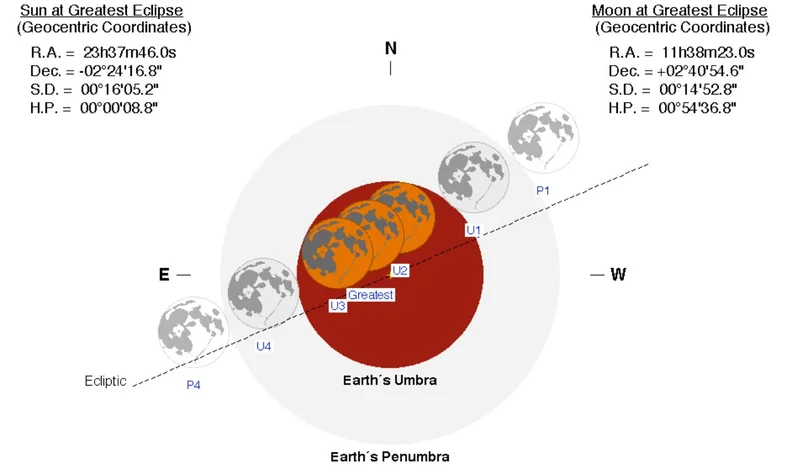 Fasi dell'eclisse totale/parziale di Luna del 14 marzo 2025. Crediti NASA