Gravitational Lensing: Unraveling the Mystery of Massive Stars
Discover how gravitational lensing reveals the mysteries of massive stars and contributes to our understanding of the universe through advanced astronomical techniques.
Gravitational Lensing: Unraveling the Mystery of Massive Stars
The invisible force of gravity has a profound impact on our universe, with one of its most captivating phenomena being gravitational lensing. This complex concept, beautifully illustrated by general relativity, demonstrates how massive celestial objects can bend the paths of light, distorting the images of stars that lie beyond. This article delves into the mechanisms, historical discoveries, and modern applications of this remarkable phenomenon.
What is Gravitational Lensing?
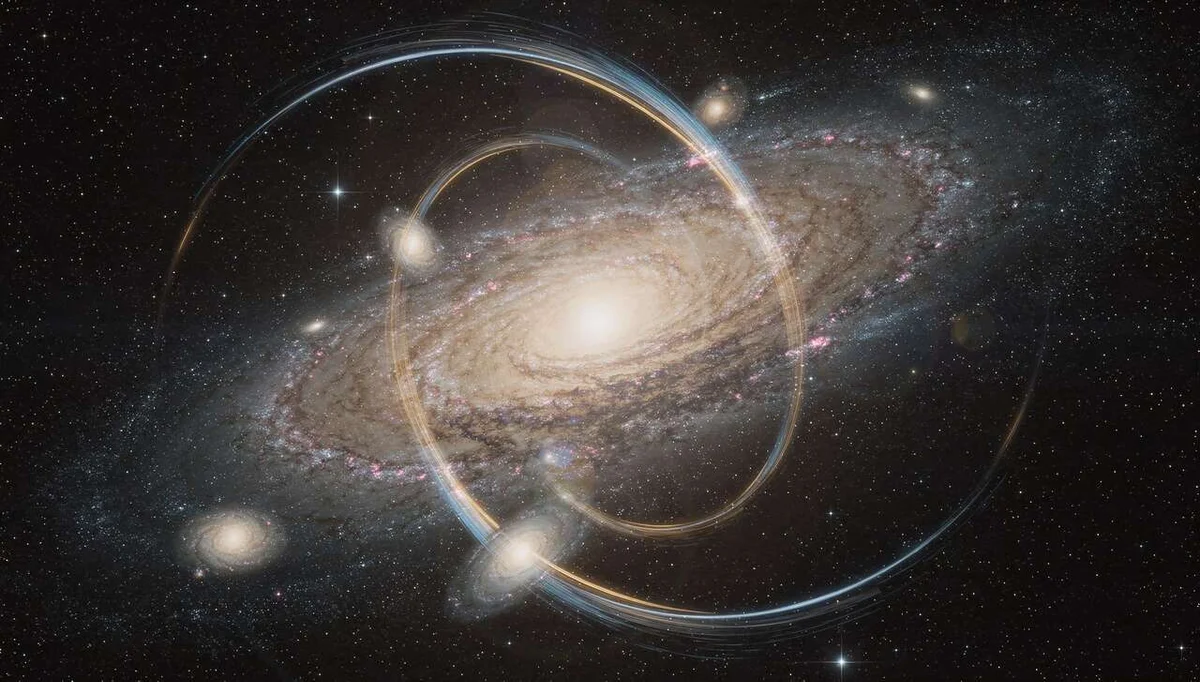
Gravitational lensing occurs when light from a distant star or galaxy is bent around an intervening massive object, such as a galaxy or a cluster of galaxies. This process is akin to an optical lens that focuses light, allowing us to observe objects that would otherwise be too faint or far away. The amplification of light makes distant celestial bodies more visible, enhancing our view of the cosmos through the curvature of spacetime.
The phenomenon is most effective when there is a perfect alignment between the observer on Earth, the distant object, and the intervening gravitational mass. This alignment can lead to the formation of luminous arcs or Einstein rings, which are spectacular images of the distorted light sources.
Historical Discovery of Gravitational Lenses
Early Theoretical Predictions
The concept of gravitational lensing first emerged as a theoretical prediction inspired by Einstein's general relativity. In 1915, Einstein introduced his famous equation, proposing that gravity is not a force but a curvature of spacetime caused by mass. By the 1920s, scientists began to recognize that this curvature would also affect light rays.
Experimental Validation
The first experimental confirmation came in 1919 during a total solar eclipse. Astronomers observed stars appearing displaced from their usual positions due to the Sun's gravity. This success not only validated Einstein's theory but also laid the groundwork for future astronomical advancements. Since these initial discoveries, our understanding of gravity's ability to bend light has led to countless applications, propelling the study of distant and unknown universes.
How Does Gravity Distort Light?
The Concept of Spacetime Curvature
According to general relativity, the presence of a massive object distorts the spacetime around it. This curvature dictates the path that light takes, transforming what would be a straight line into a curve influenced by gravitational forces.
Gravitational Lens Experience
As a light beam passes near a massive object, its trajectory is deflected, much like a projectile altered by a magnetic field. The closer the light gets to the mass, the more pronounced the curvature becomes, resulting in spectacular outcomes when these deviations accumulate over distances. Understanding these distortions is crucial not only for cosmological studies but also for leveraging these phenomena in modern astronomical discoveries.
Applications of Gravitational Lenses in Astronomy
Identifying Exoplanets
Gravitational lenses serve as tools for detecting exoplanets. When lensing occurs, it reveals objects that would otherwise be invisible or challenging to detect from Earth. The variations in light caused by these events are meticulously studied to identify new planets orbiting distant stars.
Exploring Distant Galaxies
This phenomenon is also vital in studying far-off galaxies. By distorting the light from galaxies behind those acting as lenses, astronomers can reconstruct the structures of these distant galaxies, providing valuable insights into the universe's evolution. Through these modern applications, gravitational lenses remain central to astronomical research, enhancing our understanding of celestial mysteries.
Studies and Discoveries Enabled by Gravitational Lenses
Accumulation of Cosmic Data
Analyzing gravitational lenses yields a wealth of information about the universe. Using tools like the Hubble Space Telescope and ALMA, valuable images have been captured, highlighting unusual and sometimes hidden structures within the cosmos.
Significant Discoveries
Researchers have uncovered complex galaxy clusters, gigantic black holes, and supernovae through this technique. As imaging technology advances, gravitational lenses continue to unlock new perspectives on the cosmos. Ongoing research plays a critical role in our quest to understand the universe, but these distorted images also present considerable challenges for scientists.
The Challenge of Interpreting Distorted Images
Complexity of Visual Data
Interpreting visual data from gravitational lenses is no simple task. The distorted images require advanced image processing techniques for analysis. Scientists must employ creativity by utilizing sophisticated algorithms to reformulate the images and extract valuable information.
Necessary Technological Advances
The continuous development of new technologies is essential to overcome these challenges. The integration of artificial intelligence in interpreting these images offers promising possibilities for refining our models and improving the accuracy of our interpretations. By enhancing our ability to analyze these images, we also broaden our understanding of the profound implications of these phenomena on the universe itself.
Implications of Gravitational Lenses for Our Understanding of the Universe
Insights into Cosmic Forces
Gravitational lenses allow us to glimpse the actions of cosmic forces that govern the universe. They make the interaction between dark matter and visible matter perceptible, helping to solve fundamental mysteries that still perplex astrophysics.
Impact on Modern Cosmology
By contributing to the measurement of cosmic distances and the detection of the oldest galaxies, these lenses provide a unique framework for understanding at a cosmic scale. They also enhance the precision of cosmological models, which are essential for predicting the universe's evolution.
In this way, gravitational lenses continue to inspire innovations and research in astrophysics, progressively expanding our understanding of the cosmos. From their theoretical foundations to their practical impacts, these phenomena play a crucial role in modern astronomy, opening windows to the invisible and unveiling secrets that remain elusive. With their radical implications, they continually enrich our perception of the universe and promise to reveal even more mysteries in the future.