Galactic Center Gamma Excess: A New Perspective on Dark Matter
A new study suggests that the gamma excess from the Galactic Center may be more convincingly linked to dark matter than to millisecond pulsars, employing advanced neural network analysis.
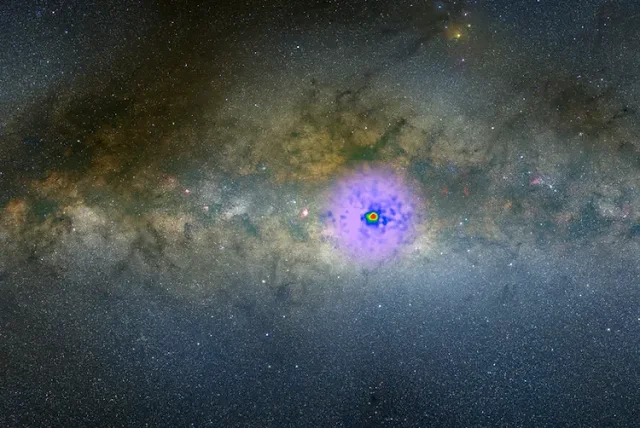
In 2011, researchers Dan Hooper and Lisa Goodenough from Fermilab published a groundbreaking study that proposed the existence of a mysterious excess of gamma rays emanating from the galactic center. This phenomenon was initially interpreted as a potential signal of exotic dark matter particle annihilation. However, as time passed, an alternative explanation emerged, attributing the gamma ray emissions to the presence of numerous millisecond pulsars. The debate between these two hypotheses has intensified over the years, with a growing preference for the pulsar explanation, even as the dark matter hypothesis remained on the table. Recently, a team of researchers has reexamined the data with a fresh approach, focusing on the energy of individual gamma photons. Their findings, published in the prestigious Physical Review Letters, suggest that the dark matter hypothesis is now more compelling than the pulsar scenario.
A key method for resolving the nature of the gamma excess from the Galactic Center (GCE) involves leveraging the characteristics of a point source, which can produce multiple photons from the same location. The predicted pixelated map of photons from dark matter annihilation follows a Poisson distribution. While this distribution is influenced by the uncertain underlying dark matter distribution in the inner galaxy, a detector would observe a relatively smooth spatial distribution punctuated by Poisson fluctuations. Point sources, due to their ability to emit multiple photons from a single position, introduce additional variations from pixel to pixel in the photon map. Even weak sources, which cannot be detected individually, can collectively alter the observable photon map compared to the Poisson prediction.
This intuition can be encoded into an analytical likelihood framework to distinguish between scenarios, as demonstrated in 2016 by Lee and colleagues, who argued that the GCE originated from point sources, specifically pulsars. However, the robustness of these methods has been debated since 2019. What remains indisputable is that computational feasibility necessitated evaluating the likelihood with two significant approximations: first, pixel-to-pixel correlations were neglected, and second, photon energies were disregarded.
Over the past five years, machine learning approaches have been successfully employed to surpass the first approximation. Notably, a likelihood-free analysis using convolutional neural networks concluded that while the GCE could have a point source origin, these sources would need to be considerably weaker than previously determined in earlier likelihood studies.
Florian List from the University of Vienna and his collaborators have again utilized the convolutional neural network methodology, this time to demonstrate that it can also eliminate the second approximation, providing the first energy-dependent analysis of the GCE's point source nature.
Conceptually, this represents a significant advancement in GCE studies. It is known that the GCE has a distinct spectrum from the dominant background. Thus, energy information serves as a powerful lever through which methods could disentangle its nature by identifying modeling errors in the background. Using their method, List and his team found a spectrum for the excess that resembles previous studies but indicates a population of sources that are much less luminous, with a median prediction compatible with a purely Poisson emission, as would be expected for a dark matter-related origin.
This contribution is substantial since the energy information leads to the assumption that the supposed point sources are significantly less luminous, indicating either that the galactic center excess is inherently diffuse or composed of an exceptionally high number of point sources. Quantitatively, for List and his collaborators' best background model, if the excess is due to point sources, the median prediction for the number of pulsars is around 100,000, and at least more than 35,000 with a 90% confidence level. In both scenarios, this represents a population several orders of magnitude larger than the few hundred pulsars favored by previous analyses of point sources in the galactic center.
The researchers note that variations allowed by systematic background uncertainties could reduce the required number of sources by about a factor of ten. However, this still exceeds a few hundred. They emphasize that this remains the primary systematic uncertainty warranting further investigation. Beyond updated diffuse models, their neural network could be trained on linear combinations of different background models, incorporate adaptive template fitting methods, or even weighted models using polynomials or harmonics. This opens up intriguing avenues for future work on this crucial and exciting question.
Although the problem is notoriously challenging, progress remains possible, and machine learning proves to be a powerful tool for overcoming past limitations. List and his colleagues have produced the first simultaneous inference of the GCE spectrum and the source number distribution, revealing that including energy shifts the source distribution to render it indistinguishable from the Poisson emission predicted by the dark matter hypothesis. This weakens one of the main pieces of evidence supporting the millisecond pulsar hypothesis.
Looking ahead, several direct extensions of this study should be explored. For instance, the method could be applied to a broader energy range, particularly at lower energies where the GCE's unique spectrum might become clearer. More broadly, while the convolutional neural network approach is effective, it may not yet represent the optimal use of machine learning for this problem. Investigating how these methods can be pushed further is a vital step for the future, especially in determining whether the discovery of dark matter was made back in 2011 through the detection of a gamma ray excess in the galactic center.