Exploring the Constellation of Lupus: A Guide to Astronomy
Discover the constellation of Lupus, its main stars, deep sky objects, and the mythology surrounding it. Learn about this southern hemisphere constellation and its significance in astronomy.
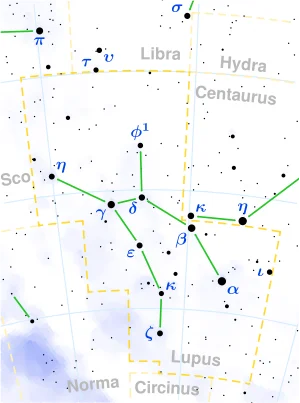
Constellation: LUPUS:
Introduction:
Lupus, a constellation located in the southern hemisphere, lies nestled between Centaurus and Scorpius. Observers in Spain can only glimpse its northernmost section.
This relatively small constellation features approximately thirty stars of second and third magnitude, with the Milky Way stretching across its southern expanse. Lupus crosses the 40° south latitude parallel, making it a noteworthy sight in the southern sky.
Lupus is home to numerous double and multiple stars, although it contains few star clusters.
Main Stars:
| Letter | Name | Magnitude | + Info | |--------|---------------|-----------|---------------------------------------------| | a | Alpha Lupi | 2.3 | Blue giant star; the brightest in the constellation. | | b | Beta Lupi | 2.68 | Blue giant star; second brightest in the constellation. | | g | Gamma Lupi | 2.78 | Blue supergiant, 1900 times brighter than the Sun. | | d | Delta Lupi | 3.22 | Blue subgiant star. | | e | Epsilon Lupi | 3.37 | Binary blue subgiant star. |
α (Alpha Lupi): Alpha Lupi is the brightest star in the Lupus constellation, shining with a magnitude of 2.3. Located about 550 light-years away, it is classified as a blue giant.
β (Beta Lupi): Beta Lupi follows as the second brightest star, with a magnitude of 2.68. This blue giant is situated approximately 524 light-years from Earth.
d (Delta Lupi): Delta Lupi, a blue subgiant, has a magnitude of 3.22 and lies around 510 light-years from our planet.
ε (Epsilon Lupi): Epsilon Lupi, with a magnitude of 3.37, is located about 506 light-years away and is classified as a binary blue subgiant.
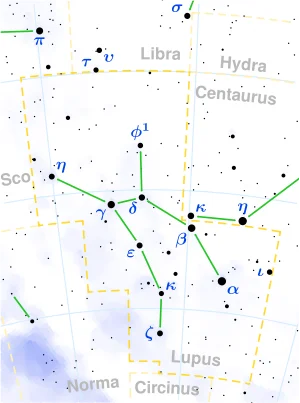
Deep Sky Objects: To the north of Lupus, two globular clusters can be observed: NGC 5824 and NGC 5986. While neither is visible through binoculars, they can be seen with small telescopes. Another globular cluster, NGC 5927, is situated around 24,000 light-years from Earth and requires a telescope for viewing. To the south, two open clusters, NGC 5822 and NGC 5749, can be found. Additionally, NGC 5643 is a barred spiral galaxy. The planetary nebula IC 4406, located on the western edge, is particularly interesting due to its inclusion of some of the hottest stars known. The planetary nebula NGC 5882 is found towards the center of the constellation.
Mythology of the Constellation: Arcade, the son of Zeus and the huntress nymph Calisto, was entrusted to Maya for upbringing after Calisto's death. Through his maternal lineage, Arcade was the grandson of King Lycaon, who ruled the land that would eventually be known as Arcadia. One day, when Zeus visited Lycaon, the king served him the dismembered parts of Arcade as a meal. There are two differing accounts of Zeus's reaction: one suggests that Zeus restored Arcade’s body and transformed him into a star (Arcturus), while the other indicates that after reviving him, Zeus punished Lycaon by turning him into a wolf, hence the name Lupus, allowing Arcade to succeed him on the throne.