Exploring Star Names in Education
An Italian primary school project on star names and constellations has garnered appreciation for its educational value, showcasing the intersection of astronomy and mythology.
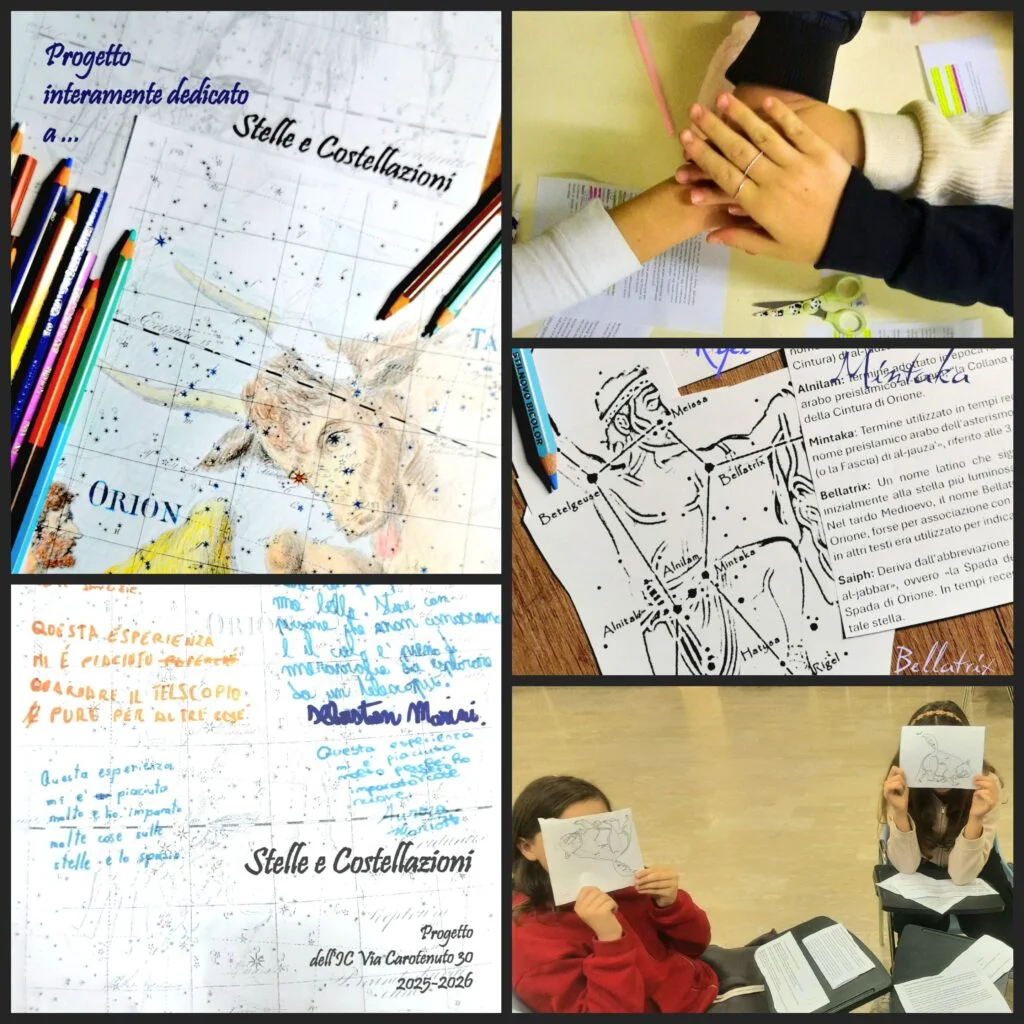
Today, I am pleased to share a letter that reached the IAU Working Group on Star Names (WGSN) last week: Two Italian primary school teachers expressed their joy over the educational materials we have made available online, as they have found them beneficial for their teaching. The letter was originally written in English and has been translated into German using DEEPL, due to time constraints. The original text can be read on the WGSN website.
Dear friends at WGSN,
I am excited to inform you that, with the help of a colleague, I recently conducted a project for a group of about twenty primary school students at I.C. Via Carotenuto 30 in Rome. This project focused on star names, identifying constellations, exploring the mythological stories behind them, and understanding the etymology of the names of their brightest stars.
Unfortunately, the sky above our city only allows us to see the brightest stars at night, which is quite disappointing. For the young students, it was truly thrilling to connect these points and recognize the shapes and figures that emerged from the imaginations of ancient cultures. They listened to mythological tales and learned to describe dozens of stars, including Betelgeuse, Sirius, Mirzam from the winter constellations, and Arcturus, Mizar, Nekkar, and Seginus from the spring constellations, while also grasping the meanings of these terms.
Starting with easily recognizable asterisms like Orion's Belt and the Big Dipper, we gradually moved on to the other stars that make up Orion and the Big Dipper, and then to those in the neighboring constellations. This process helped us learn how to orient ourselves, recognize their faint colors, understand why they twinkle, and realize that behind the appearance of these tiny points lie massive spheres of extremely hot gas, just like the Sun.
When the sky was cloudy, we used the software “Stellarium” as a virtual night sky. However, on clear nights, the ceiling of our classroom transformed into the actual sky. In addition to observing with the naked eye, we also examined some stars through a telescope to discover their binary nature and to better appreciate their colors.
Our research sources included the IAU Catalog of Star Names (CSN) and the website exopla.net. I am sharing this to express my gratitude, on behalf of my students and colleagues, for your fantastic work that enables us to name and evoke the stars of the night sky with both knowledge and poetry. Thank you very much!
Best regards,
Paolo Palma and Tiziana Gentili
“I think that the night is more alive and more richly colored than the day.” Vincent van Gogh

Disclaimer
Of course, I would normally not publish letters (letter secrecy: Basic Law Art. 10, Italian Constitution Art. 15), but this publication was explicitly authorized. We hope it inspires other teachers.