Betelgeuse's Companion Star Confirmed: A Significant Discovery in Astronomy
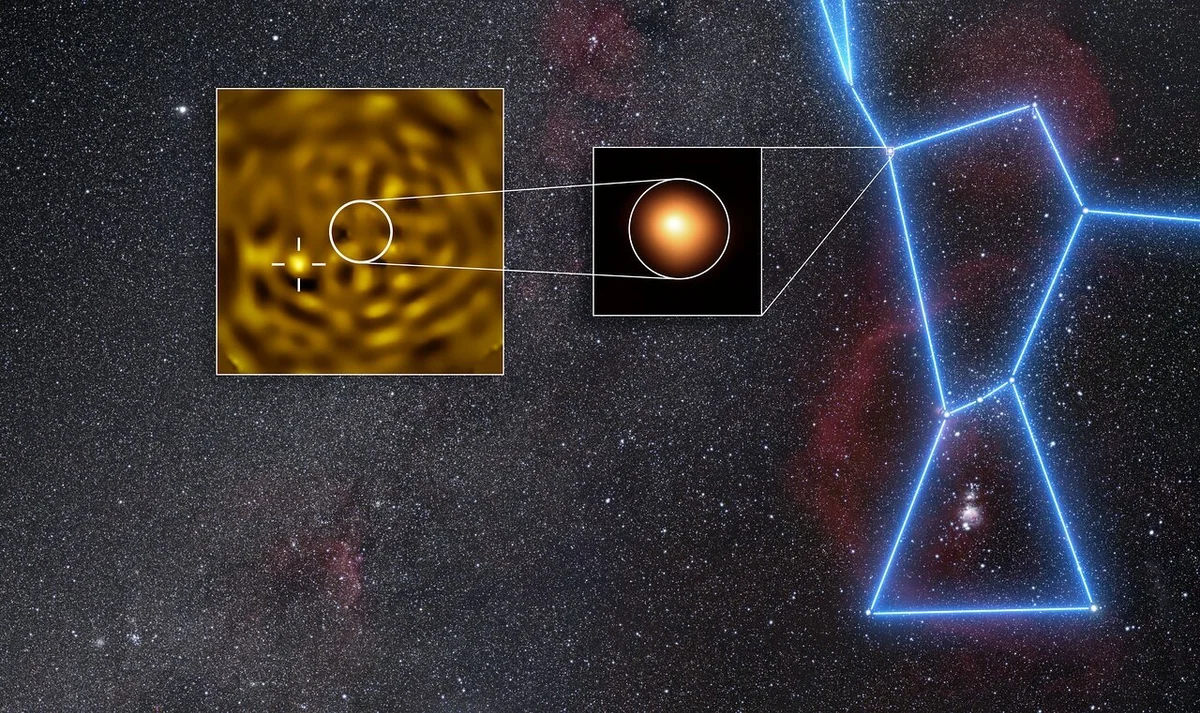
The VLT of ESO has captured the clearest image ever of Betelgeuse B, confirming a century-old hypothesis about the companion star of Betelgeuse.
Betelgeuse's Companion Star Confirmed: A Significant Discovery in Astronomy
For nearly a century, astronomers have speculated that Betelgeuse, the famous red supergiant in the constellation Orion, is not a solitary star. An international team led by Miguel Montargès from the Paris Observatory has provided the most compelling evidence yet: a sharp image of what appears to be Betelgeuse B, the star that orbits this red giant.
Timing the Observation of Betelgeuse
Utilizing the Very Large Telescope (VLT) of the European Southern Observatory (ESO) in Chile, the team employed the SPHERE instrument, originally designed for exoplanet hunting. Two studies published in 2024 had accurately predicted that in December of that year, the companion star would reach the farthest point in its orbit from Betelgeuse, making it easier to observe separately from the blinding light of the primary star. Astronomers seized this opportunity, gathering data in December 2024 and dedicating several months to processing it.
A Discovery Beyond Expectations
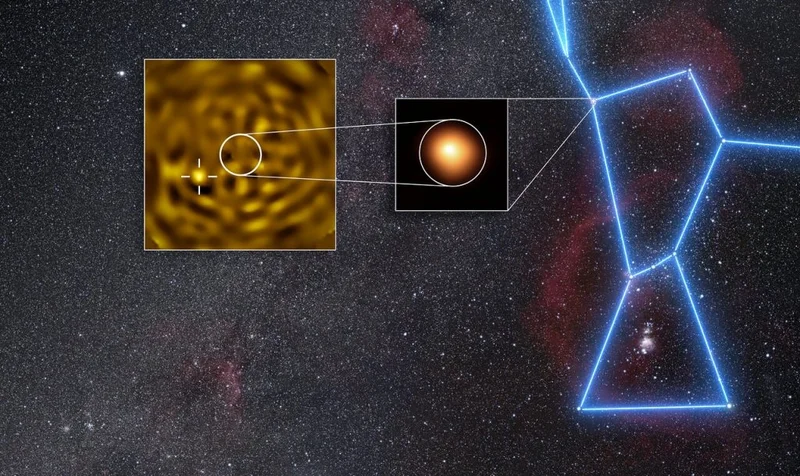
The results surprised even the researchers themselves. Montargès initially feared that the sensitivity of the instrument might not be sufficient to detect the companion star at the anticipated size. However, the new observations revealed that Betelgeuse B is significantly more massive than initially thought, estimated to be two to three times the mass of the Sun, rather than comparable to it as previously believed. This greater mass has enabled the direct observation of light from the companion star.
The Significance of the Betelgeuse Image
While there had been hints of the companion's existence in the past, including a potential direct sighting made with the Gemini North telescope in Hawaii, the image captured with the VLT represents the most solid evidence and the clearest image ever obtained of Betelgeuse B. To confirm this discovery, the research team plans to observe the system again in about a year, when the companion will be positioned on the opposite side of the primary star compared to its current location.
A Recent Enigma
Betelgeuse regained public attention a few years ago when its brightness dramatically decreased, sparking speculation about an impending supernova explosion. The same team led by Montargès had demonstrated that this phenomenon was due to a cloud of dust temporarily obscuring the star, rather than an imminent collapse.
Future Implications
The confirmation of Betelgeuse B raises new scientific questions: astronomers will need to investigate how the presence of this companion may influence the evolution of the red supergiant and its eventual supernova explosion, an event that remains expected on astronomical timescales, not imminent in human terms.