The Veil Nebula: A Stunning Cosmic Tapestry in Cygnus
Explore the stunning Veil Nebula in Cygnus, a cosmic tapestry of gas and light, captured through advanced astronomical techniques. Discover its beauty and mysteries.
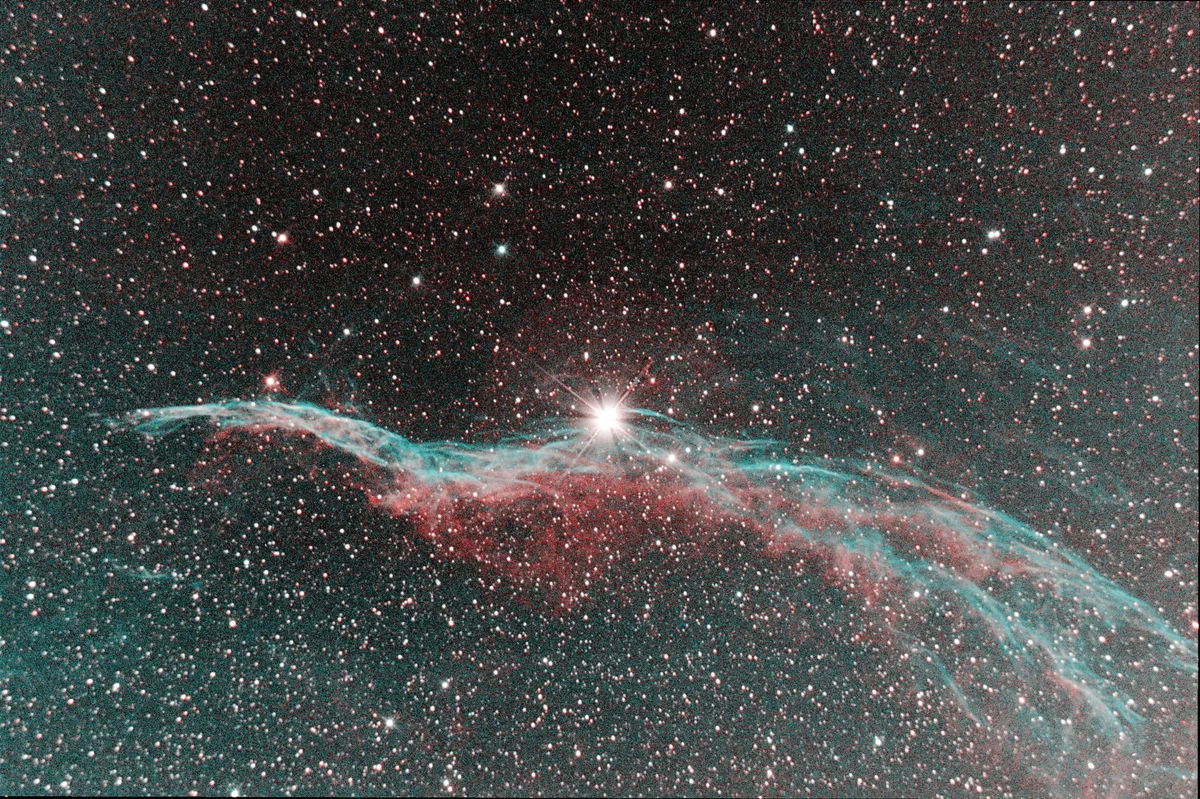
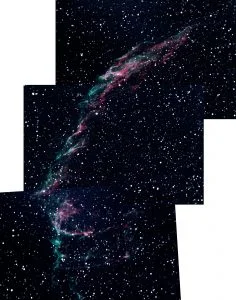
The image is a composite of five exposures, each lasting five minutes, taken on June 1, 2022, totaling 25 minutes of integration under a sky affected by artificial light pollution from the outskirts of Sassari. Equipment used included a 250mm diameter Newton Skywatcher telescope and a QHY8L CCD camera cooled to -15°C, among other specialized gear. (Massimo Dionisi)
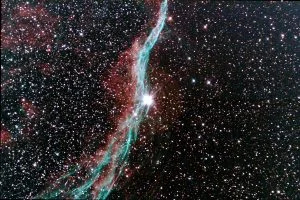
This section of the Veil Nebula, designated NGC6960, was captured on August 7, 2021, using the same equipment as the previous image, with six exposures of ten minutes each, totaling one hour of integration. (Massimo Dionisi)
Nestled within the constellation Cygnus, the Veil Nebula is a breathtaking celestial object that captivates observers during summer nights. The portion depicted in the lead image is cataloged as NGC6960, where NGC stands for "New General Catalogue," a collection of non-stellar objects compiled in the late 19th century, largely based on observations by Sir William Herschel and his son, John. NGC6960 represents the westernmost part of a vast nebular complex, which extends eastward through segments known as "Pickering’s Triangle" and the nebulae NGC6974 and NGC6979, all slightly northeast of NGC6960, culminating in NGC6992 and NGC6995 at the eastern edge of the system.
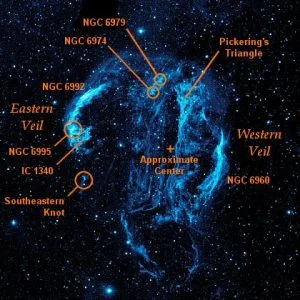
A map of the sky region occupied by the Veil Nebula, illustrating its various components. Image from Wikipedia (English Version).
Overall, the Veil Nebula consists of a series of segments from an expanding gas cloud, often referred to as the "Great Cygnus Loop," spanning approximately 2.6° in diameter. While precise distance measurements are still pending, it is estimated to be about 1,500 light-years away, with actual dimensions in interstellar space ranging from 50 to 70 light-years.
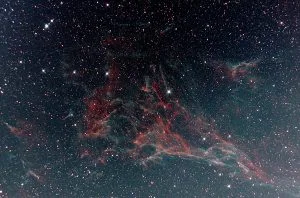
Pickering’s Triangle captured on June 11, 2022, using the same equipment as the previous images, with twelve exposures of five minutes each, totaling one hour of integration. (Massimo Dionisi)
Visually, all parts of this object are challenging to discern, appearing as indistinct nebulosity even through a 15 cm diameter telescope at low magnification. Observers with medium-sized telescopes may catch glimpses of the filamentary structure, but to view the entire nebular system, a good 80 or 100 mm binocular is recommended, ideally in a dark sky, away from light pollution, and preferably at high altitudes, devoid of lunar interference. It is important to note that the delicate colors of the filaments are not perceivable to the naked eye due to their low luminosity; only through long-exposure photography can these details and colors be revealed.
The intricate filament structure of the Veil Nebula, reminiscent of delicate lace, makes it one of the most recognized objects in the night sky and a subject of particular interest for amateur astronomers. As described in past astronomical literature, it has been likened to “long, slanted undulations of thin cascades of light, appearing to glide from one star to another until dissolving into the dark depths of space” (adapted from Kelvin McKready, “Beginner’s Star Book,” 1935). Stunning images taken years ago at the Palomar Observatory showcased the various filament colors, ranging from blue to white to red, corresponding to the temperatures of the gases comprising the nebula; these images were described as depicting diaphanous red, white, and blue filigrees.
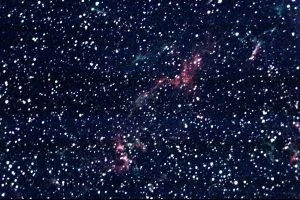
NGC6979 captured on June 20, 2020, using a Meade Schmidt-Cassegrain 200mm telescope with a focal length of 2000mm (f/10), QHY8L camera cooled to -15°C, EQ6Pro mount. (Massimo Dionisi)
The gases within this nebula are expanding at a rate of 0.06 arc seconds per year, suggesting they originated from a specific point in space, likely following a catastrophic event, such as a supernova explosion in the distant past. At the current expansion rate, it is estimated that around 150,000 years have passed since this event, although this timeline may be revised as the expansion rate could have decreased over time.
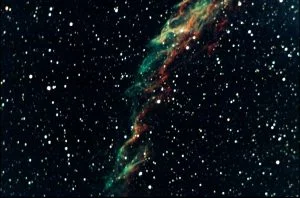
A section of NGC6992 captured on June 21, 2020, using a Meade Schmidt-Cassegrain 200mm telescope with a focal length of 2000mm (f/10), QHY8L camera cooled to -15°C, EQ6Pro mount, with a total integration time of 40 minutes. (Massimo Dionisi)
Typically, a supernova remnant exhibits an expansion velocity of about 1,600 km per second, while the radial velocity measured for the gases of the Veil Nebula is below 72 km per second. This deceleration may be primarily due to the resistance the gases encounter as they pass through interstellar dust clouds in the same region. It is evident that the nebula is expanding in a relatively dusty area, sweeping away that dust in its path; the sky within the Cygnus Loop appears clearer than the surrounding areas, evident in the number of faint background stars visible in long-exposure images. Given the deceleration of the nebula's gases, the supernova explosion likely occurred between 30,000 and 40,000 years ago. Like all known supernova remnants, the Veil Nebula emits radio waves, albeit with much lower intensity than younger sources such as the Crab Nebula in Taurus, which exploded only 900 years ago.
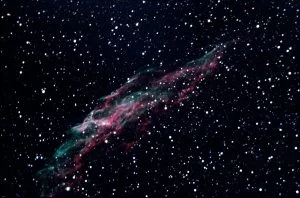
Northern section of NGC6992 captured using a Meade Schmidt-Cassegrain 200mm telescope with a focal length of 2000mm (f/10), QHY8L camera cooled to -15°C, EQ6Pro mount, with a total integration time of 40 minutes. (Massimo Dionisi)
The source of illumination for the nebula remains a mystery; spectral analyses indicate that the light is fluorescent, meaning the gases are excited by ultraviolet radiation from one or more nearby stars, emitting visible light at various wavelengths, which accounts for the stunning array of colors. However, the specific star or stars responsible for this ultraviolet radiation have yet to be identified. No object exhibiting characteristics of a "post-supernova" or "post-nova" has been found in the central area of the Loop; even the star 52 Cygni, which appears perfectly aligned with NGC6960, is unrelated to the nebula, as it is only 192 light-years from Earth, while the nebula itself is approximately 1,500 light-years away.
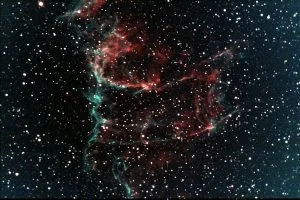
NGC6995 captured with six exposures of ten minutes each on July 21, 2020, using a Meade Schmidt-Cassegrain 200mm telescope (f/10), QHY8L camera cooled to -15°C, EQ6Pro mount. (Massimo Dionisi)
The Veil Nebula’s delicate filamentary structure is its defining characteristic, yet it remains only partially understood. The thickness of a single filament can range from 75 billion to 100 billion kilometers, with some reaching up to 300 billion kilometers; this corresponds to apparent sizes from 1” to 5” as viewed from Earth. Some filaments may actually be diffuse gas areas observed edge-on: such a surface, viewed head-on, might not be detectable due to its low average surface brightness. The expansion of gas clouds within the interstellar medium has likely played a vital role in the formation of these filaments, which appear to be the result of large-scale phenomena related to shock fronts.
However, this celestial wonder is transient, destined to dissolve completely over a few millennia due to the gradual dispersion of gases into interstellar space; thus, we must consider ourselves fortunate to witness its splendor in its current form.