Astronomy Enthusiasts: A Rare Celestial Event on February 1, 2025
On February 1, 2025, a spectacular multiple conjunction of celestial bodies will be visible shortly after sunset, featuring the Moon, Venus, Saturn, and Neptune.
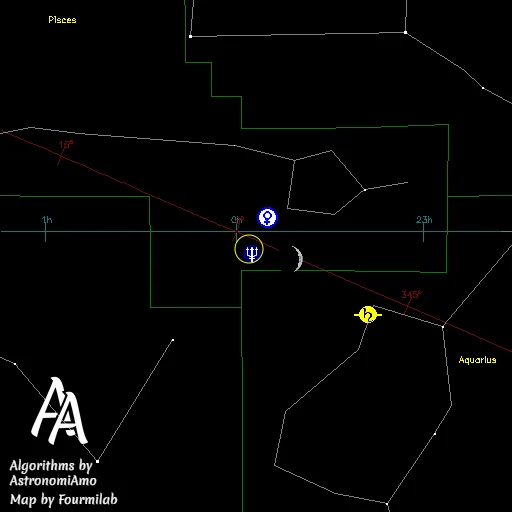
After days filled with discussions about mythical and exceedingly rare planetary alignments—events that seem to belong to the realm of fiction—an actual celestial spectacle is set to grace the evening sky. On the evening of February 1, 2025, a multiple conjunction of three prominent celestial bodies and one that requires optical instruments for visibility will be observable just after sunset.
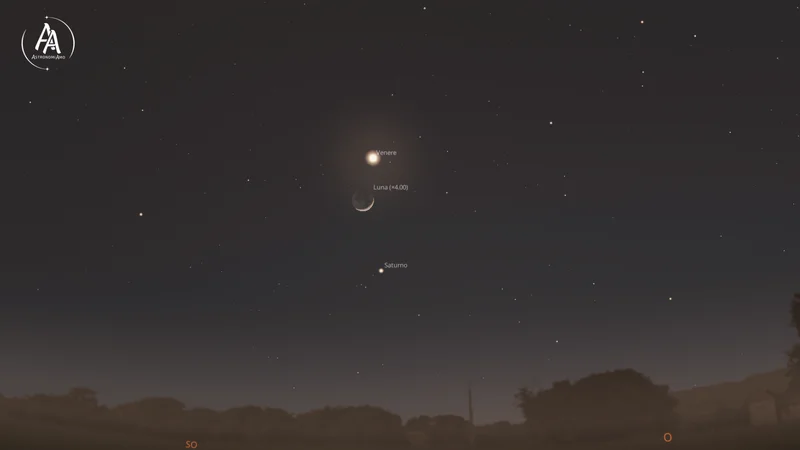
As twilight descends, a crescent Moon will appear in close proximity to the well-known planets Saturn and Venus, while also aligning with the more distant Neptune, which is not visible to the naked eye. Even without the means to observe Neptune, skywatchers can still enjoy a stunning view featuring the Moon and its soft, grayish light alongside the brilliant Venus and the comparatively dimmer Saturn.
Timing for Observers
For those located in central Italy, here are some key timings for the celestial event (you can find your local times by selecting your observation point in the respective celestial body links).
SUN - The scene unfolds within the constellation Aquarius, where the Moon resides. The Sun will set at 17:25, with civil twilight following at 17:55, nautical twilight at 18:28, and astronomical twilight at 19:01. It is crucial to remember: do not gaze directly at the Sun without proper eye protection, and avoid pointing any optical instruments at it without a suitable filter. Allow at least half an hour after sunset before observing the conjunction, as the planets will remain in view.
LUNA - At sunset, the Moon will be approximately 33° above the horizon, easily visible with a phase of around 13%. It will set at 21:04. Take a moment to appreciate the Moon, as it provides an excellent opportunity to witness earthshine—a phenomenon visible on the unlit portion of the Moon during its thinner phases (waxing or waning). This occurs due to sunlight reflecting off Earth and illuminating the lunar surface, creating a soft glow. This effect is most pronounced when Earth appears nearly full from the Moon’s perspective, typically during the early and late lunar phases.
VENUS - At the time of the conjunction, Venus will shine brightly in the constellation Pisces with a magnitude of -4.8, positioned about 38° above the horizon at sunset, acting as a true beacon in the night sky. Those equipped with binoculars or telescopes can observe Venus at approximately a 37% phase. It will be located higher and to the left of the Moon, with its setting time at 21:18.
SATURN - Positioned to the right and lower than the Moon, Saturn can also be observed. This ringed planet is significantly fainter, shining at a magnitude of 1. Sharing the constellation of Aquarius with the Moon, Saturn will set at 20:13, making it the lowest visible celestial body during this conjunction, at around 26° above the horizon. The rings will appear nearly edge-on from our vantage point, making them visible only at a slight angle.
This celestial event is perfect for photography, with recommended exposure times of around 1-2 seconds to balance light sensitivity, given that it will still be relatively bright just after sunset.
** **NEPTUNE - For those with sufficiently powerful telescopes, Neptune can also be included in this celestial observation. This distant planet will appear very close to Venus (slightly lower and to the left) and will set at 21:08, shining with a magnitude of 7.9 in the constellation Pisces.