Webb Looks Deep into the Star Factory of Messier 82
The 12 million light-years distant spiral galaxy Messier 82 (M82), currently in a phase of rapid star formation and viewed from the side, is a scientifically unique spectacle revealed by the James Webb Space Telescope.
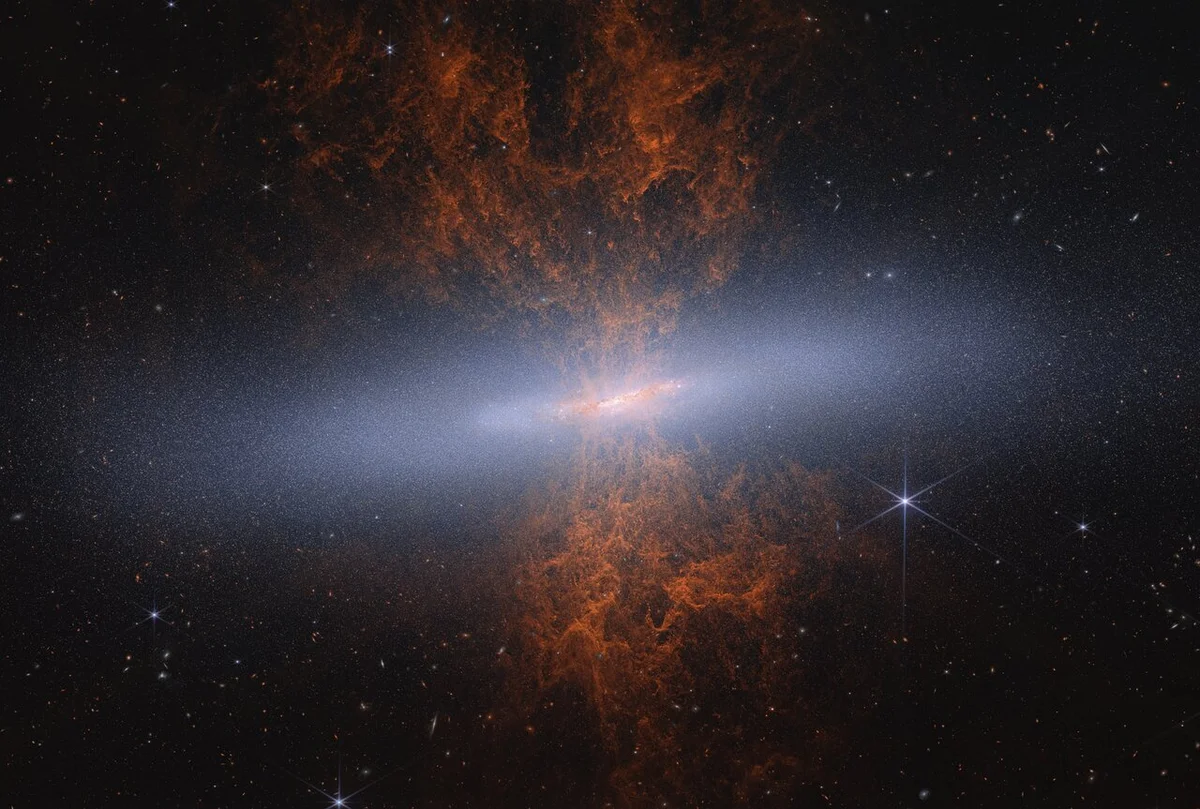
The spiral galaxy Messier 82 (M82), located 12 million light-years away and currently undergoing a phase of rapid star formation, presents a scientifically unique spectacle. Now, the James Webb Space Telescope (JWST) of NASA/ESA/CSA has revealed previously unknown details.
The intense star formation in M82, likely attributed to a galaxy merger, is considered an astronomical short-lived event, estimated to last only a few hundred million years. This transient phase of extreme star formation relative to the mass of the galaxy, as well as its position in the local universe, are among the factors that make M82, also known as the Cigar Galaxy, a unique area of research.
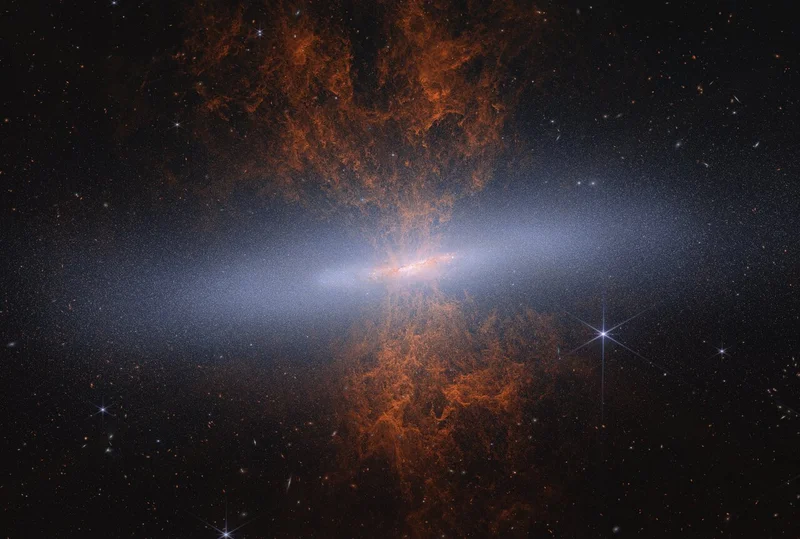
A team of astronomers has recently completed an imaging survey with Webb. This program included a total of 65 hours of observation time using Webb's NIRCam instrument, unveiling previously unknown details of the starburst galaxy, including its extended disk structure and millions of individual stars. The high-resolution images from Webb, particularly of the main plane of the disk, have provided astronomers with crucial information to uncover the formation history of M82. Furthermore, the Webb data will assist scientists in understanding the current processes within the starburst galaxy.
Before Webb, many observatories had already observed the starburst galaxy, including NASA/ESA's Hubble Space Telescope. However, the sheer amount of dust in this galaxy limited the amount of high-resolution information astronomers could obtain about M82. Although Webb had observed this galaxy before, the duration of the new imaging survey combined with the telescope's infrared sensitivity was an optimal combination that allowed it to penetrate the dense dust.
The near-infrared image from the telescope is a snapshot of a scene that has evolved over several hundred million years. The image from the Webb telescope shows about 16.5 million individual stars distributed across the entire galaxy. The starlight from these stars appears as bright blue dots. This is just a small fraction of the total number of stars that astronomers suspect exist in a galaxy like M82; most are too faint to be visible.
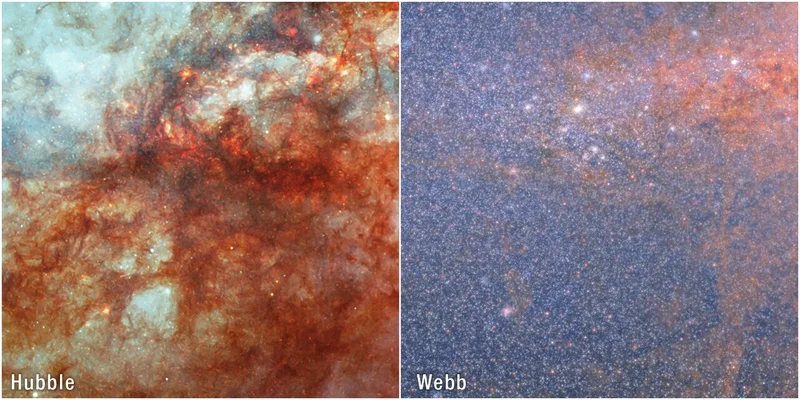
Internally, the increasing brightness and the asymmetric shape of the galactic disk indicate the unique structure of this spiral galaxy. The differing radii of both sides suggest that M82 has a distorted shape, which can occur during intense galaxy mergers.
Due to the extreme star formation in the galaxy, which occurs ten times faster than in the Milky Way, star formation will eventually be interrupted. The star formation wave in M82 leads to bipolar material flows being expelled above and below the disk. Although the region appears turbulent, the hourglass-shaped outflows exhibit a structured history. The yellow material threads near the galactic disk consist of ionized gas, while the more distant orange material represents small dust grains. These grains are called polycyclic aromatic hydrocarbons and are helpful in identifying material in the interstellar medium, the space between the stars of the galaxy.
The information collected as part of this Webb study is just one dataset that scientists will analyze to reconstruct the formation history of this starburst galaxy.