Three Stars Shape Their Accretion Disk in Orion
Discover how three stars in Orion are shaping their accretion disk, revealing potential for unusual planet formation and the mass of the disk being 30 times that of Earth.
Three Stars Shape Their Accretion Disk in Orion
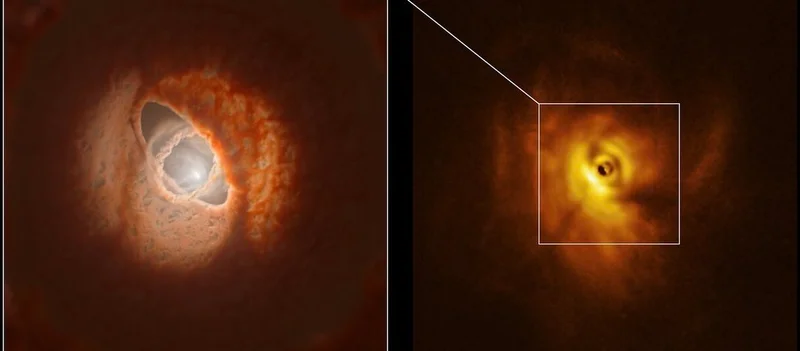
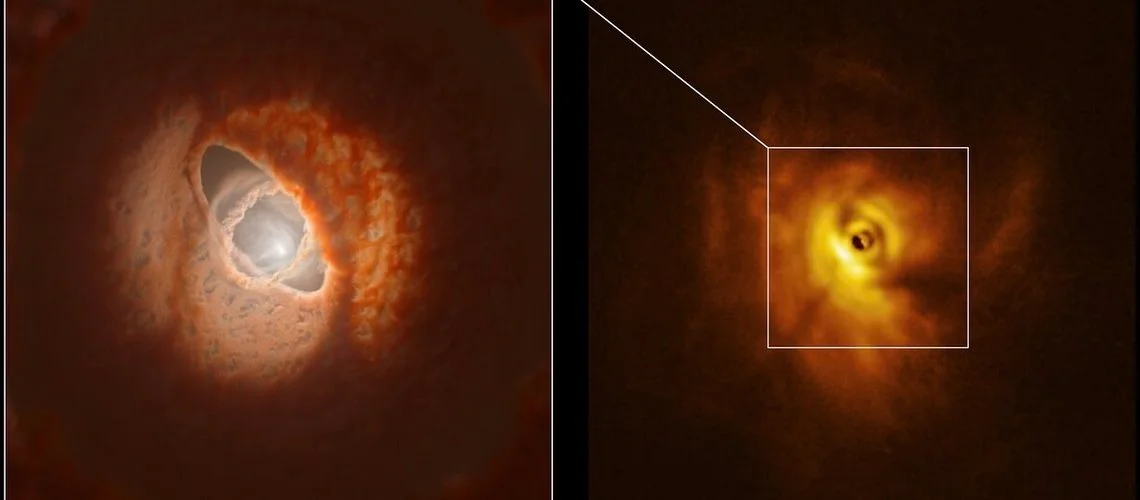
Recent observations have revealed a fascinating phenomenon in the Orion constellation, where three stars are actively forming their initial accretion disk, which is structured in multiple rings. This unique configuration could potentially lead to the birth of planets following unusual orbital paths.
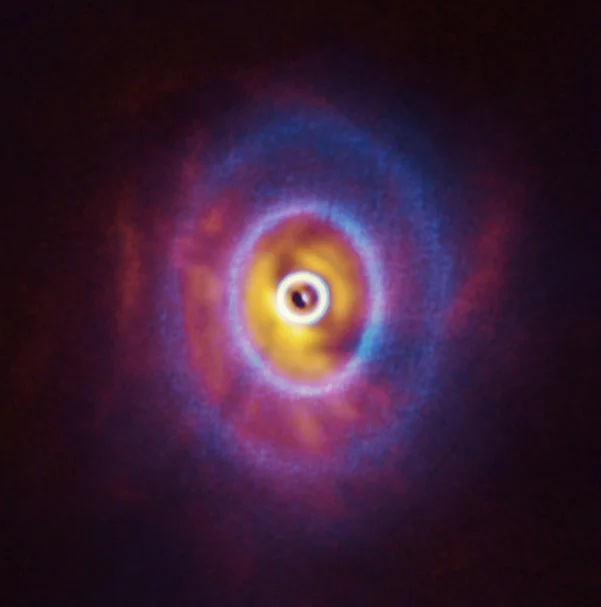
Unlike our solar system, which is organized in a relatively flat disk allowing for stable planetary trajectories, this multiple star system demonstrates how gravitational interactions can create more chaotic environments for planet formation. In this extreme case, the stars have "torn apart" the accretion disk, extracting a ring from the main sphere of material surrounding them.
The accretion disk consists of the matter that orbits around the three stars, serving as the building blocks for future planets. This remarkable observation was made possible by the European Southern Observatory’s Very Large Telescope (ESO’s VLT) and the Atacama Large Millimeter/submillimeter Array (ALMA). The composite image presented above was generated from data captured by these two powerful instruments.
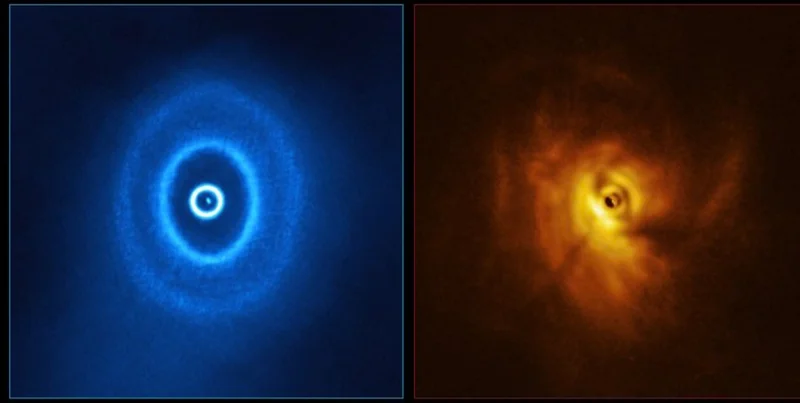
An extensive observation period spanning over 11 years has revealed that the three stars do not orbit within the same plane. The data collected has facilitated the creation of numerical models that simulate the behavior of the accretion disk, corroborating the observations made. Furthermore, studies indicate that the material constituting the accretion disk possesses a mass approximately 30 times that of Earth, suggesting promising opportunities for the discovery of new exoplanets.
For further details, you can explore the complete article on the ESO website.