The Origins of Earth's Water: New Insights from the Planet's Core
A recent study reveals that Earth's water has been trapped in its iron core since formation, suggesting a new origin for our planet's oceans.
The Origins of Earth's Water: New Insights from the Planet's Core
In March 1986, the European Giotto spacecraft made headlines by flying through the tail of Halley's Comet, capturing images of a comet core releasing water vapor into space. For decades, this mission supported a prevailing theory: Earth was born 'dry,' with oceans arriving later through a relentless bombardment of icy comets.
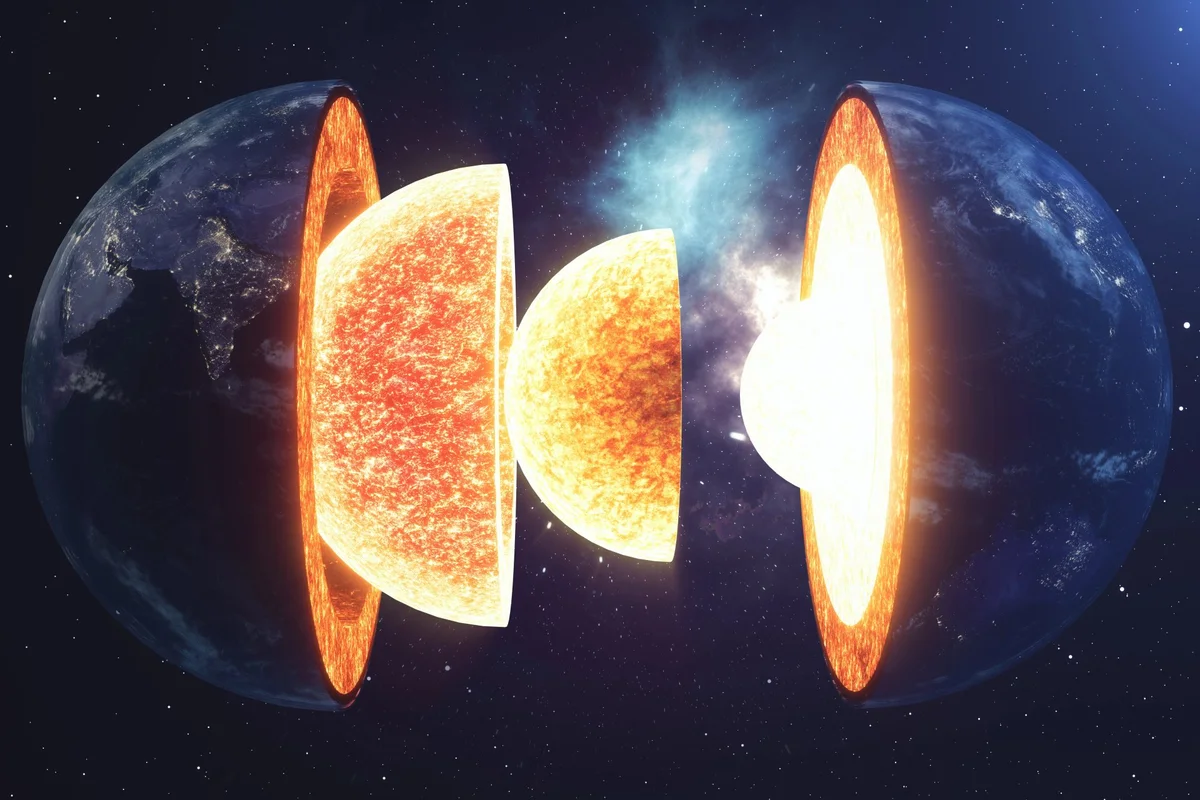
However, a recent study published in Nature Communications by Dongyang Huang, a researcher at Tsinghua University, shifts the focus of this discussion to 3,000 kilometers beneath our feet. The findings suggest that water did not arrive from the cosmos; rather, it has been present on Earth since its formation, trapped within the iron core from day one. For years, estimating the hydrogen content in the planet's heart was fraught with uncertainty, with error margins ranging from 10 to 10,000 parts per million. Huang's innovative approach involved recreating the Earth's primordial magma ocean by compressing a pure iron fragment between diamond anvils at 111 gigapascals while heating it to 5100 K with lasers.
The Chemical Signature in Silicon
To confirm that the detected hydrogen was not a result of contamination from the experimental apparatus, the researchers utilized atomic force microscopy to observe a crucial chemical interaction. Inside the iron, they found that hydrogen bonded to silicon in an exact one-to-one ratio. Given that the silicon content in the core is already established to be between 2% and 10% of its total weight, this ratio allowed for a more accurate calculation, revealing that the core contains between 0.07% and 0.36% hydrogen.
An Invisible Reservoir
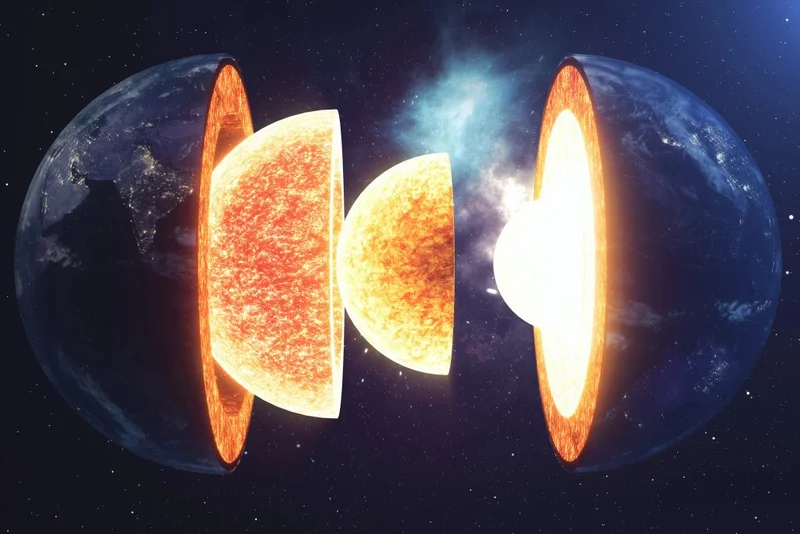
When scaled to the mass of Earth, this percentage unveils a hidden world: the iron core is believed to trap between 9 and 45 global oceans. This groundbreaking discovery fundamentally alters the narrative of a barren, young Earth reliant on celestial bodies for water. Instead, it paints a picture of a planet that retained its volatile elements from the very early stages of accretion. Long before the first seas formed on the surface, Earth had already accumulated its largest water reserve deep within its core, where it has remained protected for 4 billion years.
Source:
- Huang, D., Murakami, M., Gerstl, S. & Liebske, C. (2026). Experimental quantification of hydrogen content in the Earth’s core. Nature Communications.