A Small Guide to Lunar Craters
Observing the Moon through a telescope reveals the vast number of impact craters on its rocky surface. This guide explores various types of lunar craters, their formation, and how to identify their age.
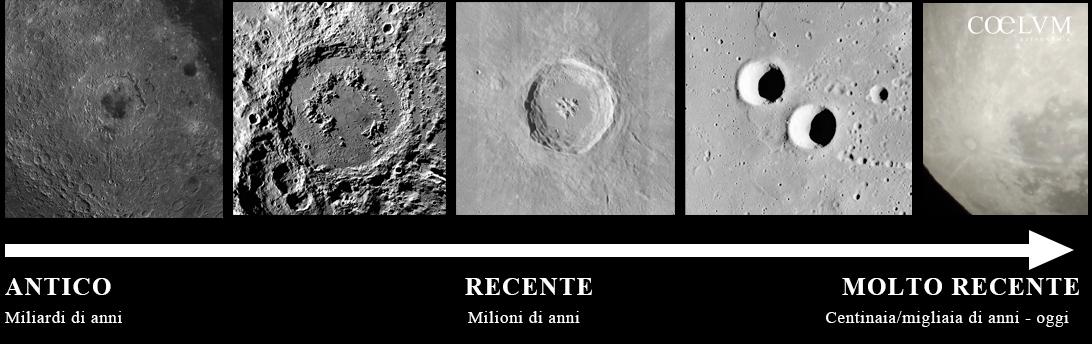
Observing the Moon through a telescope, it is immediately apparent the enormous number of impact craters that dot its rocky surface. These structures can take on multiple forms, increasing in complexity with their size. But how can we determine if we are looking at a crater formed billions or millions of years ago, or a more recent one? Here is a small guide that combines snippets of planetary geology with observational and astrophotographic sessions focused on the Moon.
- “Simple crater”: a bowl-shaped depression with raised and well-defined edges (“rims”), indicative of a newly formed and/or well-preserved crater on the lunar surface.
- “Central-Peak crater”: a relatively flat structure with a central “bulge” or swelling, surrounded by circular terraces that often extend to the edges (“rims”) of the crater. This morphology is associated with intense deformation during the formation phase of the impact crater.
- “Peak-Ring crater”: similar to the previous case, but with the central peak collapsing into a true ring or a series of smaller peaks. This type of structure also shows dependence on the gravity of the planet hosting it: the stronger the gravity, the smaller the size required for the crater to develop this type of morphology.
- “Multi-Ring crater”: the largest and most complex impact structure, featuring a series of concentric circles that can make it difficult, in some cases, to trace back to the original edges or “rims” and thus the exact diameter of the crater. The most widely accepted hypothesis regarding their formation links the depth of the depression generated by the impact to the thickness of the lithosphere or surface crust.
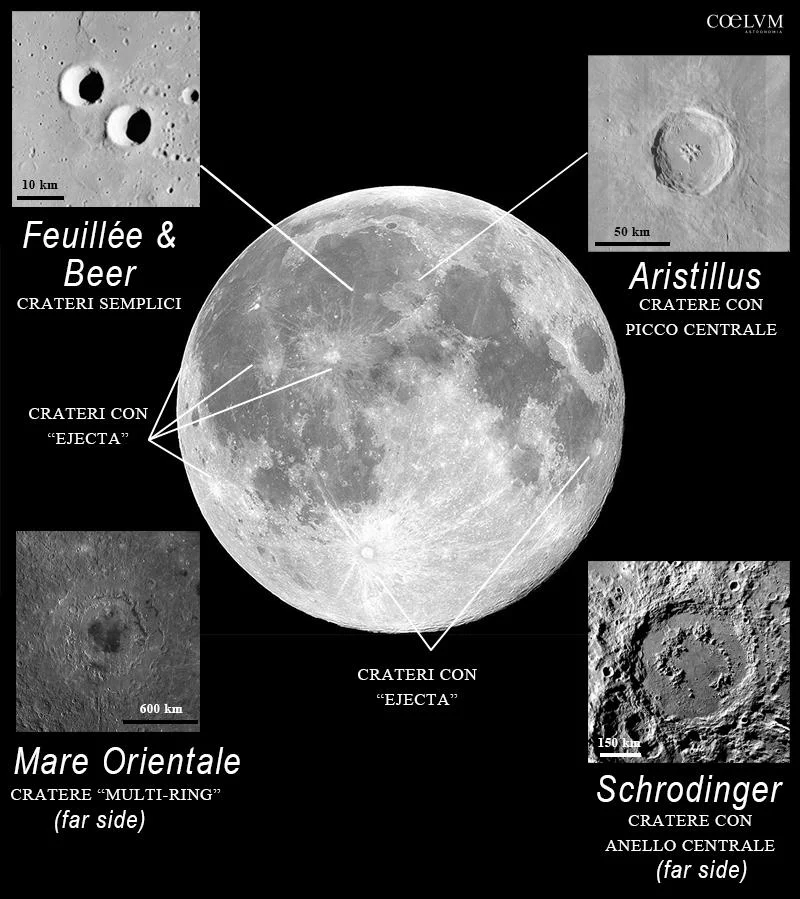
As we move from a simple crater to a “multi-ring” one, the diameter increases along with its age; thus, larger craters are also the oldest, with at least a billion years behind them. A useful element for recognizing extremely young craters is the presence of the materials ejected as a result of the impact (called “ejecta”), often arranged like rays around the edges of the central structure.