The Night Sky in May 2026 - Spreewald-Spechtler
At the beginning of May, we can find the full moon in the constellation Libra. The waning moon continues its journey through various constellations, culminating in a Blue Moon at the end of the month.
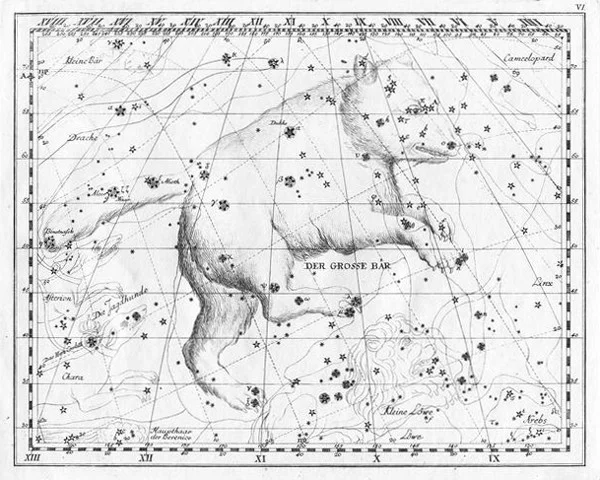
The Moon's Path
At the beginning of May, we can find the full moon in the constellation Libra. After the full moon night, the moon increasingly becomes an object of the second half of the night. On May 3, our silent companion is only 1¾ degrees southwest of Antares, the main star in the constellation Scorpius. The waning moon continues its journey eastward through the constellations Ophiuchus, Sagittarius, and Capricornus. On May 9, it appears there as a waning half-moon in the last quarter. Subsequently, the Earth's satellite passes through the constellations Aquarius and Pisces. On the morning of May 15, we can spot it for the last time in the morning twilight above the eastern horizon. The following day, it enters the new moon phase. On the evening of May 17, the thin, waxing crescent moon reappears above the northwestern horizon. On May 18, it is only 4 degrees west of the evening star Venus in the constellation Taurus. Just one evening later, we can observe the crescent moon between the giant planet Jupiter and Venus. On May 20, we can finally find the moon near Jupiter and Pollux in Gemini. They form an isosceles triangle in the evening sky, with the moon positioned 4 degrees northeast of Jupiter and 5 degrees southeast of Pollux. On the following evening, the waxing moon is located east of the open star cluster Praesepe in Cancer. On May 23, it is in the first quarter and only 6 degrees west of Regulus in the constellation Leo. Between May 27 and 28, the Earth's satellite passes south of the main star Spica in Virgo. After the moon has left the constellation Libra behind, we can find it again as a full moon in the constellation Scorpius on the evening of May 31. A so-called "Blue Moon" occurs.
The Planets
The swift planet Mercury reaches superior conjunction with the Sun on May 14, 2026. Since it is then positioned behind the Sun, it is not observable. By the end of the month, its eastern elongation from the Sun increases to 19 degrees. However, this is not sufficient to observe the -0.6 mag bright innermost planet of the solar system from our latitudes in the evening sky. It remains invisible throughout the month. Only on the last evening of May can one attempt to spot the swift planet in the evening twilight. At the end of civil twilight, Mercury stands about 7 degrees above the western horizon, setting at 10:58 PM summer time.
Throughout the month, our sister planet Venus becomes a prominent evening star after sunset, reaching the peak of its evening visibility. By mid-May, at the end of civil twilight, it stands about 17 degrees high in the west. It continues its journey through the constellation Taurus and switches to the constellation Gemini starting May 19. On May 3, it passes within 7 degrees of the main star Aldebaran. On May 1, Venus sets at 11:09 PM summer time. By the end of the month, its setting times delay to midnight. Its apparent brightness slightly increases, reaching -4.0 mag by the end of May. In the telescope, it can be seen that its illumination decreases slightly from 88 to 79 percent, while its apparent diameter increases to 13.3 arc seconds. Particularly interesting is the encounter with the thin, waxing crescent moon on the evening of May 18, where the moon is only 4½ degrees northwest of the evening star. On May 14, Venus reaches perihelion in its orbit, located at a distance of 107.5 million kilometers from the Sun.
Our red neighbor Mars still cannot assert itself in the morning sky due to the flat ecliptic position. It remains invisible. Its western elongation to our central star increases to 31 degrees by the end of the month. On May 13, the 1.3 mag bright Mars transitions from the constellation Pisces to Aries.
The giant planet Jupiter accelerates its direct motion through the constellation Gemini. Throughout the month, its visibility in the evening sky significantly decreases as darkness sets in later. While Jupiter sets at 2:03 AM on May 1, it sinks below the western horizon at 12:21 AM summer time on May 31. Its brightness slightly decreases to -2.9 mag by the end of the month. Its apparent equatorial diameter also continues to shrink to 33.1 arc seconds. On May 20, Jupiter encounters the thin crescent moon at a northeastern distance of only 3½ degrees.
The ringed planet Saturn moves direct through the constellation Pisces and will again be visible above the eastern sky in the early morning twilight by the end of the month. The 0.8 mag bright ringed planet rises at 3:00 AM summer time on this morning. At the beginning of civil twilight, it will then be about 12 degrees high above the horizon.
Uranus is in conjunction with our central star on May 22, 2026, and is not visible.
The outer planet of our solar system, Neptune, moves direct through the constellation Pisces. Due to its brightness of 7.9 mag, it cannot assert itself in the morning sky yet. It remains invisible throughout the month of May.
The dwarf planet (134340) Pluto comes to a standstill on May 8, 2026, marking the beginning of its opposition period for this year. The 14.5 mag bright celestial body then moves retrograde through the constellation Capricornus. At the beginning of the month, Pluto rises at 3:09 AM. By the end of the month, its rising times advance to 1:12 AM summer time. Only on July 27 does the distant dwarf planet reach opposition to the Sun.
Bright Comets and Asteroids
The comet C/2024 E1 (Wierzchos) travels through the constellation Gemini and is visible in the evening sky. With a brightness of 12.0 mag, larger telescopes are needed at the beginning of the month to spot the comet shortly after darkness falls. By the end of the month, its brightness continues to decrease.
The short-period comet 10P/Tempel moves through the constellation Aquila towards the east. It can already be tracked in smaller to medium telescopes, with its apparent brightness ranging between 11.5 and 10 mag.
(14) Irene will again be brighter than 10 mag on May 24 and can be found in the constellation Sagittarius, low above the horizon. Its rising times advance from 12:22 AM at the beginning of May to 10:15 PM summer time. By the end of the month, the asteroid increases its apparent brightness to 9.8 mag.
(18) Melpomene will also be brighter than 10 mag by the end of the month and moves through the constellation Aquila. On May 1, Melpomene rises at 12:43 AM in the east. By May 31, the asteroid will rise at 10:39 PM.
The asteroid numbered (21) Lutetia will be exactly opposite the Sun in the constellation Ophiuchus on May 30, 2026. Lutetia reaches an apparent brightness of only 10.0 magnitudes. At the beginning of the month, it is at its highest position in the south at 3:23 AM and by the end of May at 1:00 AM summer time.
Also, the asteroid (29) Amphitrite reaches opposition to the Sun this month with an apparent brightness of 9.7 mag on May 29, 2026. It can be observed at this time in the constellation Scorpius, 4 degrees south of Antares. At culmination, Amphitrite only reaches a very low height of just 7 degrees above the southern horizon, occurring at 3:11 AM at the beginning of the month and already at 12:45 AM by the end of May. From May 13, it will again be brighter than 10 mag.
Meteor Showers
From April 19 to May 28, the Eta Aquariids, also known as the May Aquariids, can be observed. Their activity maximum is expected on May 6. Under optimal conditions, between 40 and 65 meteors per hour can be seen then. The waning moon affects the visibility of the meteors this year. For observers in the Mediterranean region and in the Southern Hemisphere, this shower is one of the most active of the year. In our latitudes, however, the maximum zenith rate will not be reached, as the radiant is still near the horizon around 3 AM, before the morning twilight begins. The activity of this meteor shower also fluctuates from year to year. The last time the activity was significantly higher was in 2013, with over 100 meteors per hour. Additionally, visual data since 1984 show an average zenith rate of 30 meteors between May 3 and 10. Due to the low position of the radiant, in the northern part of the constellation Aquarius, the meteors entering the Earth's atmosphere at 66 km/s leave very long trails. A southern location, such as the Canary Islands or even better in the Southern Hemisphere, is essential for a successful observation of this meteor shower, as the radiant then stands higher above the horizon and the night lasts significantly longer. From a more southern location, about 20 to 40 meteors per hour can be expected, while in our latitudes only four to eight.
The parent body of the May Aquariids is comet 1P/Halley.
From May 5 to 14, the Eta Lyrids can be observed, with their radiant located about eight degrees northeast of Vega. The radiant of the Eta Lyrids remains above the horizon throughout the night and is especially high in our sky in the hours after midnight. The maximum is weakly pronounced and occurs on May 10. At that time, about three to four meteors per hour are visible, reaching average speeds of 43 km/s. Observing this meteor shower coincides this year with the last quarter of the moon, so visibility is hardly affected. The parent body of the Eta Lyrids is comet C/1983 H1 IRAS-Araki-Alcock, which passed Earth in May 1983.
The year-round visible, but numerically weak ecliptic meteors from the Anthelion source originate from an area located slightly east of the anti-solar point. In May, the radiant of the Anthelion source moves from the constellation Libra into the constellations Scorpius and Ophiuchus. With entry speeds of about 30 kilometers per second, the meteors differ slightly from the other meteor showers of this month.
The Evening Fixed Star Sky
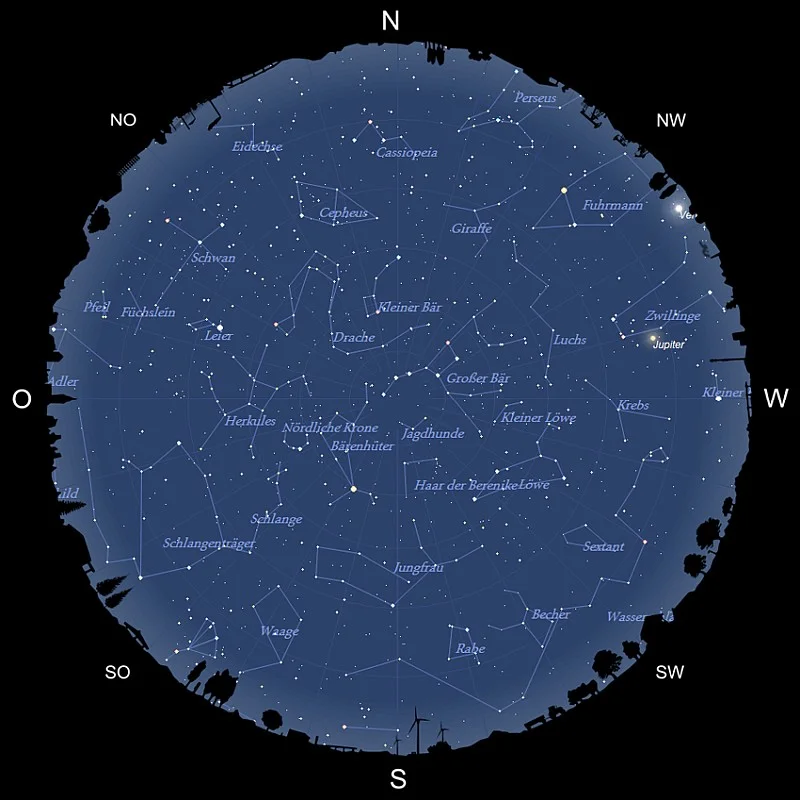
In the North
At our standard observation time, the constellation Ursa Major, commonly referred to as the Big Dipper, has just passed its highest position in the zenith and will slowly descend towards the northwestern horizon until dawn. If we extend the two rear stars of the dipper's bowl five times, we will find the North Star. It indicates the exact north direction and simultaneously marks the last pointer star of the constellation Ursa Minor. The dipper's bowl of...