The Imbalance of the Carbon Cycle: A Key Factor for the Habitability of Terrestrial Planets
A study reveals that habitability is influenced by the carbon cycle and water availability, using Venus as a case study to highlight the complexities of planetary habitability.
Assessing the habitability of a planet extends beyond merely identifying the presence of liquid water. An exoplanet with limited water resources can be inhospitable, regardless of its position within the so-called habitable zone. Earth, the only known habitable planet, relies on its carbon cycle to sustain its livability. This cycle is intrinsically linked to the presence of water, and planets devoid of it are unlikely to maintain this cycle, severely compromising their long-term habitability prospects. A recent study published in The Planetary Science Journal investigates the water content necessary for the habitability of exoplanets, using Venus as a compelling case study.
Researchers Haskelle White-Gianella and Joshua Krissansen-Totton from the University of Washington emphasize that Earth's surface water is sufficient to support a balanced geological carbon cycle: the weathering of silicates offsets volcanic CO₂ outgassing. Water vapor in Earth's atmosphere reacts with carbon dioxide to form carbonic acid, which, although weak and unstable, slightly acidifies all rainwater. Over geological timescales, this acid plays a crucial role in Earth's carbon-silicate weathering cycle, also known as the Urey cycle. This cycle, a subset of Earth's carbon cycle, removes carbon from the atmosphere over extended periods. The weak acid dissolves silicate rocks, and the resulting runoff eventually reaches the oceans, where tectonic activity buries it within the crust. Without this cycle, atmospheric carbon would continuously accumulate, leading to runaway climate change, similar to what has occurred on Venus.
On arid planets, surface water may be insufficient for the silicate weathering mechanism to maintain habitable conditions.
White-Gianella and Krissansen-Totton focused on arid planets with very limited surface water, far less than that found in Earth's oceans. Many of these planets lie within their star's habitable zone, yet there is no guarantee that they can actually support life. The researchers developed detailed models to explore the capacity of such arid planets to maintain the essential carbonate-silicate cycle. They modeled the evolution of the geological carbon cycle by tracking the flows of water and carbon between a planet's interior and its atmosphere-ocean system.
Their modeling incorporates 18 variables, including the atmospheric hydrogen escape rate, volcanic outgassing rate, fraction of land cover, global temperature, concentration of minerals in pristine rocks, rock porosity, and the fraction of rainfall that transforms into runoff, among others. This modeling builds on our growing understanding of Earth's carbon cycle and its temperature regulation mechanisms.
The findings indicate that arid terrestrial planets may exhibit unbalanced geological carbon cycles due to limited flow compared to weathering, which can result in a loss of habitability and runaway warming. Even if a planet is located in the habitable zone, with sufficient temperatures for liquid water, it can become uninhabitable if it lacks enough surface water to balance outgassing and weathering flows, the authors explain.
An arid planet could still host the Urey cycle but does not require as much water as Earth; however, it does need a significant amount. White-Gianella and Krissansen-Totton demonstrate that terrestrial planets similar to Earth need an initial surface water quantity of at least 20 to 50% of Earth's ocean mass to maintain a balanced geological carbon cycle and temperate surface temperatures over 4.5 billion years of evolution. Arid planets with less than this threshold cannot sustain high silicate weathering flows, potentially leading to uncontrolled atmospheric CO₂ increases.
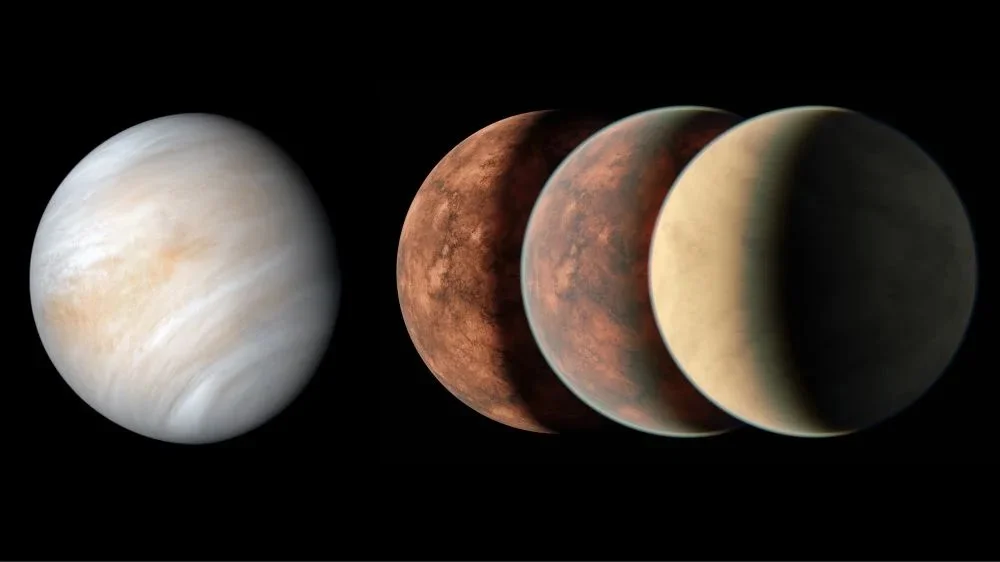
Given the challenges of determining conditions on distant arid exoplanets, the researchers examined the case of Venus. Their study reveals that limited surface water could have destabilized Venus's carbon cycle, leading to a transition from a temperate climate to an inhospitable one. Currently, Venus's surface is uninhabitable, with average temperatures around 460 °C, a surface pressure 92 times that of Earth, and a dense atmosphere dominated by CO₂. However, Venus may have been habitable in the past, under the weaker radiation of the young Sun. Uncertainties surrounding Venus's past cloud-albedo feedback and atmospheric evolution place it at the edge of the inner habitable zone, where the timing and triggers of its greenhouse runaway remain unclear.
Global climate models suggest that with sufficient daytime cloud cover and slow rotation, Venus's surface could have maintained habitable temperatures until about 715 million years ago. Evidence of a past temperate climate includes potential remnants of felsic continental crust, which typically forms in the presence of water, as well as D/H ratios indicating significant past surface water reservoirs, even if not necessarily condensed. Conversely, some data support the hypothesis of a greenhouse runaway occurring on Venus since its formation. It is believed that Venus's crustal plateaus are felsic; however, felsic mineral plateaus would likely collapse due to viscosity and the flow of the lower crust. Additionally, the atmospheric-cloud dynamics post-accretion may have hindered the condensation of liquid water on the surface, as shown by Turbet et al. in 2021.
While the past climate of Venus remains uncertain, if it was habitable at one time, it must have undergone a major climatic transition to reach its current state. One possible explanation for Venus's inhospitable conditions is that increased solar luminosity led to heightened radiation, warming its once-habitable surface and ultimately triggering a greenhouse runaway. In this scenario, any surface water would have evaporated, with subsequent photodissociation of water resulting in rapid hydrogen loss, culminating in today's dry, CO₂-dominated atmosphere. However, increased luminosity alone cannot account for the climatic shift from habitable to inhospitable. The threshold for greenhouse runaway is influenced by albedo and atmospheric composition, which are governed by long-term interactions between the atmosphere and the planet's interior. Rising sunlight merely enhances daytime cloud cover, thereby increasing albedo. This stabilizing feedback between clouds and albedo could have allowed temperate conditions to persist on Venus’s surface, even under current solar insolation.
Researchers suggest that another explanation for Venus's current uninhabitability is that an external factor, aside from increased luminosity, ended a period of habitability. MJ Way and AD Del Genio proposed in 2020 that habitable conditions might have persisted even to the present day without catastrophic volcanic activity, due to episodic or nearly continuous global resurfacing that could have acted as a trigger. However, variations in outgassing alone may not suffice to induce a permanent climate change. If Venus once hosted liquid water on its surface, silicate weathering could have regulated atmospheric CO₂ concentrations, even amidst rapid volcanic outgassing. Furthermore, large igneous province eruptions expose fresh basaltic rock, significantly enhancing CO₂ reduction through chemical weathering. It is unlikely that changes in outgassing alone could destabilize a climate where carbonate-silicate feedback is active. White-Gianella and Krissansen-Totton also note that limits to weathering are essential.
The decarbonation feedback related to tectonic stagnation has also been proposed by Höning et al. in 2021 as an explanation for the end of Venus's habitability. However, it remains unclear whether primitive Venus was in a tectonic regime characterized by stagnation, and some evidence suggests localized subduction.
Thus, White-Gianella and Krissansen-Totton explore an alternative explanation for Venus's current state following the greenhouse runaway. They propose that Venus may have initially had low surface water reserves, a hypothesis supported by models of magmatic ocean solidification, as well as planetary formation models demonstrating stochastic variations in the initial water reserves of terrestrial planets in the solar system. Additionally, Venus likely formed in a hotter region of the protoplanetary disk, which was poorer in volatile compounds than Earth. In this arid initial regime, a lack of precipitation would have limited silicate weathering and CO₂ reduction. In the absence of a weathering regulation mechanism to counteract outgassing, CO₂ could have accumulated in the atmosphere, warming the surface until all water evaporated, explaining its current state. Thus, Venus could have ultimately lost its water, and any simple life forms would have vanished.
Even a planet like Venus, situated within its star's habitable zone, can become uninhabitable if it is somewhat arid due to a carbon cycle imbalance.
These findings illustrate that a simplistic definition of the habitable zone is merely a starting point. Habitability depends on far more than mere proximity to a star; currently, this is the only factor we can measure. Even if a planet is located within its star's habitable zone, it can quickly become uninhabitable due to a carbon cycle imbalance.
According to the researchers, while many planets may be habitable for short periods and even allow for the emergence of simple life, the number of planets capable of long-term habitability—essential for the development of complex life and civilization-building species like ours—may be significantly lower. More generally, arid terrestrial exoplanets are less likely to sustain the necessary conditions for long-term habitability.