The Atmosphere of a Mini-Neptune Reveals Its Migration History
New measurements of a hot Jupiter and its mini-Neptune companion suggest both planets formed farther from their host star than their current positions indicate, shedding light on planetary migration and formation histories.
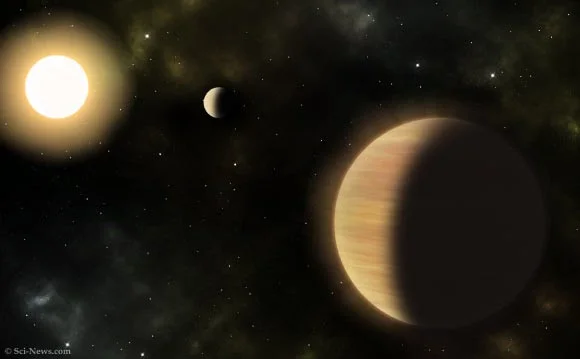
Recent measurements of a hot Jupiter and its accompanying mini-Neptune suggest that these exoplanets formed at significantly greater distances from their host star than their current orbits indicate. The findings were published in The Astrophysical Journal Letters.
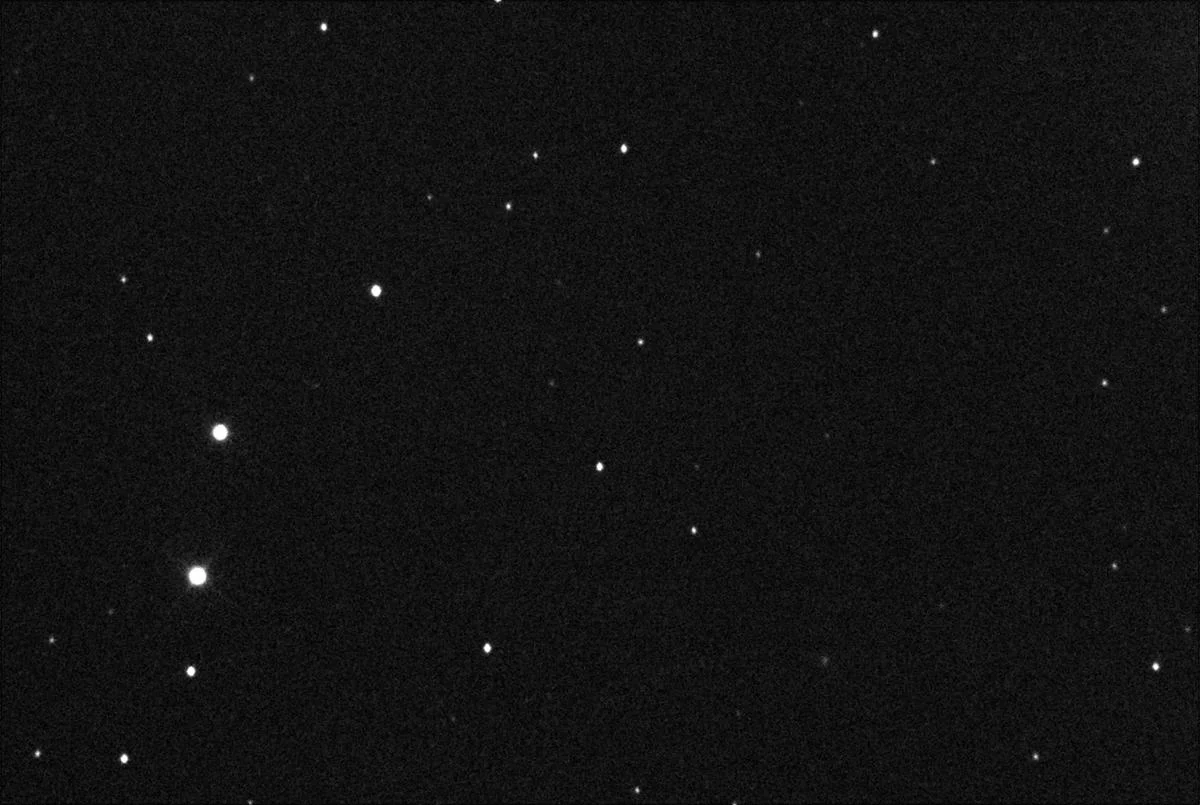
The star TOI-1130, approximately 8.2 billion years old and with a mass of 0.7 solar masses, is located about 190 light-years away. It features a unique architecture that includes both a hot Jupiter and a mini-Neptune in closer orbits. This configuration provides a valuable case study for understanding planetary formation and migration scenarios. In 2020, Chelsea Huang and her team identified this unusual planetary pair using the TESS (Transiting Exoplanet Survey Satellite) by analyzing the transit light curves of TOI-1130. They detected signals corresponding to a mini-Neptune and a hot Jupiter, with orbital periods of approximately four and eight days, respectively.
The inner planet, TOI-1130b, is a Neptune-sized world with an orbital period of 4.1 days and a surface temperature of 527 °C. It is 3.65 times larger than Earth and has a mass of about 0.17 times that of Jupiter.
Conversely, the outer planet, TOI-1130c, is classified as a hot Jupiter with an orbital period of 8.4 days and a surface temperature of 364 °C. Its mass is approximately 0.97 times that of Jupiter, and its radius measures 1.5 times that of Jupiter.
Typically, hot Jupiters lack nearby planetary companions on closer orbits. Their substantial mass and gravitational effects often destabilize and disperse nearby objects, making the existence of an inner companion a significant constraint on formation and dynamic evolution scenarios.
Mini-Neptunes, which are defined as being less massive than Neptune, are generally characterized by a volatile-rich atmosphere with a gas envelope above a denser core. They rank among the most frequently detected exoplanets in the Milky Way, although no direct analogs exist within our solar system. Consequently, their high occurrence rate leads to their classification as a 'standard' class among exoplanet populations.
Saugata Barat from MIT and collaborators have now reported new spectroscopic measurements of the atmosphere of the mini-Neptune, acquired using the James Webb Space Telescope (JWST). This study marks the first atmospheric composition determination for a mini-Neptune orbiting within the orbit of a hot Jupiter. The results challenge the idea of in situ formation at close distances to the star, which would likely result in an atmosphere dominated by lighter gases. Instead, the researchers favor the hypothesis that these planets initially formed in the colder regions of the protoplanetary disk and subsequently migrated inward.
According to the team, both the mini-Neptune and the hot Jupiter likely formed in the cold zone of the protoplanetary disk, where they gradually accreted ices and other volatile compounds, leading to atmospheres rich in heavy elements. A subsequent, slow, coupled orbital migration would have brought both objects closer to the star while maintaining their proximity and limiting atmospheric erosion.
These findings provide observational support for the idea that some mini-Neptunes form beyond the snow line, defined as the distance from the star where temperatures are low enough for water to condense into ice.
To obtain usable observations, precise timing of transits was crucial. While most exoplanets exhibit nearly regular periods, the mini-Neptune and hot Jupiter of TOI-1130 present challenges due to their resonance: their gravitational interactions cause variations in transit timing, complicating predictions and telescope planning.
The team compiled all available historical observations to create a dynamic model aimed at forecasting favorable geometric configurations, particularly transits, to ensure high-quality spectral acquisition by JWST.
Based on this modeling, spectroscopic observations of both planets were carried out at relevant orbital phases. The multi-wavelength coverage of JWST allowed for the detection of absorption signatures at specific wavelengths, inferring the atmospheric chemical composition.
The observed transit spectra reveal absorption signatures consistent with the presence of H2O, CO2, and SO2, and to a lesser extent, CH4. The detection of these heavier species indicates a significantly enriched atmosphere in heavy elements for TOI-1130b.
Such a volatile-rich atmosphere aligns with a scenario where TOI-1130b accreted a substantial fraction of ices and volatile compounds in a colder region of the protoplanetary disk, possibly beyond the snow line. The subsequent inward migration could have been accompanied by partial sublimation of the incorporated ices, contributing to the current abundance of water vapor and other oxygenated species observed. Additionally, the coexistence of an inner mini-Neptune with a hot Jupiter imposes dynamic constraints on this migration, favoring relatively gentle evolutionary pathways (such as disk-induced migration or concerted migration) that must be compatible with the preservation of an inner companion.
The combination of detected species (notably H2O, CO2, and SO2) and the absence of a dominant signature of lighter gases leads Barat and colleagues to propose a high metallicity atmosphere for the mini-Neptune, which is difficult to explain through strictly in situ formation at very close distances to the star.
However, this interpretation is contingent on the assumptions of atmospheric models (thermal structure, opacities, possible presence of aerosols/clouds) and degeneracies between molecular abundances, overall metallicity, and short orbital period photochemical effects. In particular, the identification of SO2 and constraints on CH4 may depend on the effective spectral coverage of JWST, the signal-to-noise ratio, and the treatment of stellar effects (activity, surface heterogeneities) during transits.

Further observations, particularly additional transits with JWST or ground-based telescopes, as well as radial velocity measurements to constrain masses and eccentricities, would help test the robustness of the formation scenario beyond the snow line and migration, while also exploring the resonant dynamics of the system. More broadly, studying analogous systems (a mini-Neptune coexisting with a hot Jupiter) will provide a comparative framework to assess the frequency of such architectures and the diversity of migration pathways compatible with the survival of close-in planets.
Thus, TOI-1130b serves as an essential case study for constraining models of mini-Neptune formation and hot Jupiter migration. It suggests that the accretion of volatiles in the outer regions of the protoplanetary disk, followed by a low-dissipation orbital evolution, can lead to the observed planetary architecture.