Solar Eclipse on August 12, 2026: A Partial but Significant Event in Italy
On August 12, 2026, Italy will experience a partial solar eclipse, with the most significant coverage in the North-West. Observers must prioritize safety and use certified solar filters.
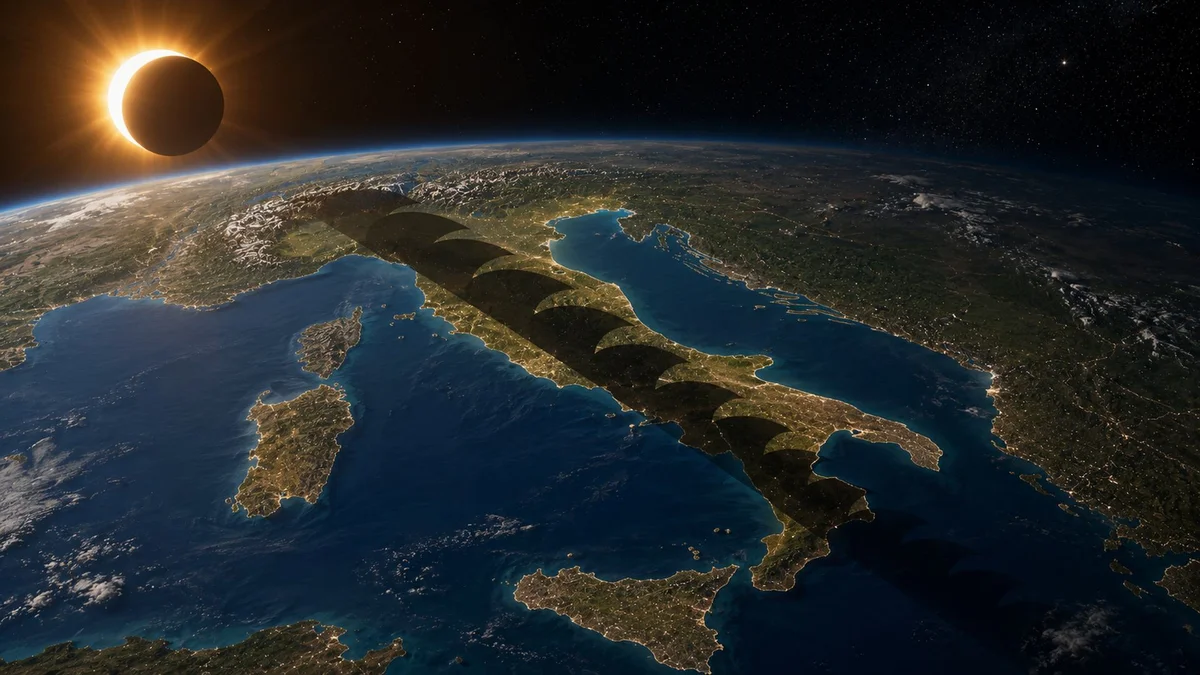
On August 12, 2026, a solar eclipse will occur as the Moon passes in front of the Sun, but Italy will only experience a partial view of this celestial event. The totality will be visible in regions including Greenland, Iceland, the northern Atlantic, Spain, and a small part of Portugal, while Italy remains outside the totality zone.
The most impressive views in Italy will be found in the North-West, particularly in the Alpine and Ligurian regions. For instance, in Genoa, observers can expect a maximum obscuration of approximately 94 percent. However, cities like Rome and Naples will experience significantly less coverage. In the north-western part of Sardinia, the geometry might allow for even greater obscuration, but the Sun will be very low on the western horizon. Therefore, selecting a viewing location requires not only an updated weather forecast but also a clear horizon and a calculated map for the specific area.
Understanding the difference between coverage and magnitude is crucial for accurately interpreting the eclipse's intensity. The percentage of an eclipse refers to how much of the Sun's apparent diameter is obscured by the Moon, while obscuration describes the fraction of the Sun's apparent surface that is covered. Although these two measurements are related, they do not equate. For example, a 90 or 95 percent coverage does not equate to totality; a significant amount of sunlight will still be visible, and the sky will not darken to the extent seen during a total eclipse. Totality is a specific geometric condition that can only be experienced along the path of the Moon's shadow.
Safety is paramount when observing the eclipse in Italy, as the event will always be partial. Observers must use certified solar filters throughout the duration of the eclipse. It is crucial never to look directly at the Sun without protection, even when only a thin crescent is visible. Eclipse glasses must comply with the ISO 12312-2 standard and be in good condition; regular sunglasses, X-rays, smoked glass, and makeshift filters are not safe alternatives. Additionally, binoculars, telescopes, and cameras require appropriate solar filters mounted in front of the lens, rather than using eclipse glasses behind them. An alternative method for observing the eclipse without looking directly at the Sun is through indirect projection techniques, such as using a simple pinhole projector.
In the days leading up to the event, it is advisable to check local maps and sky conditions to ensure the best possible viewing experience.