Partial Solar Eclipse on August 12, 2026: Use a Free Simulator to Choose Your Viewing Spot
On August 12, 2026, Italy will experience a partial solar eclipse. Discover a free simulator to help you observe it perfectly.
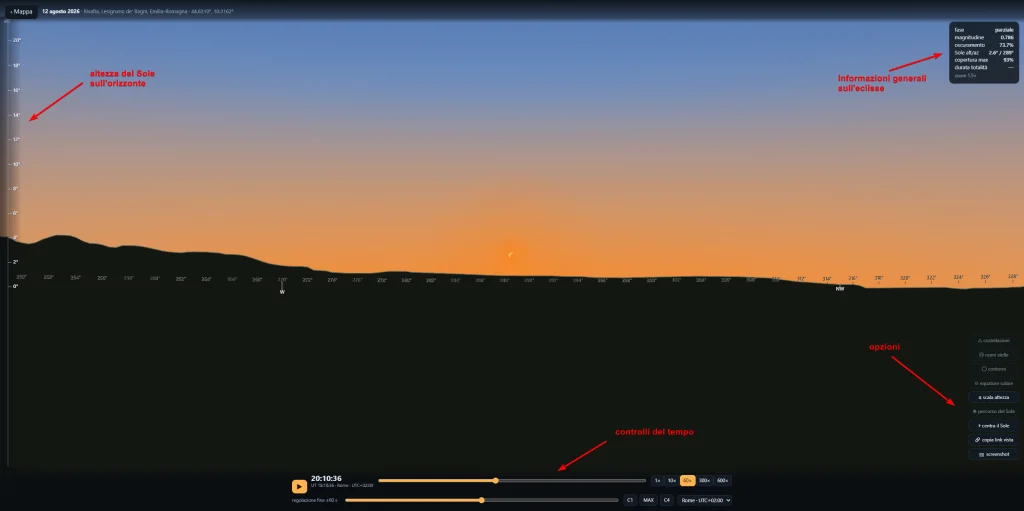
On August 12, 2026, Italy will witness a partial solar eclipse, a celestial event that enthusiasts are eagerly anticipating. Are you prepared for the observation? Given the unique circumstances of this eclipse, it's important to ensure that the Sun doesn’t hide behind a hill at a crucial moment. This eclipse will occur at sunset, with the Sun positioned low on the horizon. The event is set to begin around 19:20 and peak at 20:20, with northern regions having the best visibility. With clear skies and eclipse glasses in hand, the question remains: where will you observe from?
Planning Your Observation
To effectively plan your observation point, you can utilize the free eclipse simulator available at acacciadieclissi.space. Simply visit the site at https://acacciadieclissi.space, and launch the simulator. You will be prompted to select the eclipse you wish to observe. Since the simulator includes all future eclipses until 2100 and past ones since 1950, choose the August 12, 2026 eclipse. A map will appear, showing the totality path in gray. Although this path does not touch Italy, you can still simulate the sky from various locations.
Use the mouse wheel or pinch to zoom in on the area where you want to observe. You can also enter your desired location or paste coordinates from Google Maps in the top left corner. By clicking on your chosen observation point, a pop-up will display the eclipse times in local time along with a red arrow indicating the Sun’s position at the peak of the eclipse. This initial glance will help you determine if any mountains or obstacles are in your way.
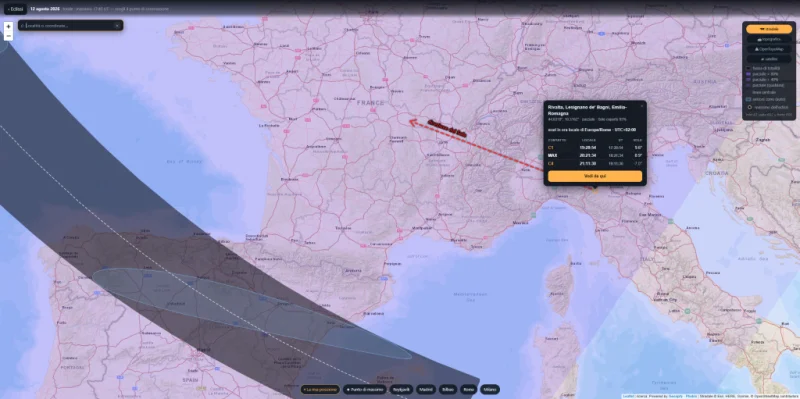
When selecting your point, precision is key. You can switch between different map views, including road, topographical, and satellite views, to find the best vantage point. Once you are content with your selection, click the large yellow button “View from here.” The simulator will then reconstruct the horizon using the actual profiles of nearby mountain ranges visible from your chosen site in just a few seconds, with the partially eclipsed Sun displayed in the sky.
Utilize the controls at the bottom of the simulator to move forward and backward in time, or jump directly to key moments: C1 (the beginning of the eclipse), C4 (the end), and MAX, the moment of maximum obscuration of the Sun.
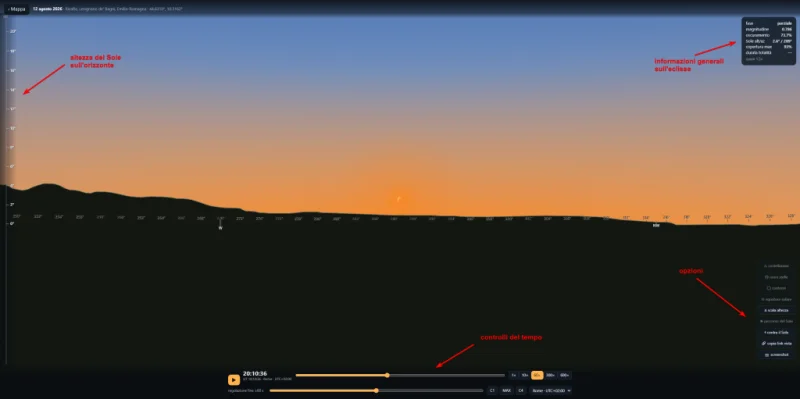
You can also drag the view left, right, up, and down, or zoom in and out for a better perspective.
Sun's Height Above the Horizon
The simulator will indicate the height of the Sun above the horizon at any moment during the event. You can also adjust the time flow at various speeds (1x, 10x, 60x, 300x) by pressing “Play,” allowing you to visualize the Sun’s trajectory across the sky. Among the options available, you can activate the Sun's path visualization, which shows where it will dip below the horizon and at what time. The acacciadieclissi.space simulator accounts for the altitude of your chosen location: if you select a mountaintop, the horizon will be simulated as if viewed from that elevation. This feature allows you to test different locations and find the best compromise between eclipse visibility and accessibility.
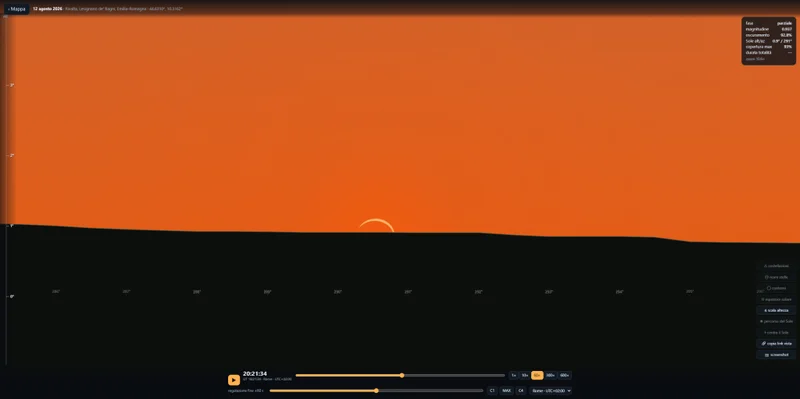
It’s important to note that the simulator does not account for obstacles other than mountains and topographical features. Structures like bridges, trees, buildings, monuments, forests, clouds, and any other obstructions are not considered. Therefore, a brief site visit after selecting your point using the simulator is advisable to avoid any last-minute surprises.
Now You're Ready for the Eclipse
If you wish to learn more about eclipses, including their formation and historical significance, check out my latest book, “The Little Book of Eclipses,” published by Apogeo and featuring a foreword by Luca Perri, available on Amazon or at bookstores.
This guide provides insights into one of Nature’s most extraordinary events, emphasizing that a partial solar eclipse is not merely an incomplete totality; they are two distinct spectacles, each with its own charm. The true magic, which will leave a lasting impression, lies within the narrow path of totality, when the shadow of the Moon engulfs you.