New Horizons Approaches Pluto: A Historic Moment in Space Exploration
NASA's New Horizons spacecraft is just days away from its historic flyby of Pluto and its moons, marking a significant milestone in space exploration.
- July 10, 2015
- Reading time: approximately 2 minutes
With just four days remaining, NASA's New Horizons spacecraft is set to reach its destination after nearly nine and a half years of travel, zooming past Pluto and its five moons at a remarkable speed of 13.78 km/s. The anticipation feels reminiscent of childhood excitement when Christmas was just around the corner.
For those following the mission via the NASA website or coverage on platforms like Spektrum.de, this journey to the outer reaches of our solar system is a thrilling adventure. Daily updates provide increasingly detailed images of Pluto, revealing its reddish hue, while Charon, Pluto's largest moon, is seen as a gray counterpart to Earth's moon.
A fantastic simulation showcasing the expected image resolution of the Pluto-Charon system during the flyby is available in a blog post by Emily Lakdawalla. For those interested in the specifics of New Horizons' trajectory through the Pluto-Charon system, an excellent infographic by Alexandra Witze and Jasiek Krzysztofiak details the flyby scheduled for July 14, 2015.
New Horizons is currently traveling at an astonishing pace of 826.8 kilometers per minute. This translates to 49,608 kilometers per hour, accumulating nearly 1.2 million kilometers each day, which is approximately three times the distance from Earth to the Moon. As I write this, New Horizons is less than 5 million kilometers from its target.
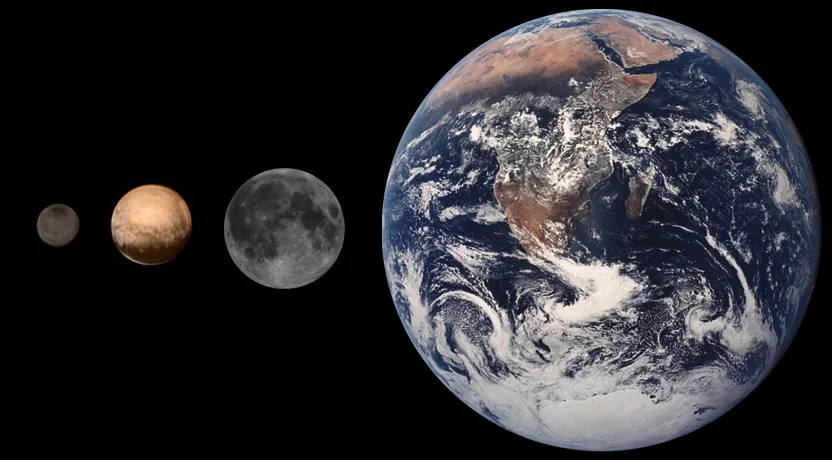
The latest images of Pluto and Charon inspired me to create a graphic illustrating the minuscule size of these celestial bodies, currently located 31.86 AU away (which is about 4,766,190,000 kilometers). At this distance, light or radio signals take 264.972 minutes to travel. The images used for my graphic were captured on July 8, 2015, when New Horizons was still around six million kilometers from Pluto, or 16 times the distance from Earth to the Moon. I can only imagine how Pluto and Charon would appear through a telescope if they orbited Earth at that distance; the details would be far less discernible than those captured by New Horizons during its flyby on July 14.
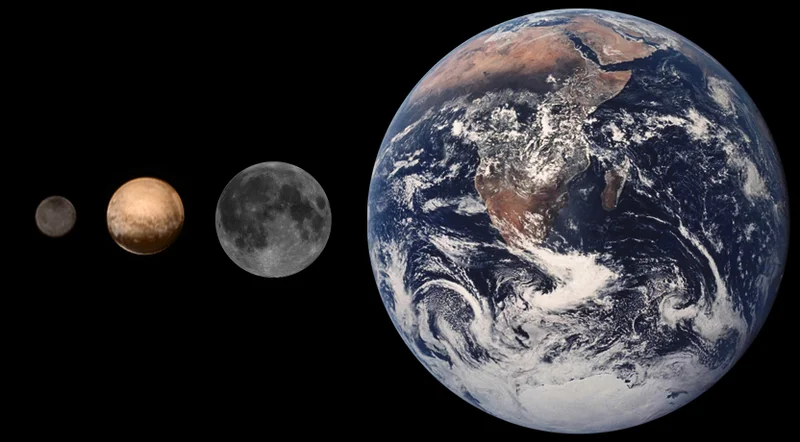
Charon, Pluto, Moon, and Earth
Photos of Earth and the Moon © NASA, montage with scale sizes from Wikipedia, released into the public domain by the copyright holder. Photos of Pluto and Charon © NASA / JHU Applied Physics Laboratory / Southwest Research Institute.
Clear Skies, Stefan Oldenburg
Astronomy has fascinated me since childhood, and I am thrilled to witness this golden age of astronomical discovery. Exciting revelations come in rapid succession, but the true allure of this science lies in exploring our cosmic neighborhood with our own eyes. "Clear Skies" is a greeting shared among amateur astronomers, accompanied by wishes for good observing conditions. This blog, established in November 2007, is aptly named "Clear Skies."