Maximize Your Experience During a Total Solar Eclipse
A total solar eclipse is a fleeting event lasting only a few minutes. Learn how to maximize your experience by observing without filters, setting timers, and focusing on the event itself.
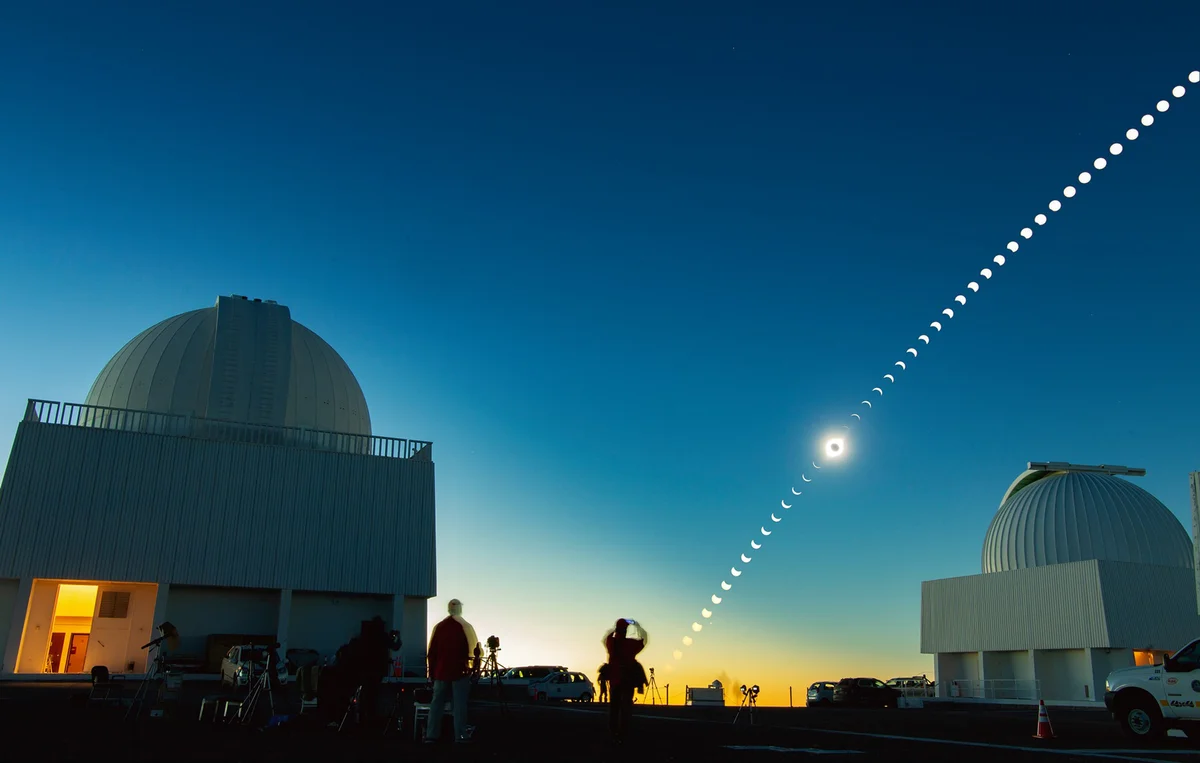
A total solar eclipse is a fleeting phenomenon, lasting only a few minutes, often just around two. This brief moment passes incredibly quickly, and the spectacle of totality is so rare that it’s crucial to capture every second of it.
Observe Without Filters
One of the first things to understand, especially for those less familiar with celestial events, is that during the total phase of a solar eclipse, it is safe to observe without filters. Protective devices are essential as long as any part of the Sun remains visible around the edges of the Moon. However, once the Sun is completely obscured, keeping filters on will result in seeing nothing but darkness. You may miss precious moments if you’re not prepared, so get ready for the total phase to ensure you don’t lose any of the experience.
If you plan to use binoculars or a telescope with filters during the partial phases, ensure you can quickly remove those protections when totality begins. It’s crucial to remember to do so in the heat of the moment.
Set a Timer
To enhance your viewing experience, it’s wise to keep track of time. Depending on your location, you can find out in advance the exact duration of totality. Useful resources include interactive maps on Xavier Jubier’s website or the user-friendly site of the Laboratoire Temps Espace (LTE) at the Paris Observatory. You can also use various smartphone applications for this purpose. Set a timer on your phone with an alarm corresponding to your observation site’s totality duration. When the last sliver of the Sun disappears, start your timer to alert you when totality is about to end, signaling the need to resume using protective filters.
Avoid Taking Photos!
For your first total solar eclipse, the best advice is likely to refrain from taking photos, particularly if you have the common urge to capture the moment with your phone. The reason is simple: you only have a few dozen seconds to experience an event that you might not see again. Don’t waste any of that precious time troubleshooting technical issues or checking your phone’s screen. Instead, immerse yourself in the event! There will be plenty of high-quality photos taken by others for you to enjoy later, but the most memorable impressions will be those etched in your mind.
If you do wish to take photos, consider setting your camera to automatic mode before the eclipse begins, so you don’t have to think about it during the event. You can review the results afterward.
Watch the Corona and Prominences
During the total phase of a solar eclipse, two key features to observe are the solar corona and prominences. The corona is the Sun’s tenuous outer atmosphere. As the Moon obscures the photosphere (the bright surface of the Sun), it allows the corona’s white light to diffuse into a twilight sky. During periods of solar activity, the corona displays structures shaped by the Sun’s magnetic field lines, creating stunning arcs visible to the naked eye and through binoculars.
Prominences are hot gas projections above the Sun’s surface seen around the edges during an eclipse. When solar activity is high, there’s a good chance of witnessing beautiful prominences, which can be visible to the naked eye along the lunar horizon due to their fluorescent pink color, resulting from heated hydrogen. This striking coloration is captivating, and if you have a telescope aimed at the Sun, take a few precious seconds to observe the prominences through the eyepiece for an even better view.
Focus on the Essentials
You can also try to identify planets in the darkened sky, spot some major stars from visible constellations, or glance at the horizon to see that the rest of the world, within about 130 kilometers, remains illuminated by the Sun. Pay attention to the subtle eclipse breeze, the drop in temperature, or the behavior of animals around you. However, this can become overwhelming with so much to take in within less than 120 seconds. Therefore, a final piece of advice: stay focused on the essential aspects! Because once this memory is in your mind, it will stay with you forever.