Lunar Occultation of Saturn Set for January 4, 2025
On January 4, 2025, Saturn will be occulted by the Moon, a noteworthy astronomical event visible across most of Italy, with specific timings for major cities.
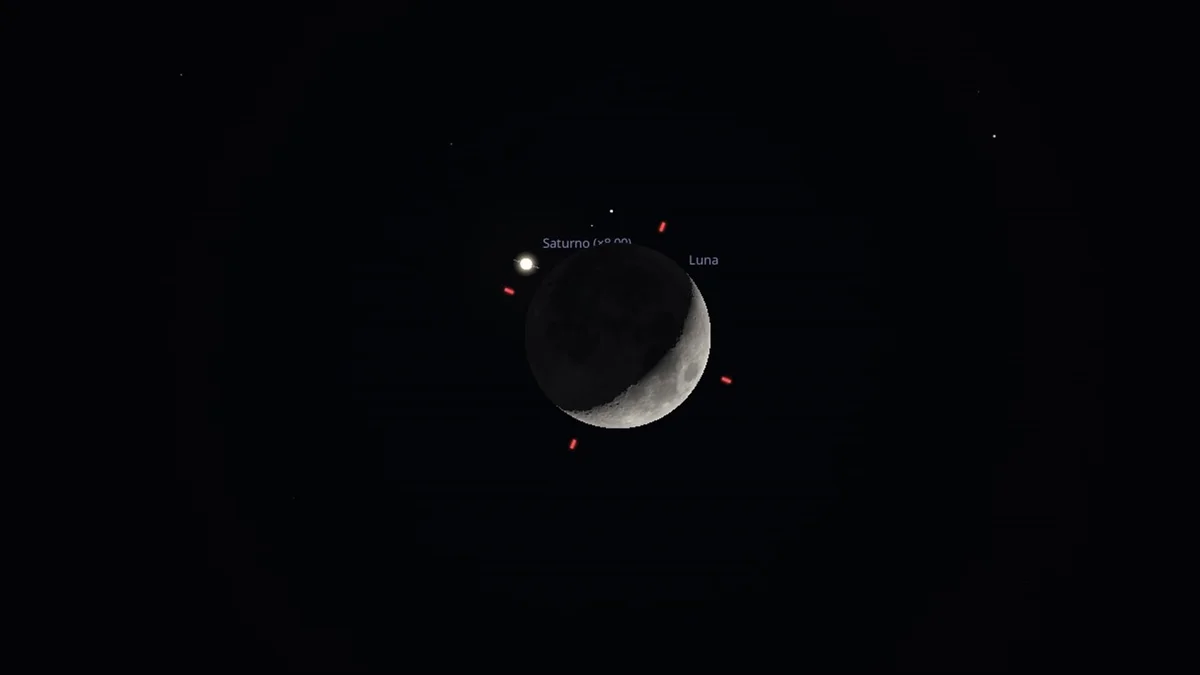
On the evening of January 4, 2025, a noteworthy astronomical event will unfold shortly after 6:30 PM, depending on the observer's location. Within the constellation of Aquarius, the planet Saturn will be occulted by the Moon, meaning that the path of our satellite will cause it to overlap with the orbit of the ringed planet.
A lunar occultation occurs when one celestial object is temporarily obscured by another object that is closer to the observer. In this instance, the Moon will hide an object such as a star, planet, or even an asteroid.
The last time Saturn was obscured by the Moon was on August 21, 2024. However, the visibility conditions from Italy during that event were not as favorable as those expected for January 4, 2025.
This upcoming occultation will be observable across most of Italy, with the exception of the southernmost regions (e.g., the lower part of Sicily and the extreme southern tip of Calabria). For these areas, a very close conjunction will occur, where the two celestial bodies will appear very close together. While some may consider this a disappointment, those able to witness the occultation will enjoy the moment when Saturn disappears behind the lunar disk and re-emerges several minutes later. Meanwhile, observers of the conjunction will have the advantage of enjoying the spectacle throughout the evening.
Timing Details
In Milan, the occultation will begin around 6:33 PM and will end (when Saturn becomes visible again) at approximately 7:34 PM. In Rome, the timings are 6:43 PM and 7:29 PM, with the duration being shorter due to the passage being closer to the lunar edge. In Palermo, the start is set for 6:56 PM and the end at 7:16 PM, as this event also occurs near the outer limb of the Moon, resulting in an even shorter visibility.
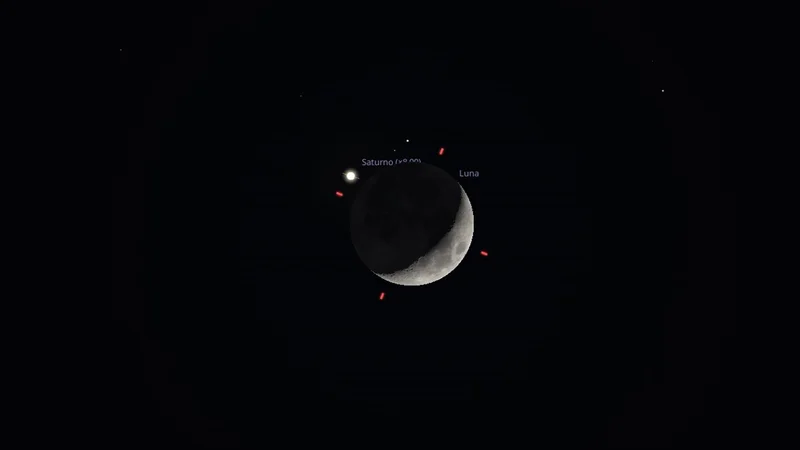
Below is a brief preview of the occultation from Milan, created using Stellarium software.