Jupiter Observations Illuminate Simple Scaling Law for Particle Acceleration
A new model published in Nature describes how charged particles are accelerated in cosmic rays, based on data from NASA's Juno spacecraft studying Jupiter.
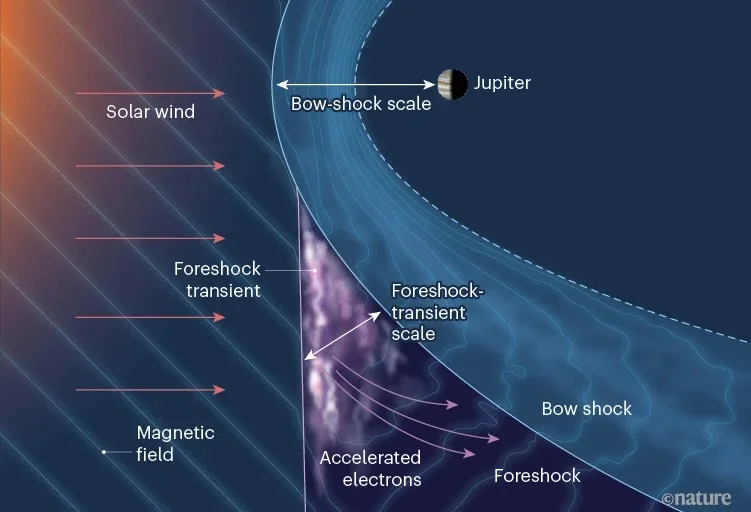
Recent research published in Nature unveils a unifying model that elucidates the mechanisms behind the acceleration of charged particles that constitute cosmic rays. This model connects the maximum energy of accelerated particles to the spatial scale of the supersonic shock within a medium. This groundbreaking discovery, derived from data collected by NASA's Juno spacecraft orbiting Jupiter, challenges conventional theories and may provide insights into the enigmatic origins of cosmic rays.

The universe is teeming with charged particles that travel at speeds approaching that of light, believed to be accelerated by colossal supersonic shocks. These shocks can occur across scales ranging from planets to supernovae. A supersonic shock represents a transition in a compressible medium where parameters such as pressure, density, temperature, and velocity change abruptly. Shocks form when a disturbance propagates faster than the local speed of sound, which can happen when supersonic gas encounters an obstacle. Through the shock, the total kinetic energy, which quantifies the collective motion of the gas, is converted into thermal energy and, in some instances, radiation (if cooling is efficient).
When a massive object, such as a meteorite, strikes the Earth’s surface, the sudden release of energy generates a shock wave in the atmosphere. For an observer moving with the shock wave, the upstream (unperturbed) gas flows towards the shock front at a supersonic speed, while the downstream gas moves away at a subsonic speed. On either side of the shock wave, the gas is compressed and heated: the downstream gas is hotter, denser, and at a higher pressure than the upstream gas.
Earth's atmosphere is dense enough for gas particles to collide frequently, allowing it to be described as a fluid using hydrodynamic equations. In contrast, much of space is filled with low-density, ionized matter known as plasma. In such environments, shock waves are transmitted not through direct particle collisions but by the electric and magnetic fields generated by the plasma itself.
These collisionless shock waves have long been considered effective sites for particle acceleration. In our solar system, interactions between the solar wind—plasma from the Sun—and the magnetic fields of planets produce collisionless shocks known as arc shocks. Observations of particle acceleration in these conditions are complex and were previously limited primarily to Earth's magnetosphere. However, advancements have been made, notably through the Juno spacecraft, which studies Jupiter's composition, atmosphere, and magnetosphere.
Savvas Raptis from Johns Hopkins University and his colleagues have provided significant insights into the plasma physics surrounding Jupiter. They analyzed data collected by Juno in the region upstream of Jupiter's shock wave, utilizing onboard instruments to measure the energy of electrons originating from the solar wind and the shock environment.
Traditionally, particle acceleration in collisionless shocks has been attributed to shock drift acceleration, where charged particles gain energy through repeated reflections across the shock front. The movement of these particles is scattered by turbulent fluctuations in the magnetic field on either side of the shock, allowing them to return multiple times rather than escaping after a single passage. Until now, direct observational evidence to determine where, within a collisionless shock environment, acceleration is most effective has been limited.
By analyzing Juno's measurements, Raptis and his team demonstrate that electrons can be accelerated to energies of at least one mega-electronvolt (MeV), not through shock drift acceleration, but via transient disturbances in the plasma occurring in a dynamic region upstream of the arc shock. These upstream transients are generated by interactions among reflected particles, magnetic field fluctuations, and incoming plasma flow. They can heat, scatter, and accelerate particles before they reach the shock front.
Astrophysicists reveal that the maximum acceleration of electrons is determined by the spatial scale of the pre-shock region, which increases with the size of the shock wave. The authors suggest that this model could be applicable to other astronomical systems.
The analysis indicates that on a planetary scale, the size of the upstream shock region correlates with the size of the shock wave. The size of the particle acceleration region allows for the calculation of their maximum energy, based on a standard relationship known as the Hillas criterion. Thus, there exists a close relationship between the shock region size and the energy of accelerated particles. The researchers conclude that it is possible to predict the maximum acceleration that particles can achieve in these planetary systems based solely on the dimensions of the shock system. Raptis and his colleagues boldly assert that this model applies to other astrophysical systems where collisionless shocks occur, including jets emitted by young stars (protostars) and supernova remnants. The proposed framework could unify shock acceleration physics across scales differing by nearly ten orders of magnitude!
By combining observations from Jupiter with historical data from other planetary environments, they successfully extrapolate this scaling relationship to astrophysical objects, including the protostellar jet HH 211 and the supernova remnants SN 1987A and SN 1006. The application of known parameter space for these non-relativistic shock waves indicates that these fundamental processes can accelerate particles to energies on the order of tens of TeV, a range likely contributing to the observed cutoff of electrons in the cosmic ray spectrum. Importantly, the predicted maximum energies for SN 1006 align with observations, directly confirming their model.
Moving forward, a crucial step will be to evaluate the proposed model on other astrophysical objects, such as different supernova remnants, nova shocks, ultra-hot Jupiters, or gamma-ray burst jets, and to determine the relative contributions of various astrophysical accelerators to the cosmic ray flux. These accelerators include not only the collisionless non-relativistic shocks studied here but also phenomena such as radiation belts, massive star clusters, blazars, ultra-fast winds from active galactic nuclei, and binary star systems. This work will require extensive simulations and observations conducted in an interdisciplinary manner.

While this presents a challenge, the size of shock waves, the intensity of the magnetic field, and the properties of the medium surrounding certain protostellar jets and supernova remnants can be estimated from direct observations, which would allow for testing and refining the proposed model.
A planet, a young star, and a supernova remnant may seem to share little in common, as they are vastly different systems with a wide range of physical conditions. The intriguing hypothesis put forth by Raptis and his colleagues—that transient plasma structures upstream of shocks could govern particle acceleration in these systems—should inspire further exploration of astrophysical environments where particles are accelerated, spanning from planetary to extragalactic scales.
Source Relativistic electron acceleration at the bow shock of Jupiter and beyond Savvas Raptis et al. Nature volume 654(3 juin 2026) https://doi.org/10.1038/s41586-026-10473-z