Exploring WOH G64: The Enigmatic Red Supergiant of the Large Magellanic Cloud
WOH G64, located in the Large Magellanic Cloud (LMC) about 160,000 light-years away, is one of the largest known stars. With a radius approximately 1540 times that of the Sun and a luminosity around 500,000 times solar, this red supergiant is a natural laboratory for studying the final stages of massive stars.
WOH G64, a red supergiant located in the Large Magellanic Cloud (LMC), is approximately 160,000 light-years away and stands as one of the largest stars identified to date. With a radius roughly 1540 times that of the Sun and a luminosity around 500,000 times solar, WOH G64 serves as a natural laboratory for examining the final stages of massive stars, which culminate in supernova explosions and the formation of neutron stars or stellar black holes.
The star is currently in an advanced evolutionary phase, characterized by significant mass loss due to intense stellar winds. These winds are so powerful that they create gas and dust structures surrounding the star, impacting both its future and the surrounding environment. The radiation emitted by WOH G64 interacts with dust particles, heating them and causing them to emit light in the infrared spectrum. This makes red supergiants like WOH G64 prime candidates for study using advanced instruments such as the Very Large Telescope Interferometer (VLTI), which can analyze their circumstellar environment with unprecedented detail.
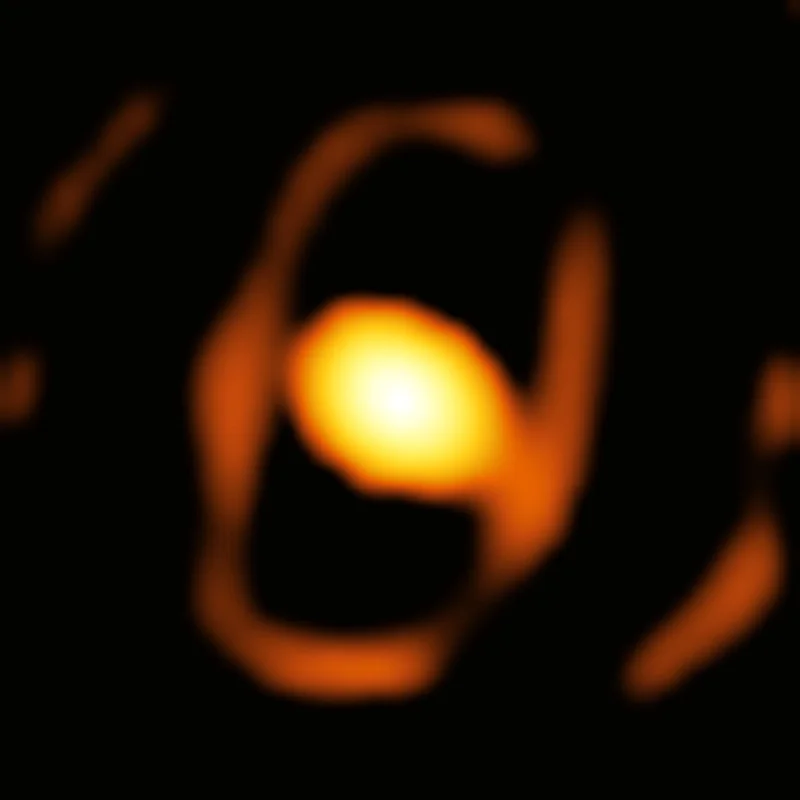
WOH G64's relatively low surface temperature of about 3400 K and its substantial mass loss through stellar winds highlight a crucial phase in its evolution towards a supernova. Red supergiants like WOH G64 can shed mass at extraordinary rates, reaching up to 10−4 solar masses per year, a phenomenon that alters their internal structure and prepares the environment for their eventual explosive end. Recent interferometric studies have revealed that this mass loss is not always symmetrical, often resulting in highly asymmetric circumstellar environments, frequently shaped by binary interactions or bipolar outflows.
A notable example of this is the system that produced SN1987A, where a ring of dust expelled during the red supergiant phase played a significant role in the evolution of the supernova, also located within the Magellanic Cloud.
Dust Torus
Surrounding WOH G64 is an opaque dust torus. Data captured from interferometers indicate an elongated structure with a major axis of approximately 13 stellar radii and a minor axis of 9 stellar radii, suggesting a potential bipolar outflow or gravitational interaction with an unseen companion. Recent changes in the infrared spectrum of the star have hinted at the formation of new warm dust located about 1.5 stellar radii from the core. This new dust has gradually obscured the central star, making it less visible in the near-infrared band.
One of the most intriguing aspects of WOH G64 is the evolution of its spectral properties over time. Astronomers observed significant transformations in the star's spectrum between 2009 and 2016. Previously, strong signs of water molecular absorption (H₂O) were evident, indicative of the star itself. However, more recent data reveal a spectrum dominated by continuous emission, likely due to the formation of new warm dust in close proximity to the star.
The emergence of this new dust may be linked to a recent acceleration in the star's mass loss. This process has rendered the central star less visible, shrouded by a denser layer of particles. Detailed studies estimate that WOH G64 loses mass at a remarkable rate of 10−4, which corresponds to the mass of the Sun being expelled over approximately 10,000 years.
The progressive obscuration of WOH G64 has been corroborated by photometric and spectroscopic observations. By analyzing light collected in the near-infrared (2-2.5 µm) and mid-infrared (8-13 µm) ranges, astronomers noted significant differences. While the spectrum at longer wavelengths (mid-IR) remains stable, the near-infrared spectrum shows an increasing continuum, suggesting that dust is forming close to the star, likely at a distance of about 1.5 stellar radii from the core.
The study of stars like WOH G64 indicates that mass loss may accelerate shortly before explosion, creating a rich and complex circumstellar environment. When the star eventually explodes, the interaction of the expelled material with the surrounding medium could lead to particularly bright phenomena, as observed in other supernovae.
- Imaging the innermost circumstellar environment of the red supergiant WOH G64 in the Large Magellanic Cloud
- The physical properties of the red supergiant WOH G64: the largest star known?